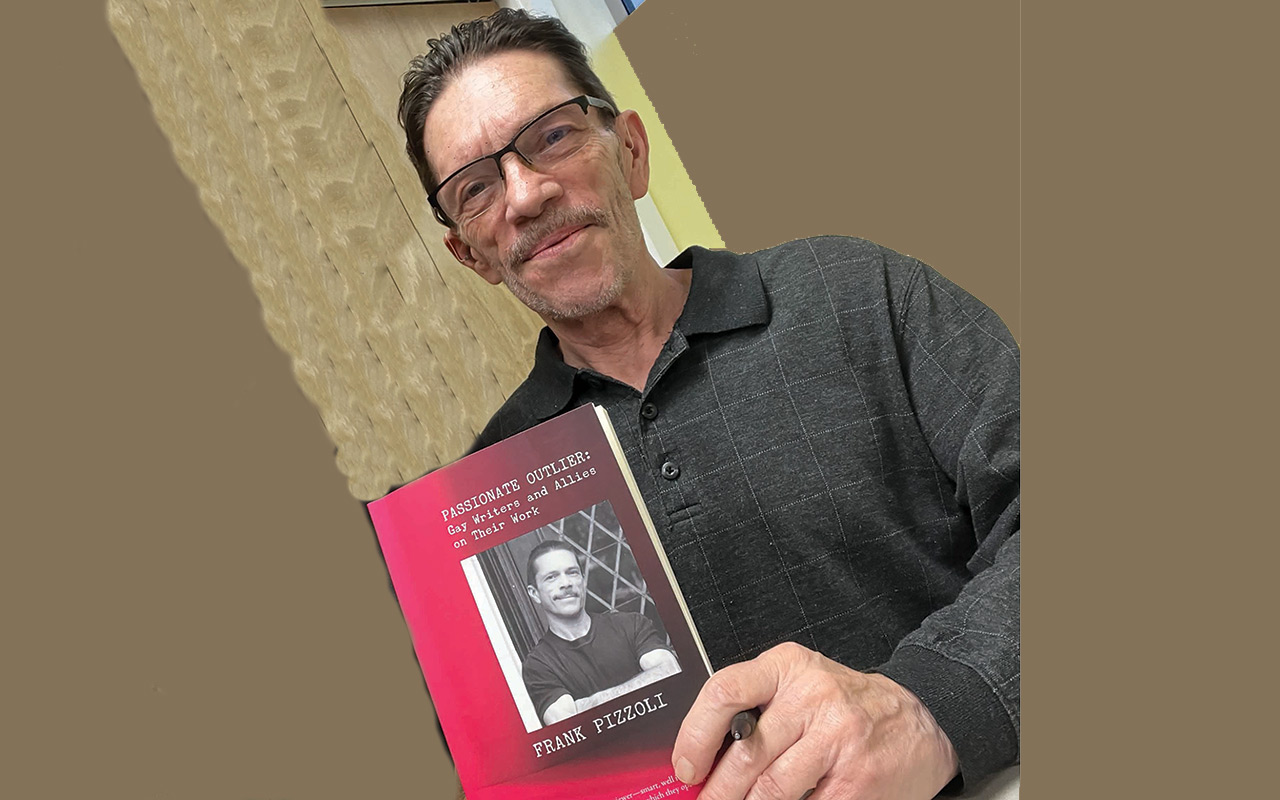
By the time he turned 18, Frank Pizzoli was already navigating a world that wasn’t built for him. Born in 1951, he came of age in 1969, the same year as the Stonewall Rebellion and Woodstock. They were moments that reshaped American culture and queer life alike. Across the country, young people protested the Vietnam War, questioned authority, and pushed for greater personal autonomy. The introduction of the Pill and landmark Supreme Court decisions on birth control further expanded conversations about freedom, choice, and bodily sovereignty.
“It was a big stew of personal autonomy and boiling-over political issues that still resonate today,” Pizzoli recalled. “Those times taught me how to push forward in a world that didn’t make space for people like me.”
The idea of being an “outlier” has shaped his life and work. “Anyone considered ‘other’ easily connects with that notion,” he said. His gay generation endured systemic oppression, then helped usher in critical civil rights protections from marriage equality to military service and financial equity. Today, many of those gains face renewed backlash. “Each generation fights its own battles,” he reflected. “We suffered, then helped secure protections. Now younger queers are fighting to hold them — or to restore them.’’





For decades, Pizzoli has chronicled LGBTQ life with precision and care. “My first responsibility is to capture people in their own words, not mine,” he explained. “When I document history, it isn’t about me. If we claim to stand on the shoulders of those who came before us, then we owe it to them to preserve their voices as they spoke — not filtered through our hindsight. Civil rights is an endeavor each generation builds on.”
That principle has guided both his journalism and activism. In 2003, he founded The Central Voice, an LGBTQ-focused newspaper and website based in Harrisburg, Pennsylvania, at a time when coverage of queer communities was scarce and often sensationalized. Funding was tight and political opposition persistent, but the publication became a lifeline that offered visibility, connection, and credible reporting to a long-underserved community. It also built a strong readership among allies and straight audiences, expanding broader understanding of queer lives and issues.
Later, he launched Positive Opportunities, a nonprofit providing employment counseling and job training for HIV-positive individuals. At a time when stigma frequently barred access to stable work, the program helped countless people reclaim dignity and financial independence.
“Historically, my HIV journey took me everywhere,” said Pizzoli. In 2004, he joined 85 HIV-positive individuals who posed nude at bistro Florent for photographer Spencer Tunick’s Positively Naked, commemorating POZ magazine’s 10th anniversary. Restaurateur Florent Morellet posted his own CD4 cell count on the specials board. In 2001, Pizzoli also produced Larry Kramer’s The Normal Heart in his home region, where the two discussed Kramer’s political awakening and the founding of ACT UP.





Pizzoli’s recent book, Passionate Outlier (Rebel Satori 2025), blends memoir with decades of reporting, offering readers a reflective yet unflinching look at queer history through lived experience. In her Out In Jersey review, Spencer Watson praised the book as “thought-provoking” and “historically significant,” noting its importance in deepening discourse around pre- and post-Stonewall eras and the AIDS crisis.
The book became the foundation for a scholarship fundraiser in Milford, Pennsylvania, aimed at supporting emerging LGBTQ writers. “We raised twice as much money as projected by working through the local gay community center,’’ Pizzoli said.













The collection captures the texture of queer life across generations — layering personal insight with conversations that situate individual stories within a broader legacy of struggle and resilience.
The book features essays and interviews with some of the most influential LGBTQ thinkers and artists. One conversation, in particular: “Interviewing Salman Rushdie stands out,” said Pizzoli. “Especially after the violent attack he survived in 2022, years after we spoke. He was amusing, warm and free-flowing — qualities I hope he still carries today.”
Midnight in the Garden of Good and Evil author John Berendt called the book “a pleasure” to read.
Another enduring memory is his 2013 discussion with the then-surviving members of the Violet Quill — Edmund White, Felice Picano, and Andrew Holleran. “Since that conversation, White and Picano have passed,” he said. “Soon, an audio recording of our long, free-wheeling discussion will be available online, preserving their voices for future generations.”
Community journalism remains central to Pizzoli’s worldview. “All news is local,” he said. “Local media keeps you grounded. National media keeps you informed. In recent years the internet has made us aware of everything everywhere, but local stories connect us to the communities we live in.”
“Each of us defines our passions. As long as you act with compassion, go forth treating others the way you want to be treated. Accept imperfection — yours and others’. It’s not complicated. Just difficult.”
For younger queer readers encountering eras they didn’t live through — early AIDS activism, rural organizing, and pre-visibility moments — he hopes his work conveys possibility. “The world is never perfect, and neither are we,” he said. “But if you contribute what you can, support others when they need it, and strive to be self-actualized, there’s a sense of purpose and possibility.”
After decades of writing, editing, and advocacy, he defines a “passionate outlier” with disarming clarity: “Each of us defines our passions. As long as you act with compassion, go forth treating others the way you want to be treated. Accept imperfection — yours and others’. It’s not complicated. Just difficult.”
Watson’s review echoes that sentiment, framing Passionate Outlier as both a record of shared history and a testament to resilience. The book — and Pizzoli’s work — reminds readers that being a passionate outlier isn’t a label. Instead, it’s a commitment to show up, telling the truth, and living fully.
https://www.facebook.com/frank.pizzoli.7