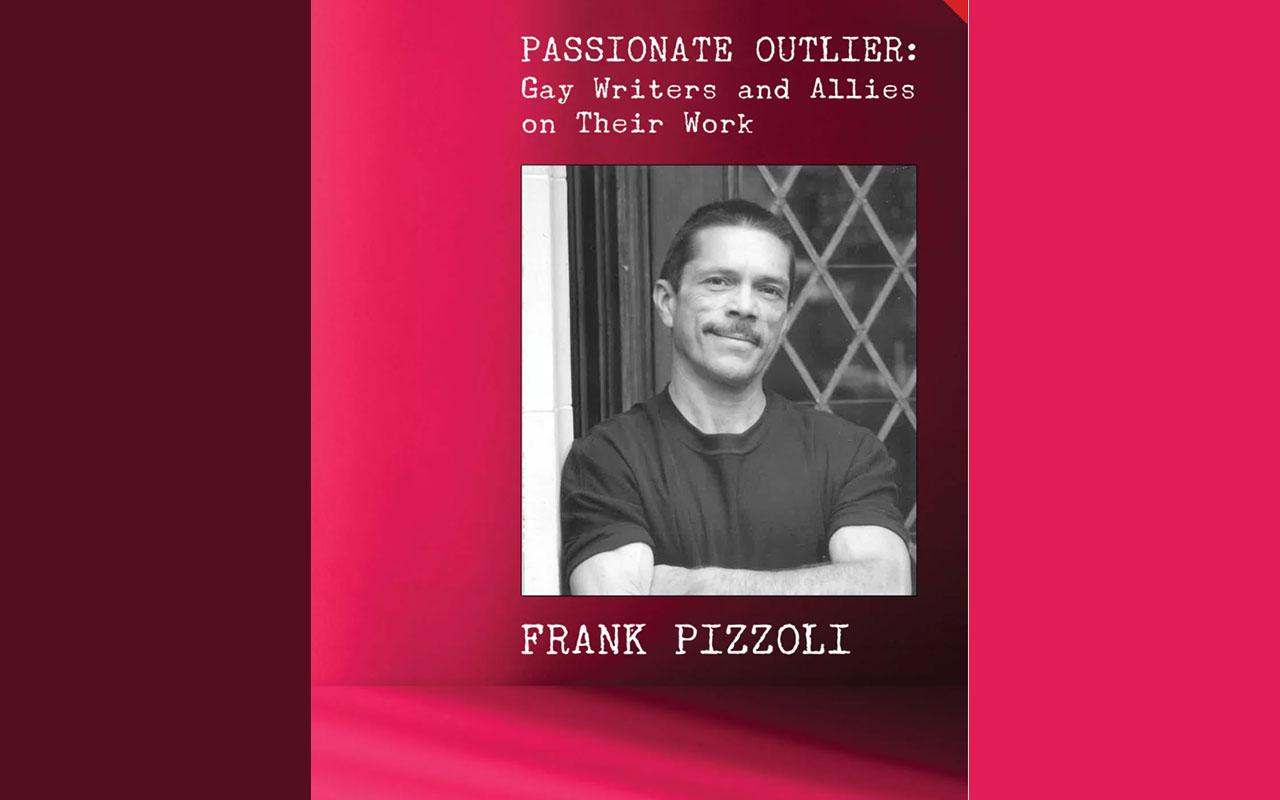
Frank Pizzoli’s book Passionate Outlier: Gay Writers and Allies on Their Work consists of 20 interviews and book reviews, spanning 2007 through 2019, of prominent authors and their writing. Readers have the opportunity to “‘stand on their shoulders’ by reading their interviews and books for firsthand accounts from men who lived through and survived pre- and post-Stonewall and AIDS.” He dives deep into LGBTQ history with his interviewees and their books. They share how the community came to form after WWII, the rise of activism into the ’70s, and the gay literary scene which evolved and grew into the present day.
He explores the gay literary scene spanning the 50 years following 1948 (and how it was affected by WWII) with Christopher Bram, who wrote the book Eminent Outlaw: The Gay Writers Who Changed America. WWII brought together one of the largest groups of gay men in history, allowing them to discover their sexuality in a way they previously never could have. The literary landscape began to change with the portrayal of sex in fiction. While homosexuality was still illegal, publishing gay literature marked the beginnings of changing portrayals of homosexuality in the media which had previously only been negative.





Pizzoli interviews numerous gay writers on their writing style, work, and literary inspirations. Most notably, he interviews surviving members of the Violet Quill, the famous group of gay male writers. They explore the distinctions between being a gay writer and a writer who happens to be gay. Their critics claimed that gay writing isn’t a universal literary experience for all readers. They explore the intersection between race, class, and gender with the gay male literary experience. They also touch on their thoughts on queer theory and the formation and perceptions of the gay community.
Pizzoli provides context for each interview. The depth of his questions to his interviewees show how thoroughly he has researched their work and backgrounds. He probes them on current and historical topics like how activism has changed, HIV breakthroughs and stigma, the Trump administration, homo-nationalism, and pink washing. They reflect on the history of gay life, activism, and the literary scene in places such as New York City for the Violet Quill and Key West in Michael Carroll’s Stella Maris: & Other Key West Stories.
The authors and Pizzoli explore life in a “post-gay” world in which AIDS is perceived as historical and the freedoms earned via early gay rights groups have already been achieved. Edmund White notes that despite having many of the same freedoms as straight people, that alone doesn’t bring happiness. Christopher Isherwood notes that we are now expected to conform to straight people’s lifestyles consisting of marriages and children. Paul Alan Fahey touches on the same concept that true equality demands no conformity.
Pizzoli also shows his versatility and intersectional approach as a journalist in his reviews and interviews of writers such as lesbian activist Anne-christine d’Adesky on her memoir and Susan Quinn’s book on Eleanor Roosevelt and Lorena Hickok’s love affair. d’Askey highlights the tension between lesbians and gay men when it comes to intersectionality. Quinn notes the erasure of Eleanor Roosevelt’s lesbian experiences in a previous biography about her. He also interviews controversial author Salman Rushdie who explores gender identity in his book The Golden House.





Frank Pizzoli is an award-winning journalist and HIV+ activist whose work has been published in numerous newspapers and magazines nationwide, including the The Village Voice, POZ magazine, and The Pennsylvania Capital-Star. He founded LGBTQ newspaper and website The Central Voice, as well as the nonprofit agency Positive Opportunities which provided employment counseling and training for HIV-positive individuals. Passionate Outlier is another extension of his meaningful work as a journalist in the LGBTQ community. It’s a thought-provoking and historically significant body of work that will hold great value for current and future readers who wish to reconnect with the past.
Passionate Outlier: Gay Writers and Allies on Their Work, by Frank Pizzoli, Rebel Satori Press.