Tammy Faye Bakker was a leader in the rise of televangelism. Using satellite broadcasting funded by Ted Turner, the PTL network brought evangelical Christianity to a growing nationwide audience of the faithful — and millions in donations from that audience.
Alongside other TV preachers such as Jerry Falwell, Jimmy Swaggart, Marvin Gorman, and Pat Robertson, Tammy Faye and Jim Bakker gained millions of followers, allowing them to live a luxurious lifestyle and wield enough influence to attract right-wing politicians. Yet they all fell from grace through an escalating procession of scandals involving money, sex, fraud, and corruption.





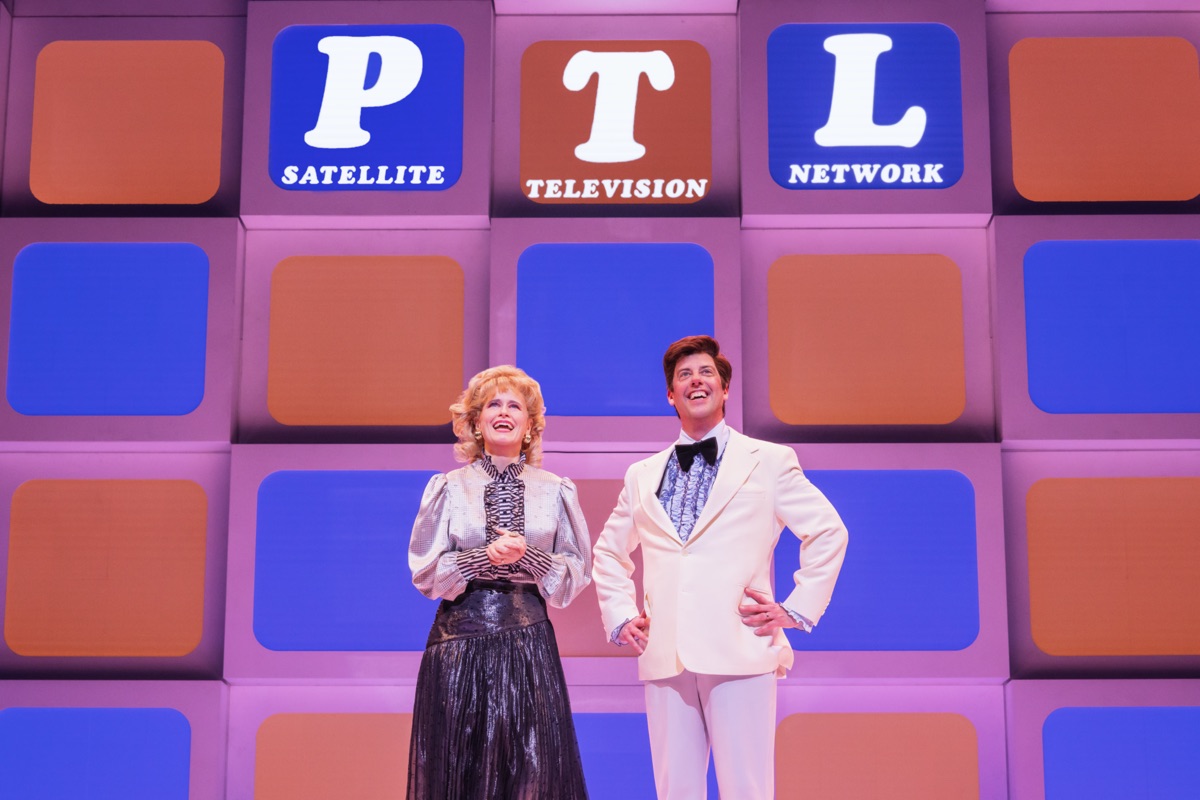
Now, the award-winning West End hit Tammy Faye, by James Graham with music by Elton John and lyrics by Jake Shears, charting the rise and fall of televangelism, has made its way to Broadway’s newly reopened Palace Theatre. It’s a brightly lit, colorful, lively show featuring a star performance by Katie Brayben, a two-time Olivier Award winner, as Tammy Faye Bakker. There are also strong supporting performances by a pair of two-time Tony Award winners: Christian Borle as Jim Bakker, Tammy Faye’s husband and partner, and Michael Cerveris as Jerry Falwell, the Bakkers’ main rival and nemesis.

The show tries to pack a mountain of information into less than three hours, so it doesn’t get into any deep analysis of the Bakkers and the course of televangelism. Still, it manages to hit the main points in their lives, proceeding in a straightforward manner. The score is sprinkled with enough lively ensemble numbers and hard-hitting power ballads to make it a good score if not one of the great ones.
Among the stand-out numbers are “He’s Inside Me,” a riotous double-entendre number ostensibly about Jesus’ spirit filling his followers; “In My Prime Time,” Tammy Faye’s self-empowerment anthem during her first prime-time solo show; “Don’t Let There Be Light,” where Jerry Falwell flat out declares his hypocrisy in his dealings with the Bakkers; “If You Came to See Me Cry,” Tammy Faye’s defiant message to a world of Christians who fall short in forgiveness; and the ensemble’s joyous closing number, “See You in Heaven.”
Director Rupert Goold and choreographer Lynne Page keep the action moving at a brisk pace. Scenic designer Bunny Christie’s set, lit by Neil Austin with videos designed by Finn Ross, utilizes a huge wall of TV monitors as well as the Palace’s array of below stage elevators moving set elements and actors up and down throughout the performance. Katrina Lindsay’s over-the-top costumes make visual comments about the Bakkers’ careers as well as showing how televangelism increasingly used show business glitz to sell its brand of religion.





Tammy Faye’s subject — the rise and fall of an over-reaching Christian evangelist TV star couple — may not be to everyone’s liking. And the real Tammy Faye Bakker may not have been as innocent, or naive, about what her husband was doing as this show claims. But it is funny and, in places, touching, with strong performances and good songs, some of which may hopefully find a life after Tammy Faye concludes its run.
I can say that I liked the show but did not love it, at least not as much as many in the audience did. But I can recommend it as a professional, entertaining theater piece. If that’s what you’re looking for, check out Tammy Faye before its all-too-brief run ends.













Tammy Faye is presented at the Palace Theatre, 160 West 47th Street in New York, through Dec. 8, 2024. For more information or to purchase tickets, go to tammyfayebway.com.