
F. Scott Fitzgerald’s 1927 short story The Curious Case of Benjamin Button, about the life of a man who ages backwards, is the basis for a new musical appearing at the Public Theater’s Newman Theater in New York. The 2025 Olivier Award-winning musical, with a book by Jethro Compton and score by Compton and Darren Clark, changes the location of the story from New England to Cornwall but keeps many of the basics from the original short story.
The story begins in Dec. 1918, when businessman Roger Button (Brandon J. Ellis) goes to see his wife, Mary (Sachiko Mae), who has just given birth to a son. Roger is shocked to see his newborn son looks like an old man, complete with three piece suit, bowler hat, and walking stick. The son introduces himself as Benjamin (Andrew Durand). The Buttons hide Benjamin away in their attic, but Mary succumbs to grief and shame and kills herself.





Years pass, and Benjamin sneaks out of the house, heading for the local pub where he has his first drink. He meets the barmaid, the beautiful Elowen Keene (Kelsee Kimmel), daughter of the midwife who delivered him, and the two tentatively fall in love. But when their parents find out, they bar their children from seeing each other again. Planning to elope, the two manage to lose each other, each thinking the other has deserted them.
Benjamin goes off to sea, making friends with the ship owner’s son, Little Jack (Morgan Morse). At the advent of World War II, Benjamin and Jack join the Royal Navy and see action as part of the D-Day invasion. The night before they embark, they go to a local dance where Benjamin reunites with Elowen and spends the night with her.
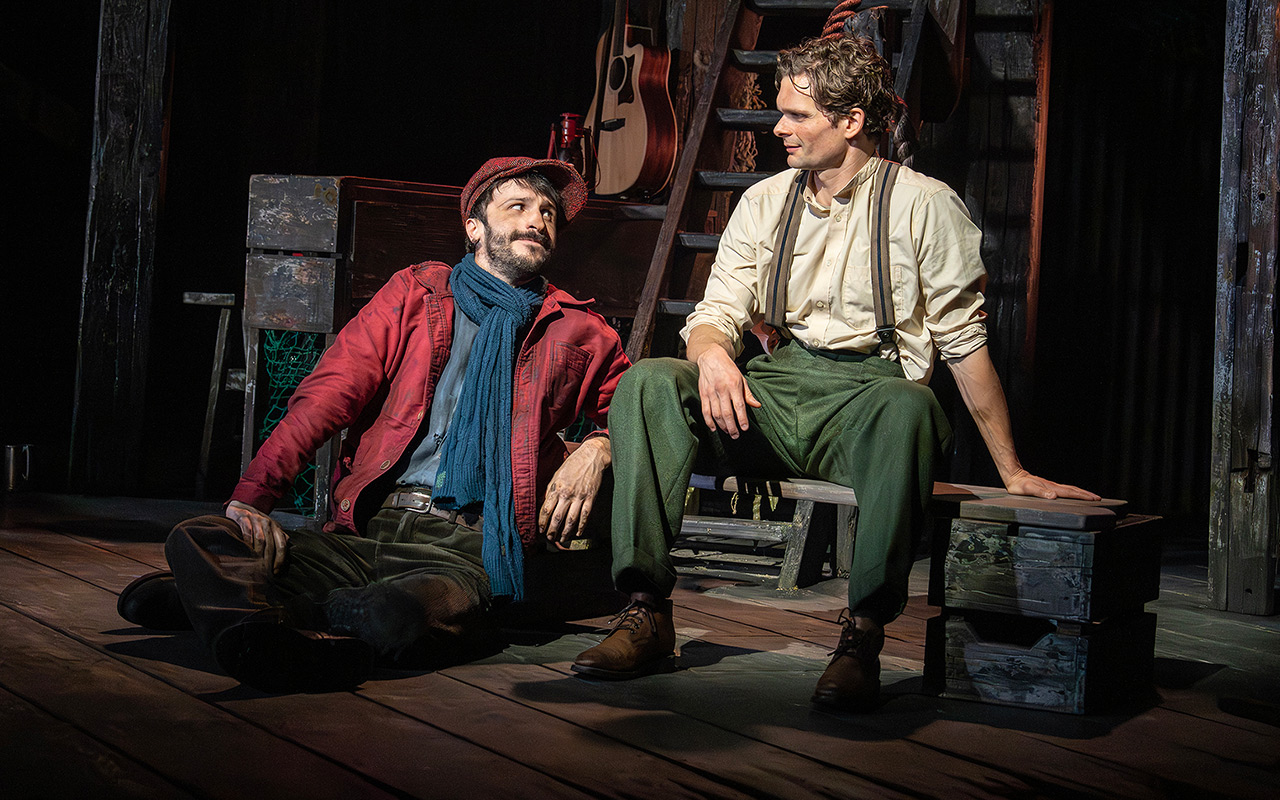


After the war, Benjamin finds Elowen and their son, Locryn (Kris Saint-Louis). Elowen tells Benjamin that she knows of his aging situation and loves him anyway. The couple wed and have a daughter, Lowen (Claire-Frances Sullivan). When tragedy strikes the family, Benjamin leaves to find a cure for his reverse aging, returning only when all hope is lost.
After Elowen’s death, Benjamin moves in with Locryn and his family, rapidly growing younger. At last, at the end of his long, strange life, the infant Benjamin disappears into nothingness.






The cast, under the direction of Compton, do their best with the material. But the book is repetitive, with a lot of references to exact dates, times, and ages related by the actors multiple times in a scene. The score contains some lovely songs, such as Benjamin and Elowen’s “The Moon and the Sea”, Mary Button’s haunting “The Kraken’s Lullaby”, and the much-reprised “The Western Wind” and “The Tide Is Comin’ In”, but is, at its most folksy, reminiscent of Riverdance. The actors play double-duty as the show’s musicians, on top of having many of them play multiple parts — townspeople, doctors, pub patrons, ship’s crews, and even sheep.
When all is said and done, the moral of The Curious Case of Benjamin Button is to make the most of the time you have, no matter how long or short that might be, whether or not if you’re aging forward or backward through time. But that moral seems to be buried in the busy-ness that is The Curious Case of Benjamin Button.












The Curious Case of Benjamin Button is presented at the Newman Theater in the Public Theater, 425 Lafayette St., New York through Dec. 20. For more information or to purchase tickets, go to publictheater.org.