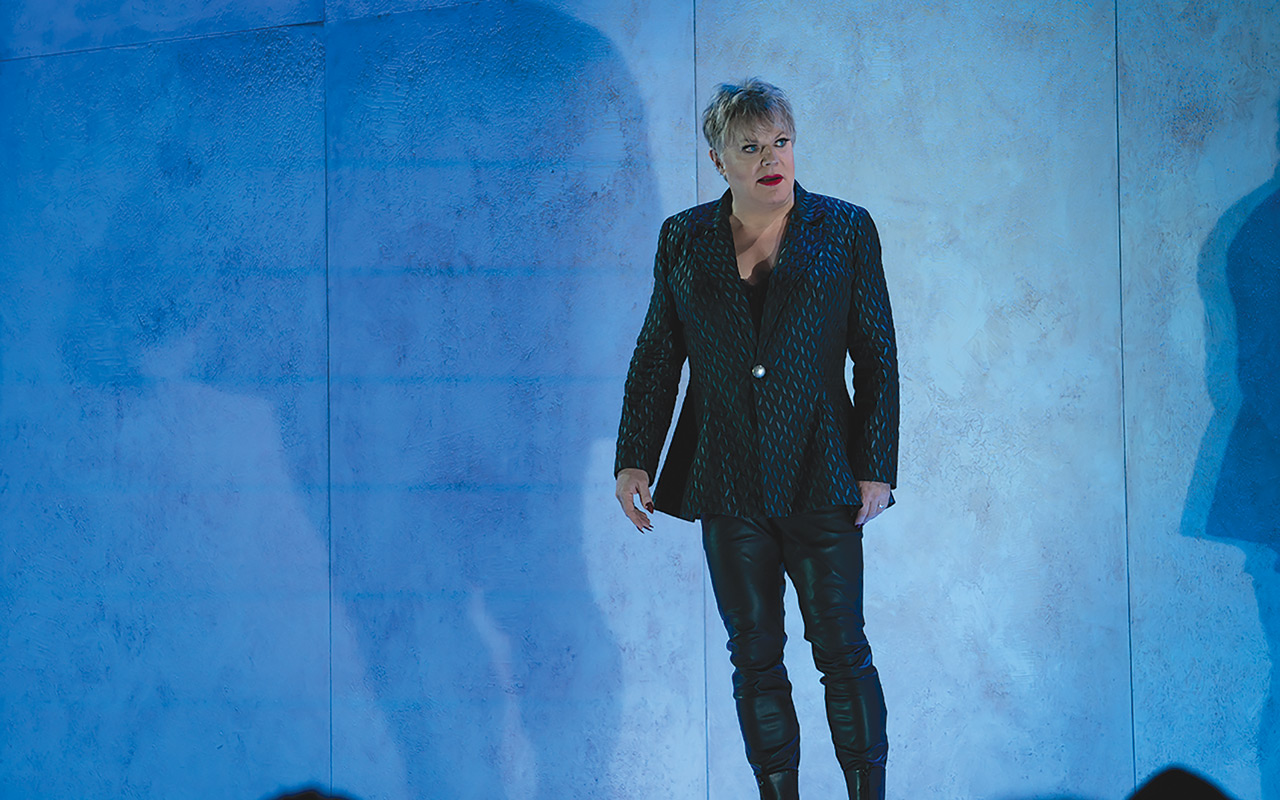
From coming out in the 1980s to touring a one-woman Hamlet across the globe, the trailblazing performer reflects on identity, endurance and why “trans people aren’t going anywhere.”
For decades, audiences knew her as Eddie — the surrealist in heels, the marathon-running comic who could pivot from Roman emperors to cafeteria theology without blinking. But in conversation now, there is no sense of rupture. No dramatic unveiling. Just continuity.




Suzy Eddie Izzard is not reinventing herself. She is refining alignment. “There was no debate when I came out,” she says of the 1980s, when being openly trans meant navigating a world that had little language and even less public discourse around gender identity. “Now there’s heated debate. But in the end, trans people aren’t going anywhere. We exist.”
It’s a simple statement, delivered without theatrics. And that steadiness has defined her career as much as the comedy ever did.
Long before gender conversations became headline fodder, Suzy was already making space — first quietly, then publicly. She describes it less as trailblazing and more as survival with intention. “I’m only a trailblazer for myself,” she says. “Everyone should see themselves as their own trailblazer.” She offers an image that feels especially apt.
In cycling races like the Tour de France, riders move in a formation called a peloton. The person at the front takes the brunt of the wind resistance; those behind can slipstream, shielded slightly from the force. Suzy doesn’t claim to lead the pack for everyone — but she acknowledges that sometimes, simply by existing, you take some of that wind. For LGBTQ audiences who grew up watching her command stages unapologetically, that wind mattered.





She is quick to emphasize that progress is not linear, but she believes in its arc. “Look at human rights from ancient Egypt to now,” she says. “The graph gradually gets a little bit better. It flatlines. It dips under extreme leaders. Then it rises again.” Her optimism isn’t naïve — it’s strategic. “This is our time. This is our fight. And we’ll go through it.”
That long-view thinking also defines her artistic choices. She dropped out of university at 19. Her comedy career didn’t take off until she was 30. She built separate agents for drama and comedy in the U.K., deliberately pushing herself toward more serious acting roles even when the industry didn’t quite know where to place her. Which eventually led her to Shakespeare.












Since the beginning of 2025, Suzy has been touring a one-woman performance of Hamlet, playing 23 characters — eight principal roles — entirely alone. She is approaching her 225th performance, with plans to push past 300 as she takes the production through Australia, New Zealand, Europe and beyond. “There are no rules to touring,” she says. “If you want to keep touring it, you can.”

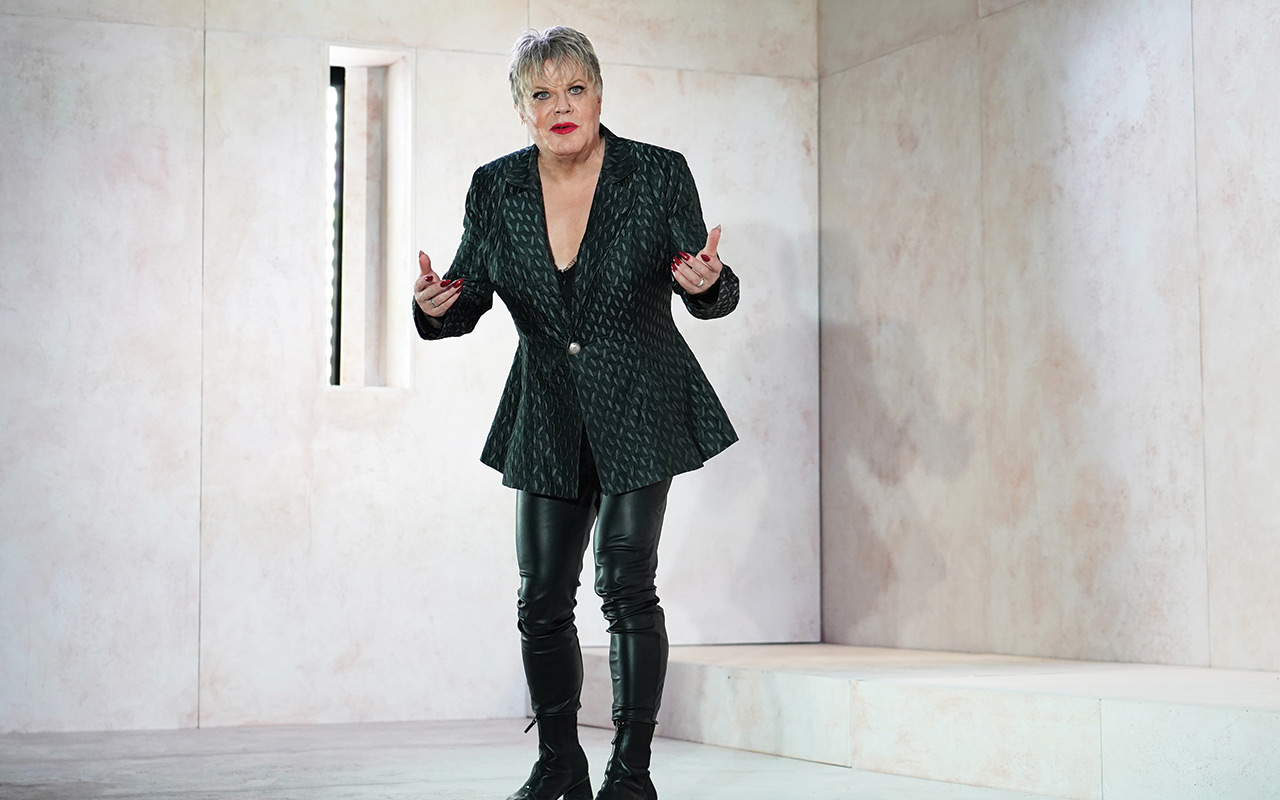


For her, the role is no stunt. It is endurance — emotional, physical and linguistic. She describes the play as now living inside her “like a dream,” a journey so familiar she no longer needs a map. Onstage, she “paints” each character in the air — Hamlet, Ophelia, Gertrude — seeing them vividly so the audience can too. As a trans woman playing both male and female roles, she speaks of honoring each character fully. “You’re in a very good position to do honor to both,” she says. It is less about statement than craft.
Language has always been central to that craft. When the word “polyglot” is mentioned, she delights in it. “Polyglot is such a gorgeous word, isn’t it?” she says, before adding that perhaps a better word should exist — something simpler, maybe just “multiple-language person.” Let’s go with “linguistic shapeshifter.”
Suzy has performed stand-up in French, German, and Spanish, discovering firsthand that humor travels far more easily than stereotypes suggest. The British assumption that “the French only like visual comedy” or that “Germans have no sense of humor” dissolves quickly when you’re onstage speaking their language.
“The truth is there are multiple senses of humor in every country,” she says. “You can talk about sex, love, death, music — 95 percent of things work everywhere.” The only barriers are hyper-local references: supermarket brands, niche television personalities, regional sports figures. Strip those away, and humanity looks remarkably consistent.
“Determination, determination, determination,” is the guidance she offers young transgender and nonbinary performers
That discovery — that people are more alike than different — feels especially pointed in today’s climate. “Right-wing people tend to say, ‘They’re so different,’” she notes. “No. Everyone’s the same. We’re all pretty much the same.”
It’s a worldview that undergirds both her politics and her art. When asked what guidance she offers young transgender and nonbinary performers who see her longevity as proof that survival is possible, her answer is distilled into three words: “Determination, determination, determination.”
The work, she insists, began as something deeply personal. In 1985, with only one support group nearby and very little infrastructure for trans people in the U.K., she decided she would make space for herself. That meant riding public transportation while presenting authentically. It meant standing her ground if challenged. It meant being “prepared for anything.”
Now, her advice is practical as well as philosophical. Seek out bigger cities, where diversity is part of daily life rather than a rarity. Build community. Understand that progress takes time. And above all, live fully. “Everyone in the world has the right to a fair chance,” she says. “That’s what I’m fighting for.”
There is something refreshingly unsensational about the way she speaks of identity. She does not frame her journey as a dramatic before-and-after. She knew she was trans from a young age. The public alignment unfolded gradually, alongside a career already in motion.
That steadiness may be why her evolution feels less like reinvention and more like expansion.
Even in Hamlet, that expansion shows up in subtle ways. She speaks thoughtfully about Gertrude’s moral ambiguity and about Ophelia as a “twin soul” to Hamlet — a young woman who, in her interpretation, should have ended up with him had events not conspired otherwise.
“If I’d grown up as a young woman,” she says, “how would I have played Ophelia? That’s how I play her.”
It is not about rewriting Shakespeare. It is about inhabiting him — fully, unapologetically, and on her own terms.
Suzy has remained. Not static. Not stubborn. Just steadfast.
When asked who she would most like to have dinner with, she answers without hesitation: Nelson Mandela. She once met him briefly but wished she could have spoken longer, deeper. Mandela, like Abraham Lincoln, represents the kind of political endurance she admires — leaders who “stayed in there” until circumstances turned. That phrase — stayed in there — could just as easily describe her.
Through shifting cultural climates, through waves of acceptance and backlash, through comedy clubs and global stages, Suzy has remained. Not static. Not stubborn. Just steadfast.
For LGBTQ readers in New Jersey and beyond, that matters. Visibility is powerful. But longevity is transformative. Suzy Eddie Izzard did not disappear when the conversation around gender intensified.
She did not retreat when debate grew louder. She did what she has always done: kept moving forward.
Like a cyclist leaning into the wind. And somewhere behind her, whether she claims it or not, others are riding just a little bit easier.