


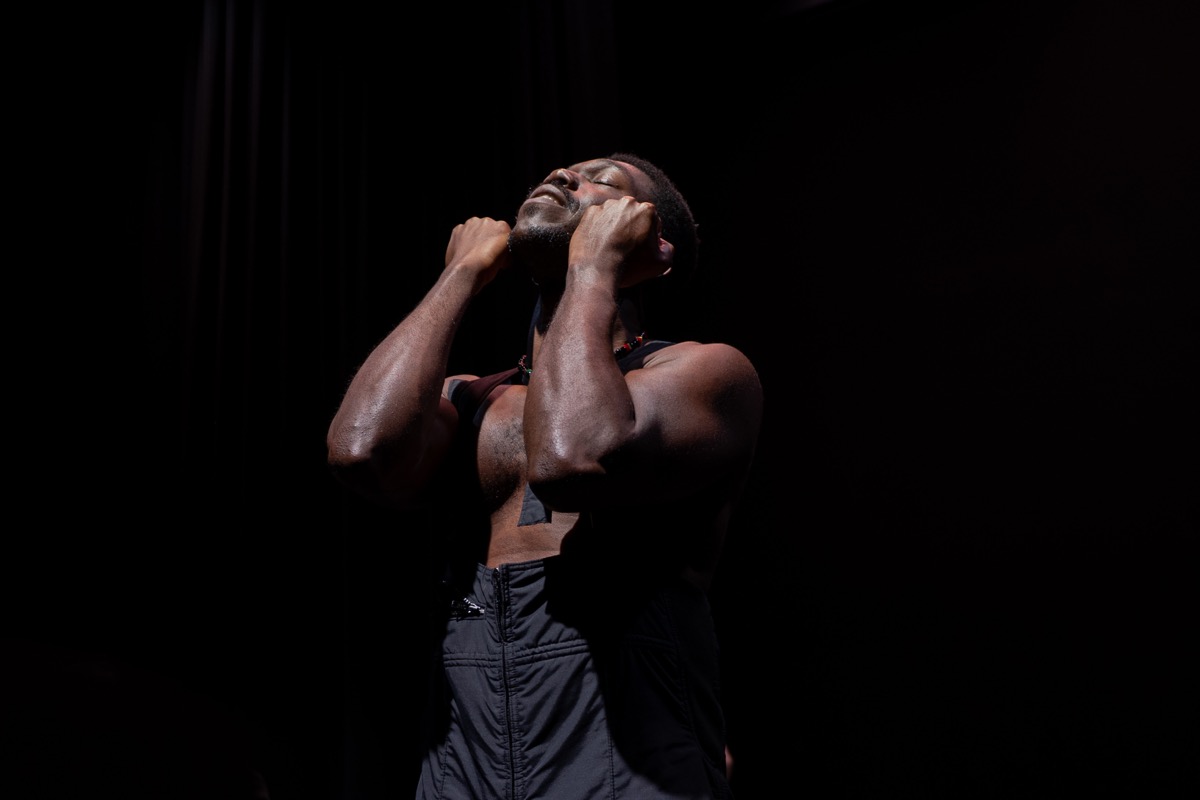
I assume you’re all familiar with Hamlet, Shakespeare’s tale of deception and murder in the Danish court. You know: Prince sees his father’s ghost (or does he?), prince goes mad (or does he?), and at the end, every major character has been killed (no questions there). The perfect entertainment for a chilly fall evening.
Jersey City’s Art House Productions has decided to present a version of Hamlet directed by C. Rashee Stevenson. This version cuts and rearranges Shakespeare’s original text, adding interpolations from Jean Genet’s plays Les Nègres and Les Paravents and from unnamed works by Federico Garcia Lorca. Neither the play’s program nor the information in the press packet says who did the rearranging and interpolating, which was probably a good idea.





Most of the basics of the original plot are there. King Hamlet has just died. His son and namesake arrives back in court from college to find his mother, Queen Gertrude, has married his uncle, King Claudius. (In no production of Hamlet do we find out why the young Hamlet, being the only child, is not now the king, but hey, it’s Denmark; maybe they do things differently.)
Hamlet’s friend Horatio takes him to see an apparition of the late king. We see a vision of King Hamlet’s murder by Claudius using a sledgehammer. (None of this poison in the ear stuff.) Hamlet plots revenge; Claudius appears to be the court’s royal drug pusher and highly suspicious of Hamlet to boot; Gertrude is either spaced out on drugs or addicted to sex with her new husband. Thank goodness for the Polonius family — Dad is still the inane counselor he always was, son Laertes is away at college, and mousy daughter Ophelia is still the lovelorn ex of the prince.
Claudius and Polonius, wondering if Hamlet is mad with grief or just pretending, try to use Ophelia to get to the bottom of his moodiness, but that trick doesn’t work. Hamlet visits his mother’s bedchamber to find out if she was in on the plot to kill his father. Asking her questions with hidden meanings only makes her more confused and concerned about her son’s mental health — which is compounded when Hamlet, startled by a noise from behind a curtain, stabs the hidden Polonius to death.
Claudius brings his stepson’s college buddies, Rosencrantz (a repurposed Lamb Chop puppet with a French accent and a cigarette dangling from its lip) and Guildenstern (played by a female actor), to the castle to find out Hamlet’s state of mind. Unfortunately, in trying to kill Claudius, Hamlet kills Rosencrantz, leaving Guildenstern bereft and vengeful.




Claudius manages to capture and drug Hamlet, trapping him in some form of bondage/torture device. Guildenstern taunts him with a hate-tinged version of the “To be or not to be” soliloquy. Hamlet escapes. Ophelia has now gone completely mad and, at her father’s funeral, is accosted by Claudius, who is trying to inject her with something. She escapes; he pursues. Nobody notices this because Claudius has gotten everyone high first.
Hamlet and Horatio visit the cemetery where the prince engages in a battle of wits with a gravedigger, which ends in a draw. (So much for that college education.) Hamlet leaves just before Laertes, the sole survivor of his family, enters. He asks how his sister died; the queen tells him she was hanging flowers on a tree near the riverbank and fell in, the weight of her wet clothes pulling her under. (One wonders if Ophelia fell or was pushed by Claudius.)













When left alone together, Claudius sweet-talks his way out of being killed by Laertes, pinning the blame on Hamlet’s weird behavior. Laertes agrees not to kill Hamlet on sight, saying he will wait until he can determine if the prince is crazy or not. Claudius, pleased to hear this, promptly kills Laertes with his trusty sledgehammer. At court, Hamlet gives the play-within-the-play Player the “speak the speech, I pray thee” soliloquy; the Player looks like she thinks she should have asked for a higher fee. Hamlet and the Player do three performance art scenes before they and Horatio pull out machine guns. Gertrude and Guildenstern are killed, but Claudius is captured. The king is met by a masked figure who may be his dead brother. As Hamlet takes Claudius’ sledgehammer and kills him, Claudius falls into the masked figure’s arms, Hamlet falls dead to the ground, Horatio says “Good night, sweet prince,” and the play stops dead.

Since the program does not say who did this adaptation, I have to suspect that the Sam Peckinpah concoction that is this version of Hamlet is the product of director Stevenson and the dramaturg, Rebecca Frank. Stevenson is also listed as the Sound Designer for the show. This may explain why the contemporary background score is allowed to overwhelm the actors at times, and why the actors, who are not miked, are directed to speak some of their lines so quietly that, even without the music, their voices barely carry to the first few rows of the audience.
Celia Krefter’s lighting design is perfunctory. There is no scenic designer listed, which is just as well, since the stage is all black with side curtains upstage for exits and entrances, populated by a few pieces of bargain store furniture. There is also no listing for a costume designer; one gets the impression that the actors may have provided most of their own costumes themselves.
The one thing I cannot fault, given all of the above, is the cast. They are a talented group who seem to be trying to do their best to get the essential story and lesson of Hamlet across. Best among them are Colin Pieters as Prince Hamlet, giving a strong performance where he is asked to make split-second changes of attitude between the giggling lunatic and the darkly plotting revenger.
The rest of the cast provides good support. In no particular order, they are: Max Katz as Claudius, most of the time looking like a tourist dad at Disney World but sporting a leather apron and horned mask when he has murder on his mind; Ashley Escoffery as Gertrude, shuffling around the court in a long white dressing gown and bunny ears; Jacob Ready as Polonius and the ghost of King Hamlet; Hannah Jane Ginsberg as the Actor and the Gravedigger, providing what little comic relief there is; Elena Lozonshi as Horatio and Laertes; Laura Hajek as Guildenstern and the voice of Rosencranz; and Jessie Kenner Tidball as Ophelia.
I have heard about and seen many different productions of Hamlet. The plays of Shakespeare are noted for being adaptable into many eras, containing characters that can be played with various motivations and emotional states. But this version of Hamlet is, in my opinion, a poorly thought through production done more for shock value than anything else. I cannot recommend making the trip to Jersey City to see this version of Hamlet.
Hamlet is presented by Art House Productions in Jersey City, near the Grove Street PATH station, through Oct. 25, 2025. For more information or to purchase tickets, go to arthouseproductions.org.


