


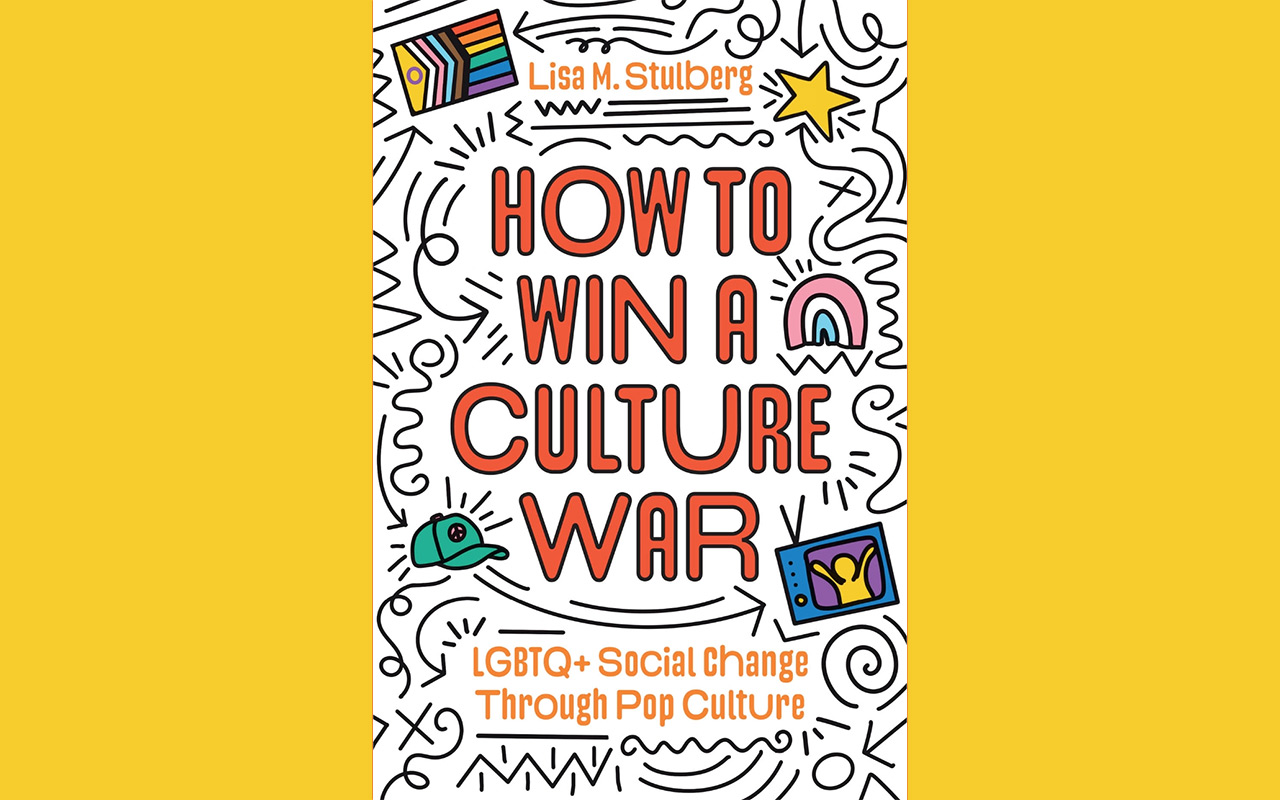
Lisa Stulberg will visit Watchung Booksellers at 4 Fairfield St. in Montclair on Oct. 29 at 7 P.M. to discuss LGBTQ+ liberation in How to Win a Culture War: LGBTQ+ Social Change Through Pop Culture. Stulberg is an Associate Professor of Sociology of Education at New York University’s Steinhardt School of Culture, Education, and Human Development.
In 2018, Stulberg wrote LGBTQ Social Movements, an accessible history of and introduction to the various forms of queer activism that have taken place throughout the 20th century. At the Watchung Booksellers event she will be speaking with Nina Mauceri, PhD. “This is the second time I’ll be doing an event there,” said Stulberg. She spoke at the Montclair bookstore back in 2018 to promote her book, LGBTQ Social Movements. Stulberg is a frequent patron of the store, describing it as “a great space for my kids and me” and a wonderful independent bookstore to support, “at a time when it’s rough to be in [the bookselling] business.





Stulberg moved to Montclair in 2010; she had been living in New York for the first eight years she taught at NYU. Now 16 years later, she finds that she “actually really loves it. It was not on my dance card to become a New Jerseyan, but I feel very connected to Montclair through raising kids here,” she says. “The longer you’re in a place, the more it feels like home.”
Through her interest in studying queer social movements Stulberg is all too aware that the places that LGBTQ+ people can call home are becoming limited. “As a country, we’re just getting more and more polarized; there are already states where queer people and families can’t go to or live in because they can’t live safely.” Stulberg cites healthcare access and education as two of the areas that anti-LGBTQ+ legislation targets.
When asked about how education about queer topics is being targeted by policymakers both in regards to K-12 education and with censorship online, Stulberg points to the “long-standing [homophobic] trope of protecting children from queer people.”
“This [language around protecting children] just seems like it’s in that line,” Stulberg says. Policy makers are “jumping on the larger bandwagon of the real risks of social media use for people in general and young people. It seems very cynical and disingenuous.” She said that they are employing the language of mental health protections.





Stulberg points to the hypocrisy in claiming to want to protect women and children while rolling back protections. “If they were really serious about protecting mental health and protecting women and protecting children, that would be reflected in their legislation. Instead, they’ve done pretty much everything they can to roll back those protections.”
Title IX she said is an example of how the conservative lawmakers and the Trump administration have both rolled back the protections against all women, and have in particular weaponized Title IX against transgender and nonbinary athletes.













Along with interviewing media professionals for How to Win a Culture War, Stulberg also spoke to several athletes, both those who are part of the queer community themselves and allies. The intertwining of both mainstream media and sports is perfectly encapsulated by the hit TV show Heated Rivalry, which Stulberg said she was just barely able to squeeze in before the book had gone to print.
Though Stulberg doesn’t identify as part of the queer community, she found that Heated Rivalry resonated with her. To explain why, Stulberg turns to Esther Perel, a Belgian psychotherapist and author of Mating in Captivity: Unlocking Erotic Intelligence. Perel called Heated Rivalry a “corrective experience” on her TikTok. Stulberg describes it as “how straight women would want their partners to be. The kind of masculinity they would want their partners to exhibit.”
Perel uses “corrective experience” as a term to describe both the safe model of masculinity that Stulberg describes, and more generally as the thing you wished had happened. She uses coming out to your parents going well as another example.
Though she enjoyed Heated Rivalry and Esther Perel’s TikTok commentary, Stulberg is not blind to the shortcomings of the TV show. “There’s a gender gap regardless of sexuality, in media representation, there are just more male characters in general.” She says sapphic stories seem to be underrepresented. “The trope of killing off the lesbian characters, having the lesbian characters be either homicidal, suicidal, tragic in some way, has existed for decades and decades for queer people in general.”
The trend Stulberg is referring to emerged in part due to the Motion Picture Production Code in the last century, colloquially known as the Hays Code. The Hays Code essentially mandated that queer characters be “homicidal, suicidal, or tragic in some way,” because media in Hollywood could not appear to endorse queerness at all.
Through interviewing over 170 individuals involved in media and sports, Stulberg learned how much the value of a project, especially a big movie, depends on leading men. “Women’s stories and their work are just devalued,” Stulberg says. “It’s tougher to have a breakout story. I think the stories that end up getting support and financial backing and then a lot of hype, tend to end up being about men.”
“I’m not naive about, how pop culture is impacted by the political times we live in, but I do think it’s a, it’s a space of relative openness.”
With these biases that Hollywood and society at large have in mind, it’s no wonder that Heated Rivalry was able to appeal to the masses despite not being made by a major production company.
She acknowledged the prejudices that still exist and remains hopeful about the future of queer activism. “The win is an active verb, not something that is settled or achieved.” she said in response to a question about why she kept the title as is even as the political tide has turned against LGBTQ+ rights. “I’m not naive about, how pop culture is impacted by the political times we live in, but I do think it’s a, it’s a space of relative openness,” she said. Beyond the fact that artistic and creative spaces include more open-mindedness, Stulberg believes that they may offer hope in dark times.
Connecting with others through art and pop culture is “a way to engage and build an identity. I think engaging with pop culture is often a really active thing, and that means it’s a space for potential agency when a lot of agency is being taken away right now. People and resistance always find a way.”
The book How to Win a Culture War: LGBTQ+ Social Change Through Pop Culture is published by Chicago University Press and will be available for purchase with a discount at Watchung Booksellers for ticket holders on Oct. 29.


