



A death creates a chasm of grief among family and friends left behind, whatever the cause. In a homicide, the grief can grow to envelop the perpetrator’s family and even the perpetrator themselves. If a killing is not premeditated, can the perpetrator and the victim’s family ever reconcile feelings of loss and remorse and move forward?
That is the question posed by Punch, a new play by James Graham based on the memoir Right from Wrong by Jacob Dunne. Directed by Adam Penford, the play is one of great power and well worth experiencing.





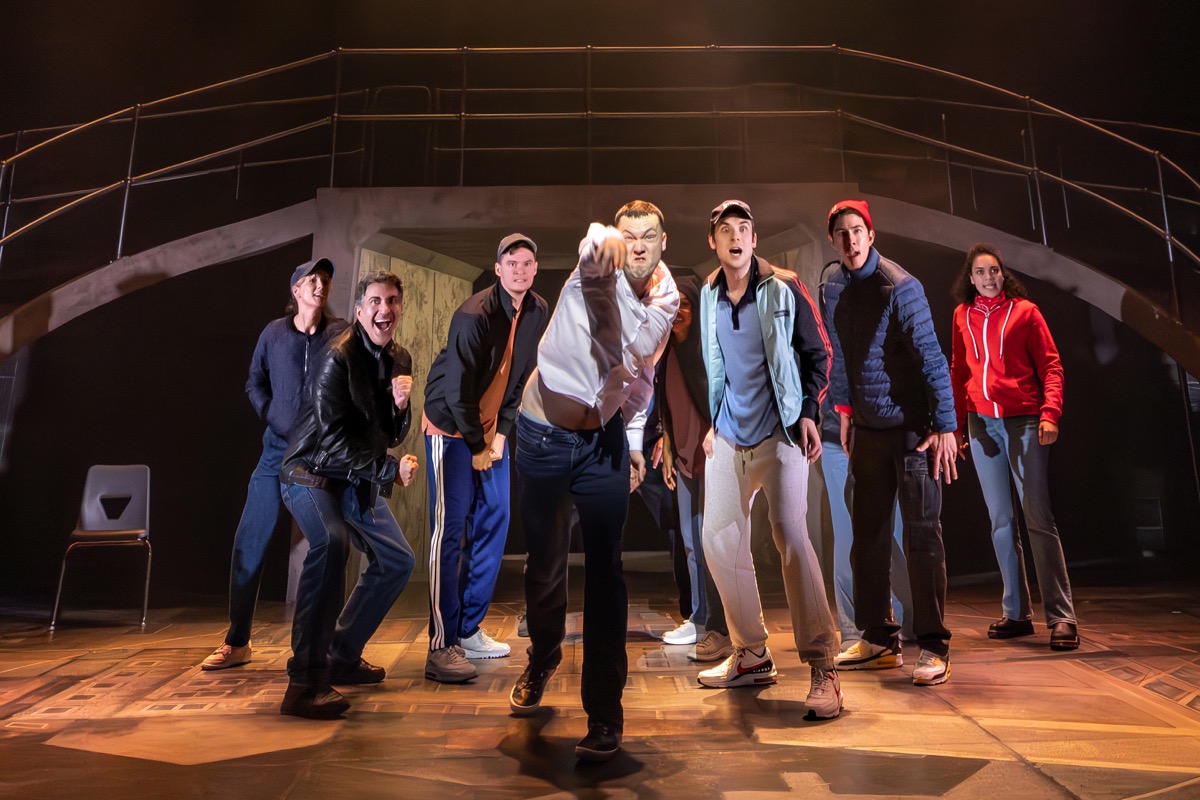
The story takes place in Nottingham, England, starting in 2011. Jacob (Will Harrison), a teenaged layabout, spends his days earning money by selling drugs. His nights are drunken, drug-fueled revels — pub-hopping with his gang and looking for a good brawl against rival gangs.
On one such night, Jacob throws himself into a pub fight, going in swinging in support of his gang, and knocking a bystander, James Hodgkinson, out with one punch. James’ head hits the pavement as he falls. He seems all right, but gets taken to the hospital. When complications appear, he dies following surgery.
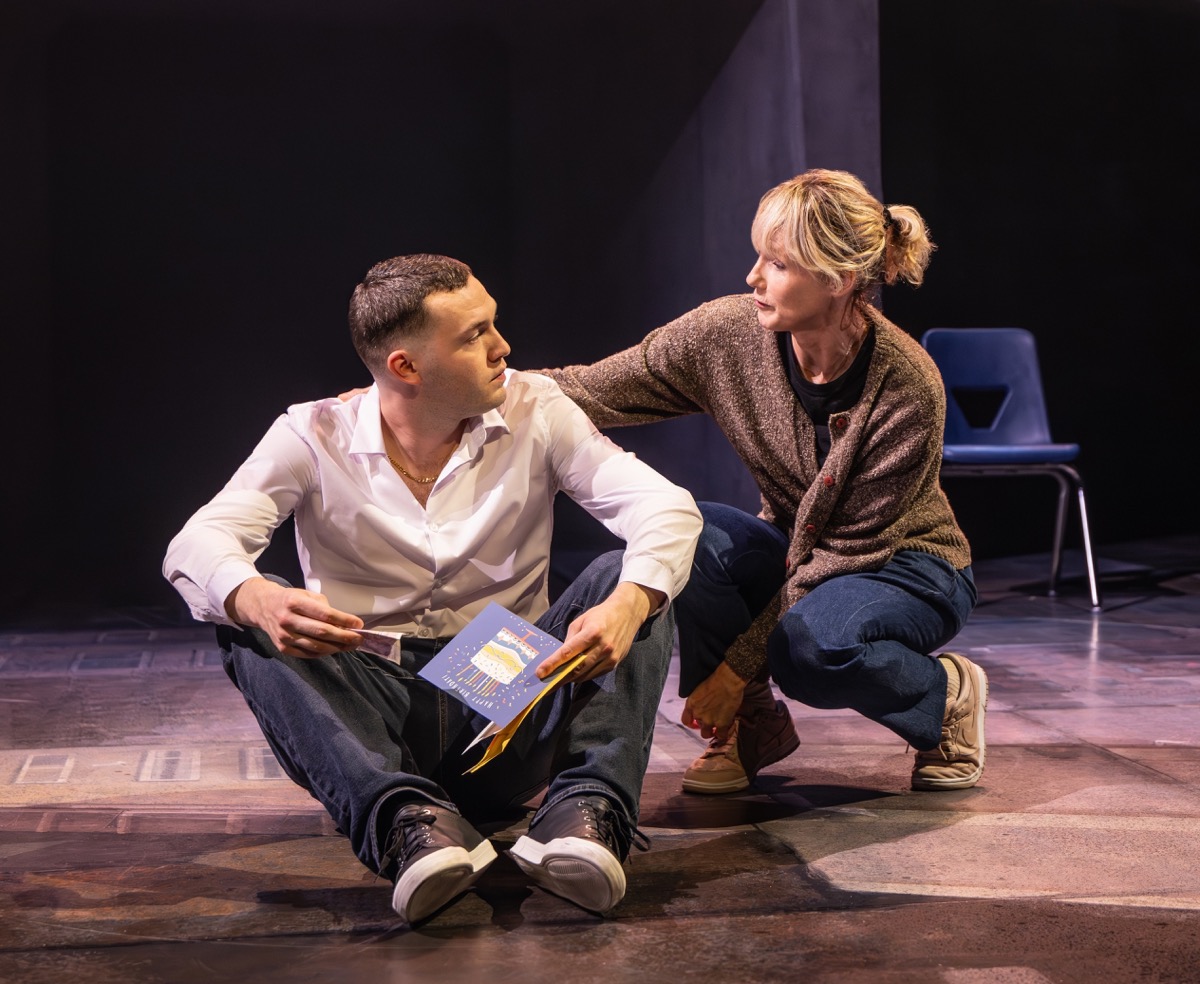
Jacob, ratted out by one of his gang mates, is sent to prison for 13 months for manslaughter. James’ parents, Joan (Victoria Clark) and David (Sam Robards), are outraged at the light sentence: their only child is dead and his killer is getting away with murder.
Jacob falls into the routine of prison, counting the months until he’s free. Joan, meanwhile, investigates support groups to relieve the ongoing ache of her loss, finally contacting a group called Reparative Justice (RJ). Through RJ, Joan and David make contact with Jason via his probation officer, initially through letters.




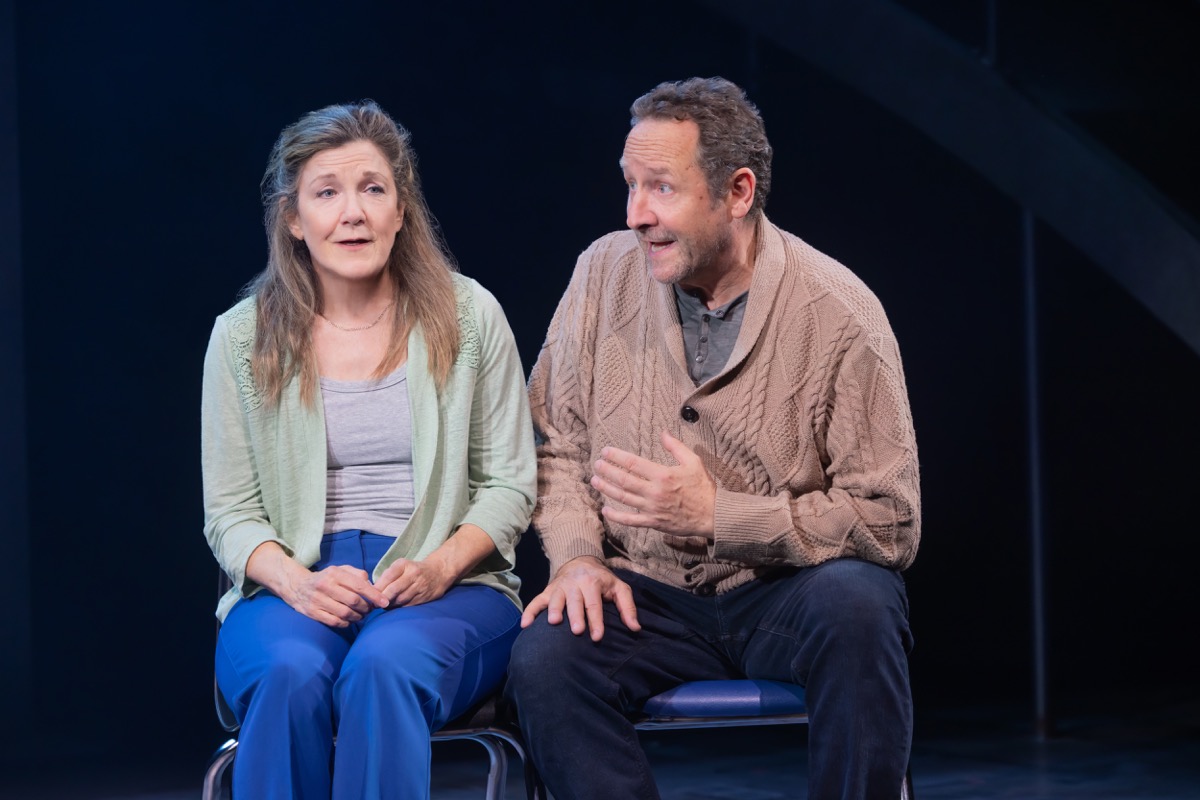
The caliber of acting in the three major roles of Jacob, Joan, and David is outstanding. Joan, played by two-time Tony Award® winner Victoria Clark (Kimberly Akimbo; The Light in the Piazza), is an inwardly hurting mother. She is determined to get an answer to why her son was killed while seeking a resolution for her loss.

Sam Robards, himself a Tony Award® nominee, plays David as a counter-balance to Joan. He casts his son’s killer as the scapegoat for his pain, a villain unable to feel remorse and unworthy of redemption. His hurt is volcanic and outwardly focused.













Will Harrison’s deep and moving portrayal of Jacob from his teens to his twenties captures all the contradictions in the character’s life. Brought up in an environment of competing street gangs, where nights are a blur of booze, drugs, and fights, Harrison’s Jacob has no sense of what he wants for his future. He is truly bewildered and anguished about how his actions could have ended up in someone’s death. Still, something inside him recognizes Joan and David’s outreach as an unlikely lifeline, one he can hardly believe yet guardedly grabs at in a chance of breaking his cycle of violence.
Fine work is done by the supporting cast as well, many of whom take on multiple roles. Camila Canó-Flaviá provides emotional support as Joan and David’s RJ counselor and as Jacob’s girlfriend, a nurse. Lucy Taylor runs the emotional spectrum as Jason’s anguished mother and his tough love probation officer. Cody Kostro turns in sensitive performances as Jacob’s friend/betrayer Raf and as Sam, Jacob’s younger brother, who has secrets of his own. Finally, Piter Marek does a good job in the disparate roles of Tony, the local pusher and leader of the gang, a bad influence to end all bad influences; Derek, a BBC news host who invites Jacob and Joan to tell their stories together; and the determined police officer whose investigations bring Jacob to justice.
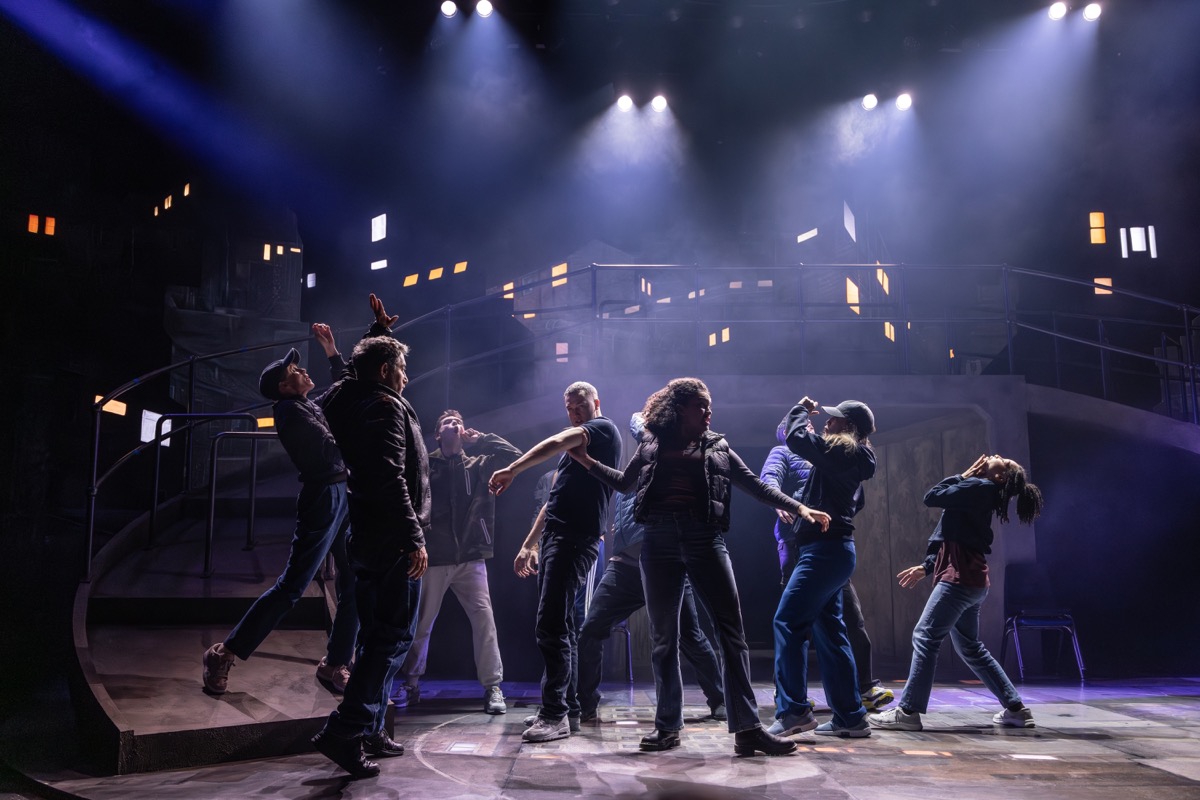
Anna Fleischle’s set, a huge oval staircase surrounding the main playing area like a pair of all-embracing arms, encircles a smaller space containing everything from the mean streets of Nottingham to the pubs of the city to Jacob’s jail and the BBC studios. In this, the lighting design of Robbie Butler and the sound design and original music by Alexandra Faye Braithwaite contribute to bringing the milieu to life. Leanne Pinder’s movement direction creates whirling scenes of club life featuring a mix of frenzied and slow-motion moves, and a mechanistic dance encapsulating the grinding routine of jail time.
Punch is not a perfect play. There are some gaps where one is not sure how we got from point A to point B, and there are some characters, most importantly Sam, who is only seen to express a plot point and not heard of again. Still, Punch is an emotionally gripping play, and one that I would not hesitate to recommend.
Punch is presented by the Manhattan Theatre Club at the Samuel J. Friedman Theatre, 261 West 47th St.,in New York, through Nov. 7, 2025. For more information or to purchase tickets, go to manhattantheatreclub.com.


