


The multi-talented Todrick Hall, who has graced Broadway and off-Broadway audiences with his performances, set himself a near-unbelieveable task. He has written, composed the score for, directed, and choreographed the new musical Midnight, in which he plays the leading character.
On all levels, Hall has succeeded, creating what I can only describe as a modern opera on the corrosive nature of slavery in the antebellum South. It is full of rich, emotionally moving music. Its story mostly keeps away from overused tropes and cliches. And the acting and singing talent of the large cast, from Hall down to the chorus, is first rate.





The story opens with a prologue, related by Ethel (Ayana Groege), a matriarch among the slaves, with the help of fellow slaves Horace (Dwayne Clark), Squeak (Sidney DuPont), and the chorus. A young couple have just given birth to a son they name Rail (because he was born by the railroad tracks). Slaveowner Sylvester (Ciarán McCarthy) finds them and in his cruelty kills the father, sells the mother to a neighbor, and keeps the baby as property.
Growing into manhood, Rail (Todrick Hall) becomes the object of sweet housemaid Lily Rose’s (Charlotte Odusanya) affections, to the disapproval of her sour sister Happy (Kolbi Jordan). Meanwhile, Sylvester’s wife Charlotte (Autumn Hurlbert) is preparing her daughters — spoiled, pampered favorite Scarlet (Kennedy Coughell) and the less-regarded Violet (Bella Coppola) — to enter the marriage market. Charlotte’s sights are set on neighboring brothers Richard (Jeremy Beloate), who runs his family’s plantation, and Harry (Jimmy Brewer), an ill-tempered drunkard who was lamed in battle. Richard and Scarlet make a match, and Sylvester lends his male slaves to Richard to build a new house.
Richard is ahead of his time, treating the slaves with respect for their work and forming a friendship with Rail. Rail wishes he could put his feelings for the now-pregnant Lily Rose into words, so Richard, against the custom and laws of the time, teaches Rail to read and write. During one of these lessons, Richard impulsively kisses Rail. The men are quick to claim that it was an error, a mistake meaning nothing. But they cannot deny to themselves the attraction between them, planning other secret midnight meetings.
Both Scarlet and Lily Rose cannot understand why their men have seemingly lost interest in them. Scarlet finds Richard’s cache of letters from Rail under a loose floorboard and incites Harry, Sylvester, and Charlotte to violence against Rail. Richard tries to stop them but is restrained by Harry. In anguish, Rail invokes a curse at the stroke of midnight: that for the next 24 hours, the white community would find out how it would be to live as blacks do.




Hall’s score, consisting of some 33 distinct songs, runs the gamut from soaring romantic ballads to lullabies, lively dances to deeply emotional soliloquies. They are rarely interrupted by short unsung yet rhymed lines, giving Midnight the feel of watching an opera, with all the grand emotional power that implies. Think of works like Gershwin’s Porgy and Bess, Bernstein’s Candide, or Sondheim’s Sweeney Todd, which have all been performed as operas, and you’ll get an idea of the depth of talent displayed in Hall’s Midnight.
The set, designed by Morgan Large, is dominated by an enormous clock face, suspended above the stage, with a single hand pointing to a minute before midnight. It is mirrored by the stage’s large turntable, also with a clock design. A number of the costumes designed by Beck Jones hang from the rafters. Their descent to the stage mark the start and end of the play proper. Jake DeGroot’s lighting design and Lawrene Shober’s sound design add depth to the actions of the play.












The sound leads me to my one criticism of Midnight. In the large ensemble numbers, the lyrics were mostly a blur of sound with a word here and there breaking through. In a show with so many talented singers providing aural pyrotechnics, something’s lost by not being able to understand what’s being said in the large group numbers. However, the vocal and melodic qualities of the music conveyed the emotional impact of the songs, giving the audience non-verbal clues to the meaning of ensemble scenes. And the solo and duet numbers were searingly, soaringly transporting.
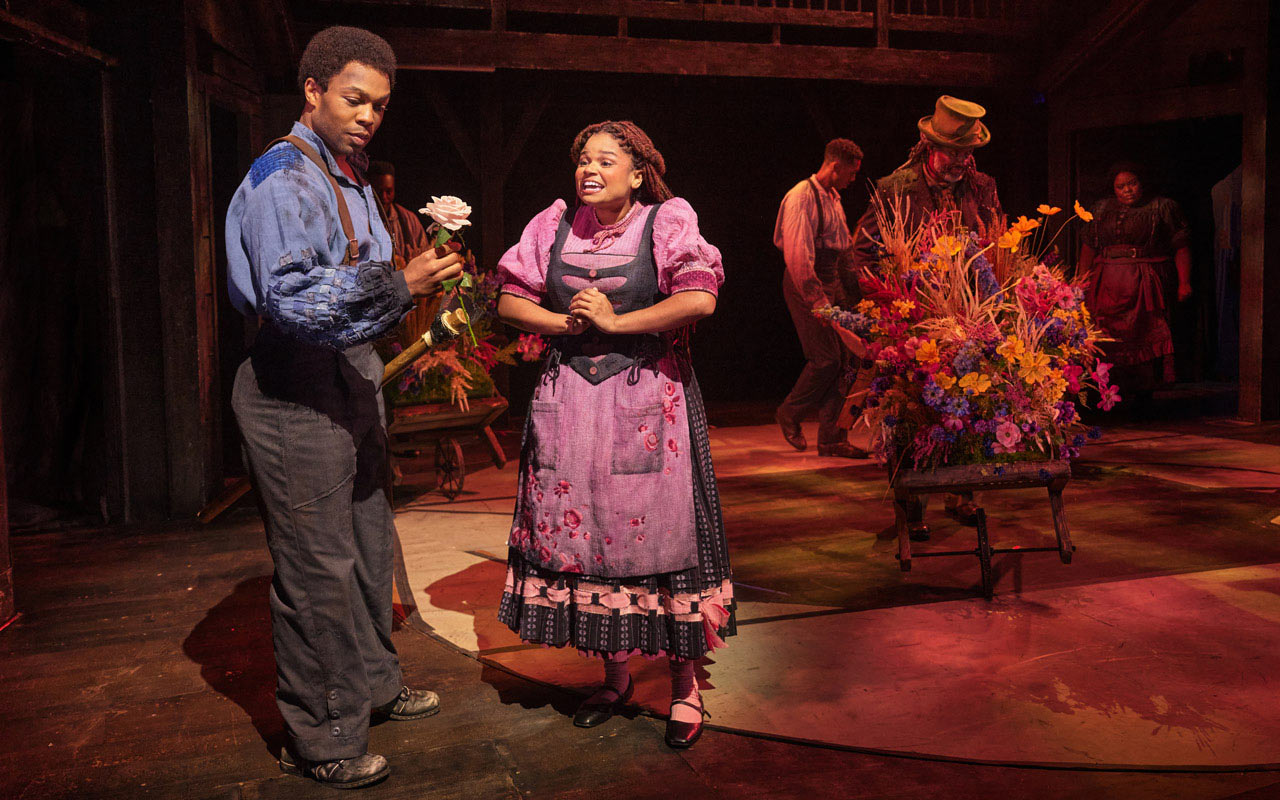


I had been mostly unaware of Todrick Hall’s abilities prior to this show, so I was unprepared for the overwhelming amount of talent he and his cast delivered in Midnight. I cannot more strongly urge you to attend a performance of this show before its regrettably short engagement ends. You owe it to yourself to make the acquaintance of the multi-talented Todrick Hall and the cast of Midnight!
Midnight is presented at the Daryl Roth Theatre, 101 East 15th St., at Union Square in New York, through Jan. 3, 2027. For more information, or to purchase tickets, go to darylroththeatre.com.


