


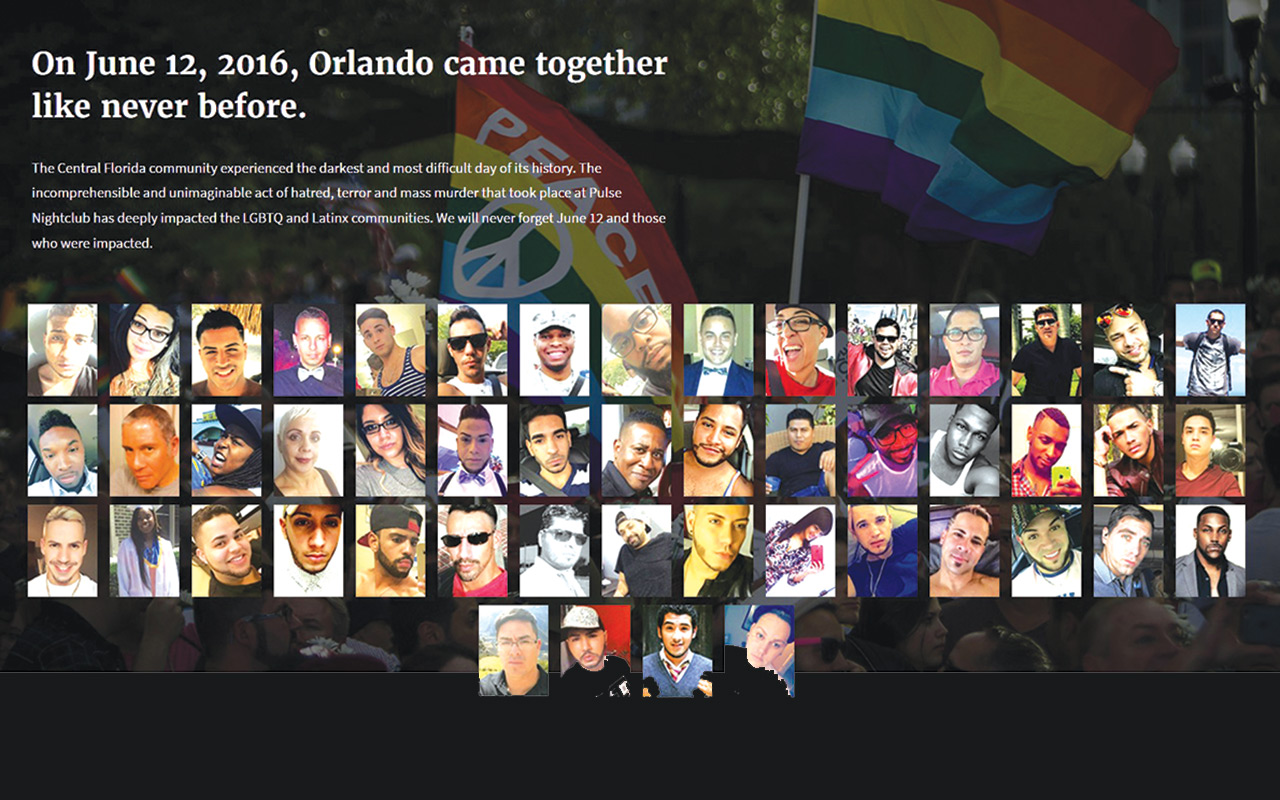
On June 12, 2016, at 2:06 a.m., Mina Justice received a text message from her son, Eddie, who was at the Pulse nightclub in Orlando, Florida, saying, “Mommy I love you.”
Justice said in an online video posted on dearworld.org that her son then called her and told her that someone was in the club shooting and to call the police. Eddie was hiding in the women’s restroom. Justice said she told her son to hang up because she did not want the shooter to hear him.





The mother and son continued exchanging texts, and two that Eddie sent at 2:39 a.m. revealed that Eddie knew what his fate would be: “Mom he’s coming.” “I’m gonna die.” Eddie Justice, 30, was one of the 49 people murdered and 53 injured in the massacre.
The shooter, Omar Mateen, 29, of Port St. Lucie, Florida, was shot dead by police at approximately 5:15 a.m. after officers detonated an explosive and used an armored vehicle to get inside the club. Mateen had previously appeared on the FBI’s radar and was interviewed twice by agents prior to the shooting.
The founder of dearworld.org, Robert X. Fogarty, did not respond to an interview request, and Justice could not be reached for an interview.
Ten years later, the tragedy remains seared in the psyche of the nation and the rest of the world. In the time after the shooting, vigils and tributes were held in cities nationwide as well as internationally in places including Berlin, Paris, Seoul, and Sydney. A permanent memorial is planned at the Pulse site.






Tatiana Quiroga, 48, the executive director of the Orlando-based nonprofit organization Come Out With Pride Inc., remembers where she was that day and how she found out about what had happened. “My wife and I were actually visiting some relatives that she had in Alabama at the time, and so she came to wake me up at like 4 o’clock in the morning because one of our friends who is with the Orlando Police Department had posted on her social media that our world will forever be changed once this news gets released,” Quiroga said.
The aftermath on the local level resulted in feelings similar to those felt after 9/11, according to Quiroga, where it unfortunately took a tragedy to bring the community together.













There were some silver linings that could be found, according to her. For one, she said, several nonprofit organizations were formed to provide support. Also, she continued, the shooting prompted conversations about culture and religion, and it brought to the forefront the intersection of the LGBTQ and Latino communities, as Pulse was holding a Latino Night on the night of the tragedy.


Everyone could agree, she said, that this was wrong, and many allies or those who had little exposure to the LGBTQ community heard personal stories and learned of the stigma the community endures.
“There were bodies that were not claimed by their families because they were at a gay nightclub, and either the families knew that they were gay, or were in complete denial, and so there were bodies that were literally never claimed, and that were disowned,” she said.
While that news might be unfamiliar to the current generation, older LGBTQ folks who lived through the AIDS crisis in the 1980s know that many families refused to claim the bodies of their supposed loved ones who died from the disease.
“[Pulse] heightened awareness…and it certainly made individuals aware of the existence of homophobic violence, and unfortunately there were some people who were unaware of it”
Bill Courson, 73, an LGBTQ activist who lives in Montclair, New Jersey, and winters in Florida, certainly remembers that time, as does Quiroga, and he was asked if he felt the Pulse shooting changed the world.
“Regrettably, it did not. It heightened awareness locally, and it certainly made individuals aware of you know the existence of homophobic violence, and unfortunately there were some people who were unaware of it,” he said.
Courson was in New Jersey when he learned of the shooting. He wakes up early in the morning, and the first thing he does is turn on the news. “They just said there had been a shooting at a nightclub in Orlando, Florida. I didn’t know it was the Pulse; I didn’t know it was an LGBT venue at all, but something in my gut just clenched up and said, ‘Oh, my God, it’s happening again,’” he said.
Courson was previously let down when another high-profile crime against the LGBTQ community took place in the late ‘90s.
“I was quite convinced in 1998 when Matthew Shepard died, that after Matthew’s death everything would change, that there couldn’t possibly be any antipathy toward queer folk. I was completely wrong,” he said.
“Pulse is in the back of all our minds.”
In Orlando, the shooting remains a sensitive topic and a raw point, and the LGBTQ community is still scared, according to Quiroga. Her organization produces the Pride celebration in the Orlando area. It’s the largest single-day event in the region, and last year it drew more than 240,000 people, she said.
“As the event planner [for Come Out with Pride], Pulse is a constant [topic of] conversation. To plan an event at the size that we plan, Pulse is in the back of all our minds. We work very closely with the city of Orlando, with the Orlando Police Department, with Orange County Sheriff’s Office, and so when we’re having these safety conversations with our local law enforcement and city partners, Pulse is right underneath the surface.”
Security, of course, is a topic when it comes to planning Pride celebrations up north as well.


“We’ve got Montclair Pride coming up on Saturday, August 1,” Courson said, “and already we’re talking about safety measures that need to be taken, but you know what? At the end of the day, there’s not that much you can do. Madness can erupt anywhere anytime. You can simply be prudent and be aware, and if you see something, say something, as the saying goes. But there’s really not much that we can do to deter insanity. We simply protect ourselves against it to the best of our ability.”
One of the ways, perhaps, to mitigate insanity like what took place at Pulse is for LGBTQ people to keep telling their stories.
“We need to really continue the messaging that love will always win, the importance of inclusivity and visibility and representation, and continue to work against these narratives about the stigmas that still exist on a cultural and religious level for so many marginalized communities,” Quiroga said.
“Whoever you are, whatever your condition in life, there’s always something you can do.”
Courson’s message was similar. “Whoever you are, whatever your condition in life, there’s always something you can do. Join a community organization, take part in Pride events, write letters to your elected representatives, but make your presence felt — continuously,” he said.
In many places in Florida, the presence of the LGBTQ community is felt, but the state’s warm, sunny climate generally contrasts with a cold, gray political climate the community often faces there.
Quiroga noted that the state is “ground zero” for so much of the “hate legislation” that gets proposed and the hate speech and propaganda” against the LGBTQ community.
She said she knows a lot of people who have left the state because they don’t feel safe, but that decision, she added, comes with privilege as many don’t have the means to move.
Quiroga and her wife, though, have chosen to stay. “This is our home, and if we don’t stay to fight, then who will? And I really feel that at the end of the day, as a parent — right now my wife and I, we’re raising a 10-year-old and a 14-year-old — we’re choosing to stay because I really think that my kids are going to be better for it.”
She said her kids see their two moms doing advocacy and volunteer work, in addition to Quiroga’s job, and the importance of standing up “for what you believe in.” Moreover, she continued, one of the “huge things” about Pride is to celebrate the progress that has been made.
“I think it’s essential, regardless of how my kids end up identifying, that they see what it’s like for people to just have at least one day to celebrate as their authentic selves. To see what pure joy looks like because I want that for them despite how they identify,” Quiroga said.
And she emphasized that despite the hardships, silver linings do exist. “Here in Orlando, [the shooting is] still very fresh. It’s important to never forget what happened to our community and at the same time realize that we did have silver linings. That we did take away some major lessons from this tragedy, and we came out on the other side of it more united and stronger.”
Courson also is not without hope, and he had a pointed message to those in charge: “To our leaders, I would say, ‘We’re here, we’ve always been here, we’re not going away. We’re going to continue to be here, and we’re not going to allow you to trample on our rights. You’re not going to take anything away from us. We’ve worked too long and much too hard to allow that sort of thing,’” he said.
On that day 10 years ago, human beings gathered in a place to dance.
“I think that one of the things that we have to remember is that at the end of the day, our 49 angels were simply people that went out to have a really good time and were dancing on the dance floor and that they will forever be part of the fabric of the community here in Central Florida,” Quiroga said.


