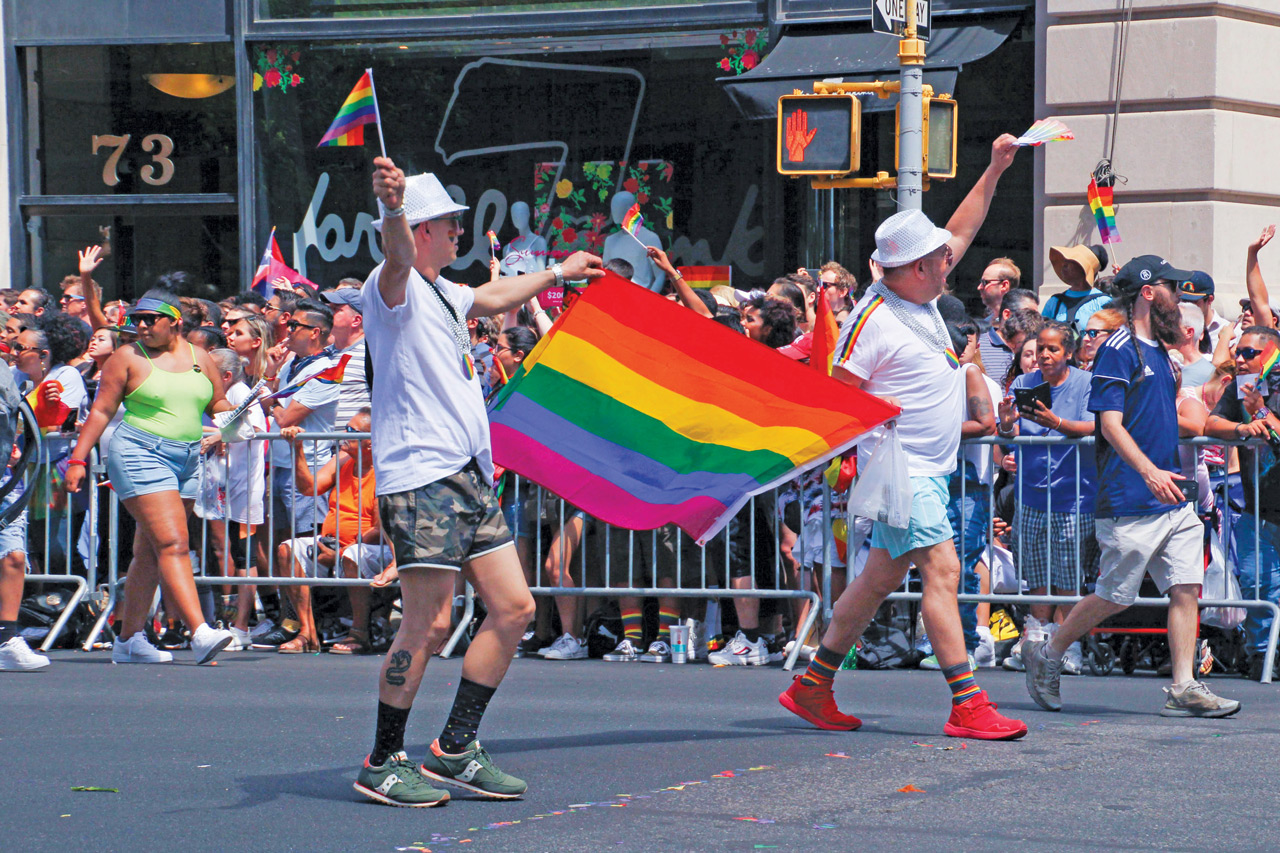
During June rainbow flags line storefront windows and hang from streetlights, stretching across small towns and major cities alike. In places like Asbury Park, Philadelphia, and New York City, June arrives with a familiar rhythm — visible, anticipated, and widely recognized.
That visibility traces back to the site of the Stonewall Rebellion. In June 1969, at the Stonewall Inn, resistance poured into the streets after years of routine police raids targeting LGBTQ gathering places. Figures like Marsha P. Johnson and Sylvia Rivera became central to what would become the Gay Liberation Movement.





By 1970, the first Pride marches honored that defiance, transforming grief and anger into public expression. The rainbow flag, introduced in 1978, became a lasting community symbol.
Today, Pride can feel seasonal, even expected. Its presence is the result of people who insisted on being seen long before it was safe to do so.
That openness often feels expansive. However, it does not exist everywhere.
Across parts of the Americas and Europe, Pride unfolds through mile-long parades and public celebrations. Meanwhile, in regions of the Middle East and Africa, even the suggestion of queer identity can carry severe consequences.





Pride exists on uneven ground, defined less by scale and more by geography. Countries like Brazil, the United States, Canada and the Netherlands host some of the largest Pride celebrations globally. In many of these places, legal protections are in place.
São Paulo’s Pride routinely draws millions, making it one of the largest gatherings of its kind. In Amsterdam, decorated boats fill the canals during Pride, blending celebration with history as the city marks milestones like 25 years of marriage equality and prepares to host World Pride in 2026. Likewise, Toronto remains a major North American hub, where community programs meet large-scale celebration.
This creates the illusion that Pride has always existed as something secure. It hasn’t.













Progress and pushback

As Cathy Renna, director of communications for the National LGBTQ Task Force, put it, “Progress is holding the line, continuing to resist … We all need to be in this fight for the generations that are coming.”
Legal safeguards, public acceptance and cultural visibility did not occur overnight. Instead, advocates built them over decades shaped by activism, legal challenges, public pressure, and a refusal to disappear — even when openness carried real danger.
Safety does not extend evenly across communities. Transgender individuals, queer people of color, and those outside major urban centers often navigate more complex realities, where public expression still carries risk.
Russia’s laws targeting so-called “gay propaganda” have significantly narrowed space for public expression.
In Uganda, the 2023 Anti-Homosexuality Act intensified global concerns. President Biden called the legislation “a tragic violation of universal human rights,” warning of broader implications for individuals and the country’s economic future.
“After Stonewall, and long before, our community found pride anywhere we found community — through dance, food, joy, or solidarity … despite darkness, wherever queer people are, we’ll find a way,” said Lauren Albrecht, senior director of advocacy and organizing at Garden State Equality.
Ultimately, Pride adapts. It does not disappear.
More than 60 United Nations member states still criminalize same-sex relationships. In some, penalties include imprisonment or even death.
In countries like Nigeria and Iran, severe legal consequences make public expressions of Pride nearly impossible. There, connection requires caution.
People move carefully. Identity often remains private. Conversations become deliberate, built on trust. Consequently, the margin for error narrows.
In these environments, Pride becomes an act of survival.
Where queerness is criminalized, visibility can affect housing, personal safety, and employment. Legal systems frequently reinforce stigma rather than offer protection, and family structures can shift under that pressure.
A rainbow flag may represent joy and identity in one place, yet signal danger in another.
Social media and global coverage circulate glimpses of Pride. For some others, they affirm what is possible. For others, they highlight a divide that feels difficult to bridge.
Here in New Jersey, Pride celebrations continue despite political efforts to roll back diversity, equity and inclusion initiatives.
Renna said the current climate has left many feeling less secure, describing “a permissible climate of hate” in which hostility has become more normalized.
Even in states with stronger protections, rights do not always guarantee access. Albrecht noted that in New Jersey, “Despite the legal protections we enjoy here, hospitals have been put in a terrible position,” referring to uncertainty surrounding gender-affirming care.
Therefore, the most visible versions of Pride — parades and landmark legal victories — represent only part of the story.
Holding both truths together
For many, June offers connection — a chance to gather, celebrate and feel seen.
But geography shapes Pride. In one country, it fills city blocks. In another, it stays behind closed doors. Elsewhere, it goes unspoken.
Recognizing that range does not diminish celebration — it deepens it.
Albrecht, who grew up in suburban Monmouth County, reflected on how local visibility can change lives: “If we’d had that kind of welcoming and inclusive local government in the ‘90s, life would have been easier for many of us.”
Renna said Pride also reminds people that they are “part of something so much bigger than ourselves” — a wider community shaped by shared struggle, recognition and care.
Even where LGBTQ identity faces criminalization, Pride does not disappear. Instead, it adjusts to its environment, taking shape in small, intentional moments.
Though these expressions may be less visible, they remain just as real.
Each June, as rainbow flags rise in places where Pride can be celebrated openly, they carry layered meaning.
They represent progress. They reflect ongoing struggle. They point — quietly but clearly — to the parts of the world where authenticity remains out of reach.
To engage with Pride fully means holding both realities at once: celebrating the gains while recognizing the distance left to go, embracing visibility while understanding its limits.
Pride is not a singular moment of joy. Rather, it is a global condition. It may unfold on a crowded street, behind closed doors, or in a message sent carefully and erased just as quickly. Its legacy endures.
Happy Pride.