


The first hyacinth flower is said to have grown out of the blood of the slain male lover of the sun god Apollo, Hyacinthus. New Jersey’s largest and first HIV/AIDS service provider’s namesake possibly comes from this story. It was either that or the founder just liked the flower.
The current CEO of Hyacinth, Kathy Ahearn-O’Brien, is hard at work in her service to the organization and the community in New Jersey in which Hyacinth serves. It is not hard to imagine that someone as dedicated to social justice as she is did not immediately know going into college what she wanted to do. Just like many other teenage college students, it was hard to imagine what exactly she was going to do with a degree years down the line. And much like many business majors may attest to, she chose this major exactly for the reason of knowing it would be useful, but not particularly sure at the exact application it would be used for down the road.





Being a middle child of seven and a first-generation college student, she made the fiscally responsible choice of beginning with an associates of arts and sciences at Bergen Community College, going to Montclair State to get a bachelor’s degree in business, then finishing at Rutgers with a master’s in public administration.
Before joining Hyacinth, Ahearn-O’Brien worked in retail, where she was given the idea to pursue business by a former manager. After getting her bachelor’s at Montclair, Ahearn-O’Brien worked as a director of human resources at two different businesses. After working her first main position at a family retail chain, she began working at Hyacinth.
Her initial work at Hyacinth was for just six months. Instead of going into a job right away, there were no permanent open positions. The work she did for Hyacinth at this time was in 1997 for the annual AIDS walk. Having a drive for social justice, she intended to work with them again. After her time was finished, she was told by then executive director of Hyacinth, Riki Jacobs, that she would be getting a call back should there be any open positions.
After working for six months, Ahearn-O’Brien worked in human resources for one year. She disliked this job, and it was at just around the one-year mark of working there that she got a call from Jacobs. Filling a grant management, office admin, and HR position, 1997 would mark the true beginning of Ahearn-O’Brien’s work with Hyacinth. In 2013 she would be appointed to the position of CEO, succeeding Riki Jacobs.




Becoming the leader of such a prestigious organization — and following such a spectacular person as Jacobs — was very intimidating. Though she knew that she had the qualifications and experience to handle the job, it was frightening for the reason that the shoes of Jacobs would be hard to fill. Instead of attempting to do this impossible task, Ahearn-O’Brien said that she has created her own shoes.
The work is tenuous. Though the state gives money to Hyacinth, it is not as easy to get private money. After the decades following the height of the HIV/AIDS crisis, the gay community has seen a shift in priorities when it comes to specific issues (though all valid). AIDS has never been a sexy issue even in the gay community, let alone within the cis-hetero mind. Just as the amount of time that has passed since the rise of fascism during the 1930s has jaded the average mind on the issue as it stands today, the problem of HIV has seen a similar down shift in the minds of the average person in an even shorter period.













Public education on the issue has not always been good. As a 22-year-old writing this, when I was in a public New Jersey high school, the teachings around HIV were far better than ever before 2018 as I took my senior health class. However, we were not taught proper sexual safety beyond wearing a condom correctly. Though we were taught all of the ways that people could contract HIV, and that straight people were susceptible to being infected, we were not taught other methods of protection that have been used in the queer community for years before then. PrEP has been around since 2012. I didn’t even know what PrEP was until I saw it in a movie theater commercial before Bohemian Rhapsody only a few months later that same year.


On Hyacinth’s About section of their website, there is a message from Ahearn-O’Brien regarding the mission of the organization. Among many good points, two sentences stand out. “We stand up for what we believe — and our most fervent belief is that it is beyond time to end this epidemic. To do so, it will take all of us working together to fight the systems that contribute to the spread of HIV — racism, homophobia, transphobia, and poverty.” This could not be better stated, as she is backed up by the CDC.
According to a fact sheet on HIV among gay and bisexual men, “Social and economic factors like homophobia, stigma, and lack of access to care that some people experience — especially African American and Latino gay and bisexual men — can increase risk behaviors or be a barrier to receiving HIV prevention services.” Not only does the CDC point out the risk of infection disproportionately affecting black and brown people, but it also states that infection affects younger people more. It is not hard to see why those very people who are continuously hammered by racism, homophobia, and lack of medical care continue to be at risk. The CDC also has stated that the estimated infections of HIV decreased by 12% from 2012 to 2017. It however makes the point that if the rate of infection still continues to stay at what it has been since then, 1 in 6 gay and bisexual men may be diagnosed, 1 in 2 African American gay and bisexual men may be diagnosed, and 1 in 4 Latino gay and bisexual men may be diagnosed.
The issue of HIV/AIDS is not going to go away if the attitude around it changes. It is through the work of organizations such as Hyacinth that the fight continues. Hyacinth and its staff hold a variety of events and programs both to fundraise and bolster a sense of community. Project LOL is an example of such, holding well-attended Balls. There are also events held to watch movies. Very recently in December 2023, there was another fundraising effort in which the New Jersey Devils hockey franchise auctioned off their Pride Jerseys that they wore before warming up for their Pride Night. The proceeds would be donated to Hyacinth.
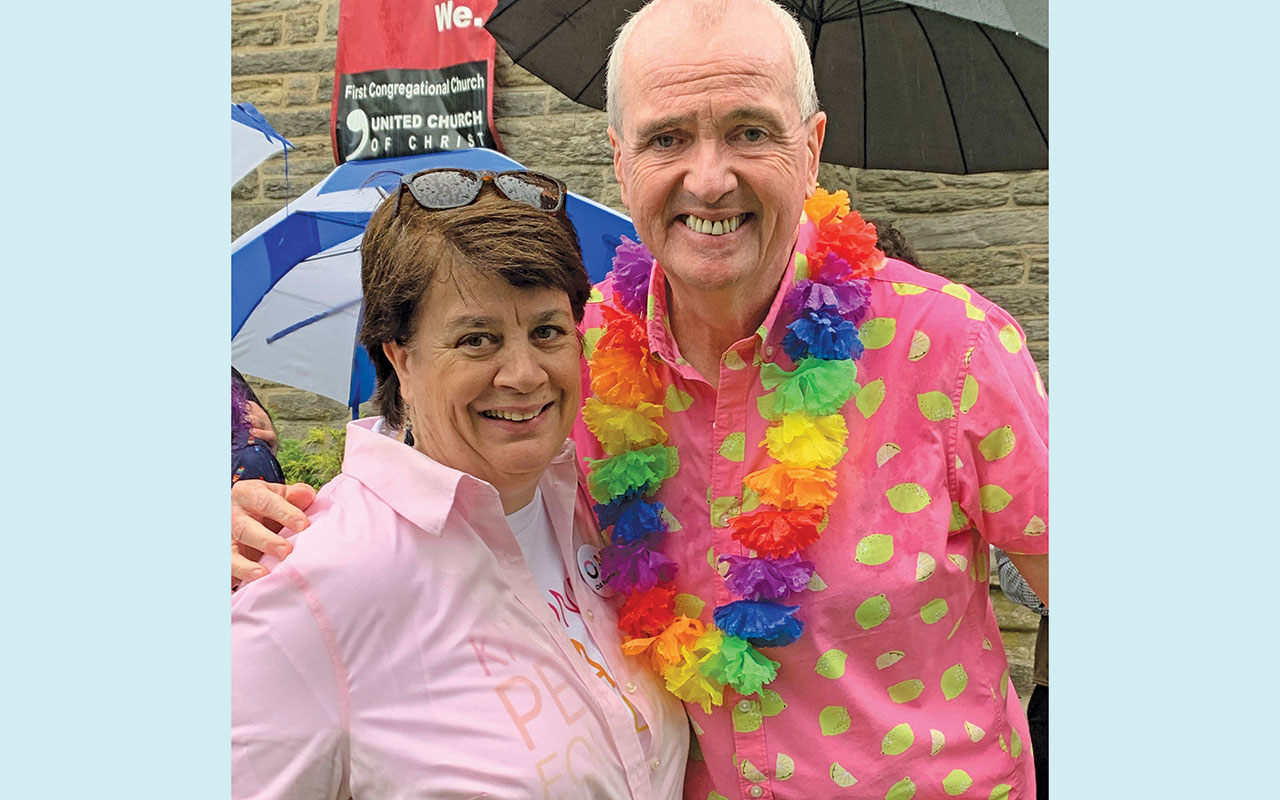
Ahearn-O’Brien herself works out of the New Brunswick office. She makes it a habit to go to many events around the state, such as those held by Garden State Equality. During Pride, she has gone to Hudson, Montclair, and others. Her favorite Pride in particular is Asbury Park, being that it has been there for such a long time and that it is as big and well-attended as it is. In her personal time, she likes to travel and see Broadway shows with her close friends and her son. Previous trips have included Alaska, LBI, and Rome.
Working with other LGBTQ organizations in the state, an example being Edge, they have done trips to Washington, D.C. in the past to talk with legislators, and collectively improve on public policy work.
Ahearn-O’Brien has become acquainted with the idea that Hyacinth is New Jersey’s best kept secret. As it employs 110 people and manages an $11 million budget, it is rather interesting that such a big group is as unknown in some circles as it is. But for all of their work, though it may go under the radar, Hyacinth and Ahearn-O’Brien are hoping to give services and resources to those most affected by HIV/AIDS. Though anti-discriminatory laws in housing have been long interpreted to include protections for HIV-positive tenants, it is still difficult at times for such prospective tenants to gain proper housing.
Through this work, Hyacinth and Ahearn-O’Brien hope to create a better and safer community for those they serve.


