At Princeton University, in 1937, famed black soprano Marian Anderson gave a well-received concert. Later that night, her hotel, the Nassau Inn, denied her access to the room she had reserved. Upon learning of this, Albert Einstein, an admirer of hers, immediately invited Miss Anderson to stay at his home — the beginning of a life long friendship between them.
That starts the action of Deborah Brevoort’s play My Lord, What a Night, presented at the George Street Playhouse. Directed by the esteemed Sheldon Epps, the play speculates on the conversation between Einstein and Anderson, ranging from music to segregation to anti-semitism to publicity. While reporters swarm on Einstein’s lawn, the pair are visited by two other people.





Abraham Flexner, head of the Institute for Advanced Study at Princeton, is trying to avoid any hint of scandal. After all, Einstein is a single white man and Anderson is an unchaperoned black woman, and he thinks it best if Anderson goes to the black YWCA for the night.
Mary Church Terrell, activist and founder of the National Association of Colored Women, thinks Anderson should go back to the Nassau Inn and demand a room, leading a protest — or at the very least make a statement to the press denouncing her treatment. Anderson is offended by Flexner’s implications, and sees Terrell’s plans as imperiling her career.
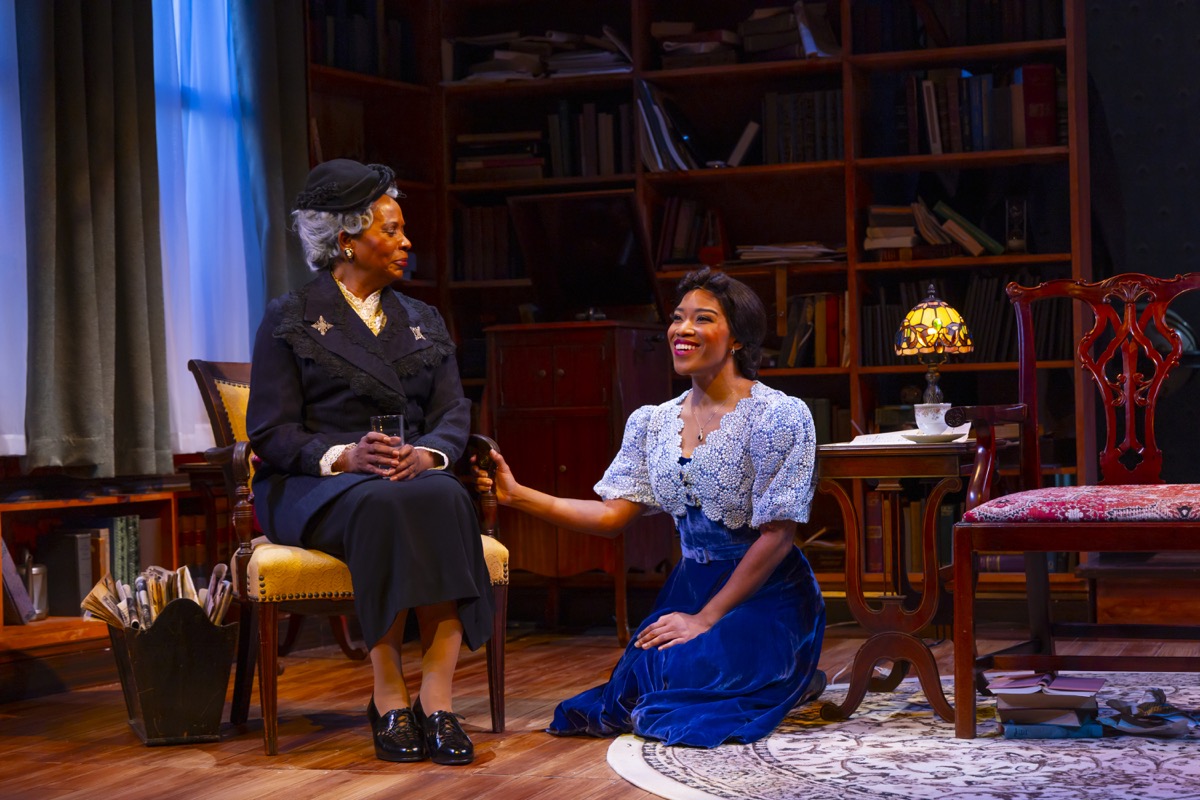
The play moves forward to 1939, as Anderson accepts Einstein’s invitation to stay with him when she is singing locally. Meanwhile, she has tried to book a concert at Washington’s Constitution Hall, owned by the Daughters of the American Revolution (DAR), only to be rejected on segregationist grounds. He also has just learned that the atom has been split, and that the Nazis are trying to create weapons of incredible destructive power.
Both of them are unsure what, if anything, they can do to have an effect.They are again visited by Flexner and Terrell. Flexner urges Einstein to write to the President and warn him of this imminent threat, but Einstein counters that there’s no guarantee that Roosevelt will even read the letter. Terrell once again urges Anderson to confront her oppressors, either by leading a protest or issuing a statement against the DAR’s leadership. But Anderson is loath to do either, concerned with the potential harm to her career and unsure how she by herself can have any effect.






Epps directs a talented cast. Anthony Cochrane is a self-deprecating Einstein, his basic decency and humanity evident in word and deed, yet worried that his most creative days are behind him. Rashidra Scott as Marian Anderson presents us with an uncertain young black woman, all too aware of societal restrictions, coming into her own. She also favors us with a beautiful, powerful singing voice in the rare moments the script allows her to do so. The Abraham Flexner of Mitch Greenberg is a man having to walk his own mental tightrope daily: being aware of his position as a Jew in the tightly Gentile environs of the town and its university, trying to please funders of his institute while doing all he can to rescue Jewish scientists from the Nazis. Gayle Samuels’ portrayal of Mary Church Terrell shows us a genteel, determined warrior for women’s rights and racial equality, a bit too devoted to tried-and-true methods but painfully aware that her time may be running out.
The set, designed by Meghan Raham and lit by Katy Atwell and Jeff Croiter, portrays Einstein’s living room/office as an extension of his rumpled, unpretentious self. Karen Petty’s costumes, especially those of the women, give off the aura of mid-1930s glamor.













While My Lord, What a Night has a solid tale to tell, there are a number of lines that land with a thud despite the best efforts of Epps and his cast. Ms. Brevoort could, with some judicious trimming and some clunky lines made more naturalistic, cause a decent play to become a fine one. And having Rashidra Scott unleash that sublime voice a little more often would not be a bad idea, either. As a play depicting an overlooked episode in the American story, My Lord, What a Night does a workmanlike job, and I recommend you see it.
My Lord, What a Night is presented by the George Street Playhouse in the Arthur Laurents Theatre at the New Brunswick Performing Arts Center through May 17, 2026. For more information, or to purchase tickets, go to georgestreetplayhouse.org.