
New technology is a wonderful thing. Programs and algorithms can track your usage of them, discern patterns of behavior, and influence that behavior. And surely there is no person, no company, no organization, no government that would ever use the abilities of those algorithms for less than savory purposes.
Be afraid. Be very afraid.





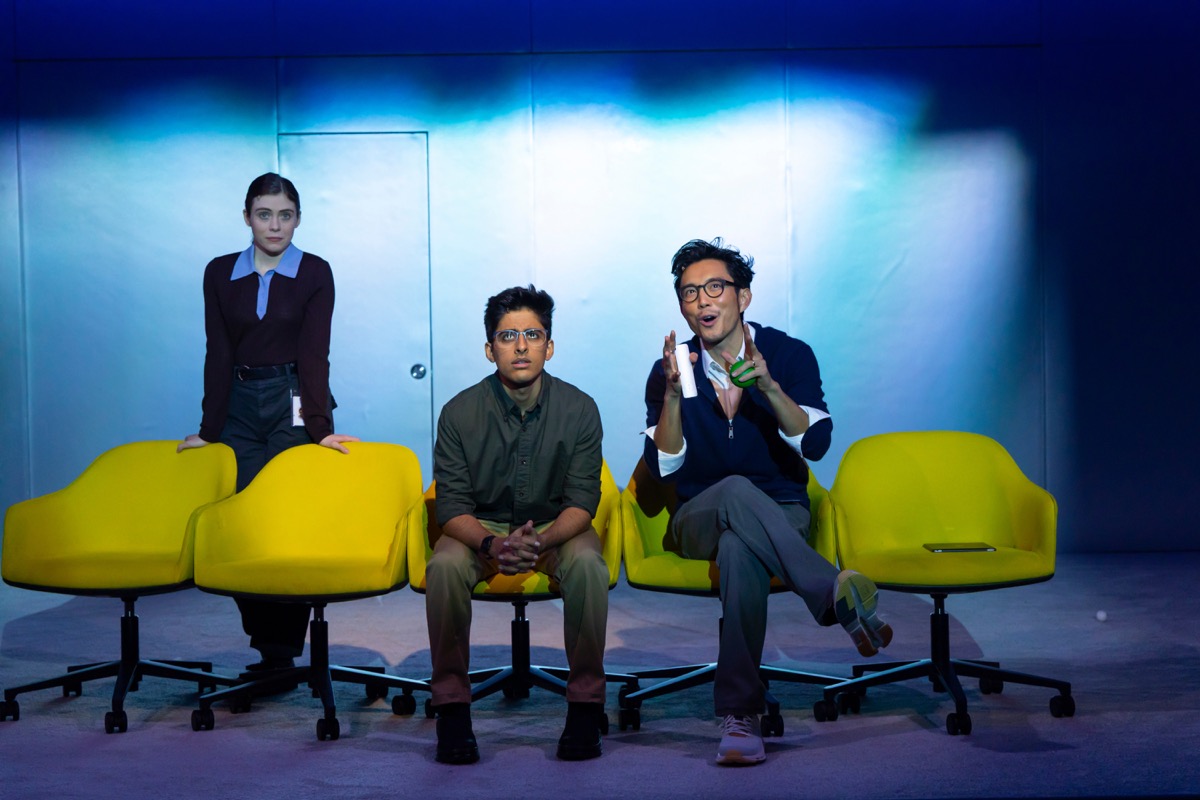
Data, a new play by Matthew Libby, is a suspense thriller with an overlay of modern-day anxieties. It revolves around Maneesh (Karan Brar), a mathematical genius with career-controlling parents, a younger brother who has perhaps stayed too long in his sibling’s shadow. Self-deprecating and passive to a fault, Maneesh has recently been employed by a cutting-edge technology company in their user interface department. His frat-boy-like protegeur, Jonah (Brandon Flynn), would kill to get onto the glamorous data analysis team, currently working on a top-secret project for the government. Riley (Sophia Lillis), a former classmate of Maneesh, is on the data analysis team and hopes Maneesh will join it.
It seems that Maneesh, for a college project, developed an algorithm that technologically is light-years beyond any other, capable of analyzing for and predicting anomalies — those strange out-of-left-field events for which no one else would dream of looking. He applied the algorithm to baseball with startlingly accurate results, then erased all traces of it and stored it away, maintaining ownership so that no one else could use it.
Riley has filled out a job transfer request for Maneesh without his knowledge and submitted it to her boss, Alex (Justin H. Min). Alex is impressed with Maneesh’s credentials, especially his college work. But Alex wonders why someone with Maneesh’s talents didn’t apply to be in data analysis, preferring the relatively dull world of user interface. Maneesh’s reluctance to be recruited into data analysis, unlike most of the firm’s other employees, is a challenge to Alex.
But it seems everyone at the firm has secrets, and too many people are starting to wonder about Maneesh’s algorithm. Alex’ bosses are putting pressure on him and his team to perform. Jonah desires to know the secrets behind the top secret projects of the data analysis group. Riley is increasingly uneasy about the client and the project Alex’ team is developing for them. And Maneesh wants nothing more than to be ignored and overlooked.




Under Tyne Rafaeli’s skillful direction, Data starts slowly, with that creepy feeling just under your senses, increasing the pressure and suspense step by agonizing step until you can no longer see anyone as truly innocent or truly guilty. His talented cast bring formidable acting talents to play — Brandon Flynn’s sly frat-boy stupidity; Justin H. Min’s smooth corporate facade hiding a corrupt, equivocating nature; Sophia Lillis’ slightly egocentric earnestness; and above them all, Karan Barr’s weak integrity born of a knowledge that his work can be used with horrifying consequences and a desire to have himself and that knowledge be overlooked and ignored. Unfortunately, everyone wants to use Maneesh for their own ends, including his parents, so no one is willing or able to give him the anonymity he craves.
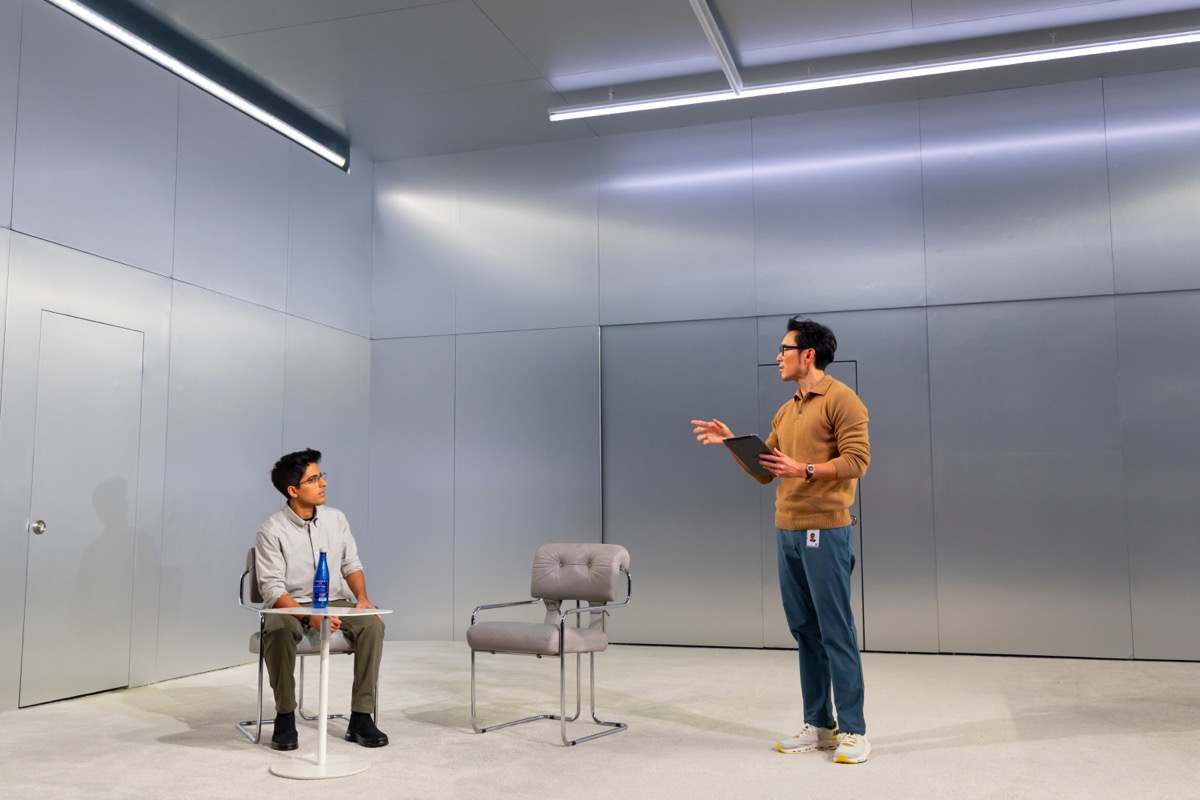
The suspense of Data is enhanced by the set, a monochrome series of large, nearly empty rooms either too brightly lit or, in an outdoors scene, almost impenetrably shadowy. These are spaces, designed by Marsha Ginsberg and lit by Amith Chandrashaker, designed to irritate the eye, letting the characters take the attention and thus reveal their flaws to the audience.













Data is a singularly powerful play, skillfully playing off humanity’s long-standing fear of new technologies and their uses – and abuses. This is a play for serious adults and theatre-goers who enjoy the frisson of suspense in their dramas. I strongly encourage you to make the trip to off-Broadway’s Lucille Lortel Theatre and get your fill of chills from Data.
Data is presented at the Lucille Lortel Theatre, 121 Christopher St. in New York City, through Mar. 29, 2026. For more information, or to purchase tickets, go to boxoffice.lortel.org.