For many of us, the concept of sumo is what we see briefly every four years at the Olympics. Extremely large men wearing loincloths try to push each other out of a ring or get each other to fall down. But sumo is more than just stylized Japanese wrestling: it is a way of life, an austere, cloistered brotherhood, living under rules laid down by the Shinto religion and steeped in centuries of tradition.
A look into the larger world of sumo is what playwright Lisa Sanaye Dring puts before us in her new play SUMO, now playing at the Public Theater in New York.





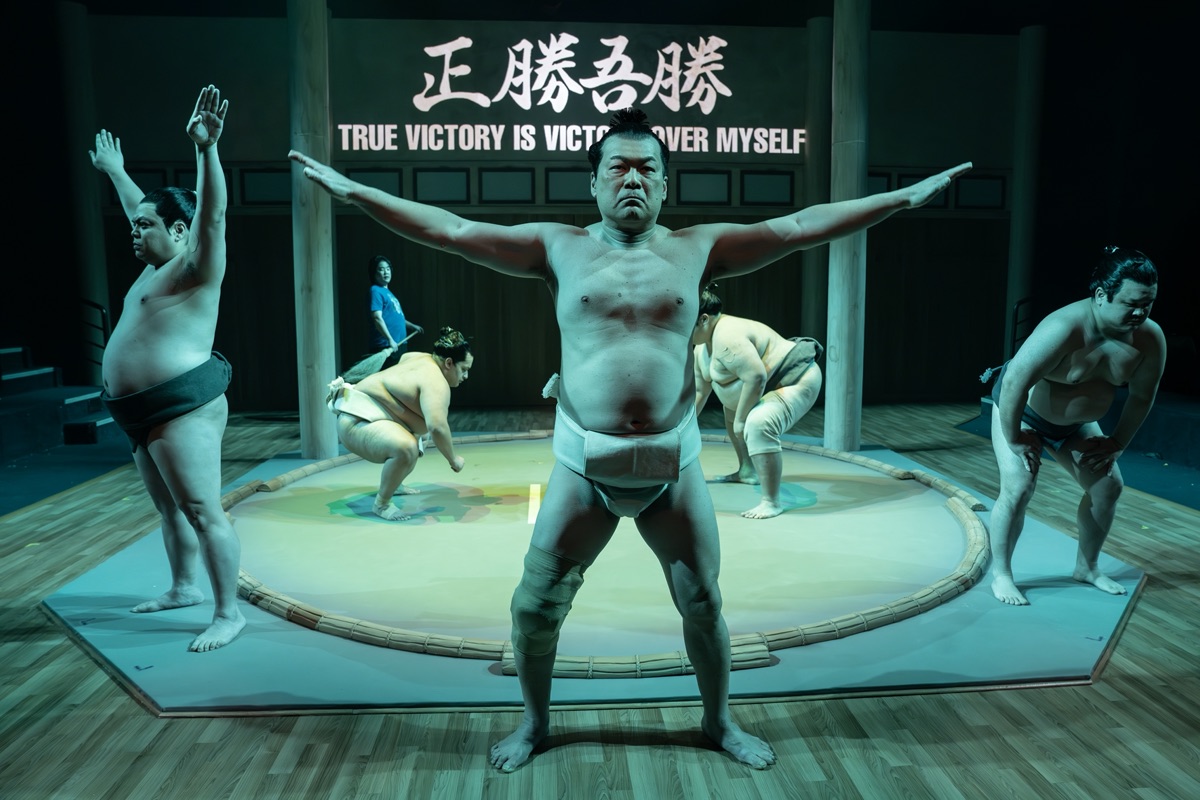
In its simplest form, SUMO is the story of Akio (Scott Keiji Takeda), the newest recruit in the heya (training stable) run by master wrestler Mitsuo (David Shih). Expecting a life of fame and comradery, Akio is instead introduced to the life of the lowest rank, or jonokuchi: to perform the most menial tasks; never to speak unless spoken to; to learn humility first before learning the art of sumo at its higher levels. Mitsuo, who sees himself in the younger Akio, begins to impart his hard-learned lessons to the youngster — sometimes to the disapproval of stable-mates at higher levels.
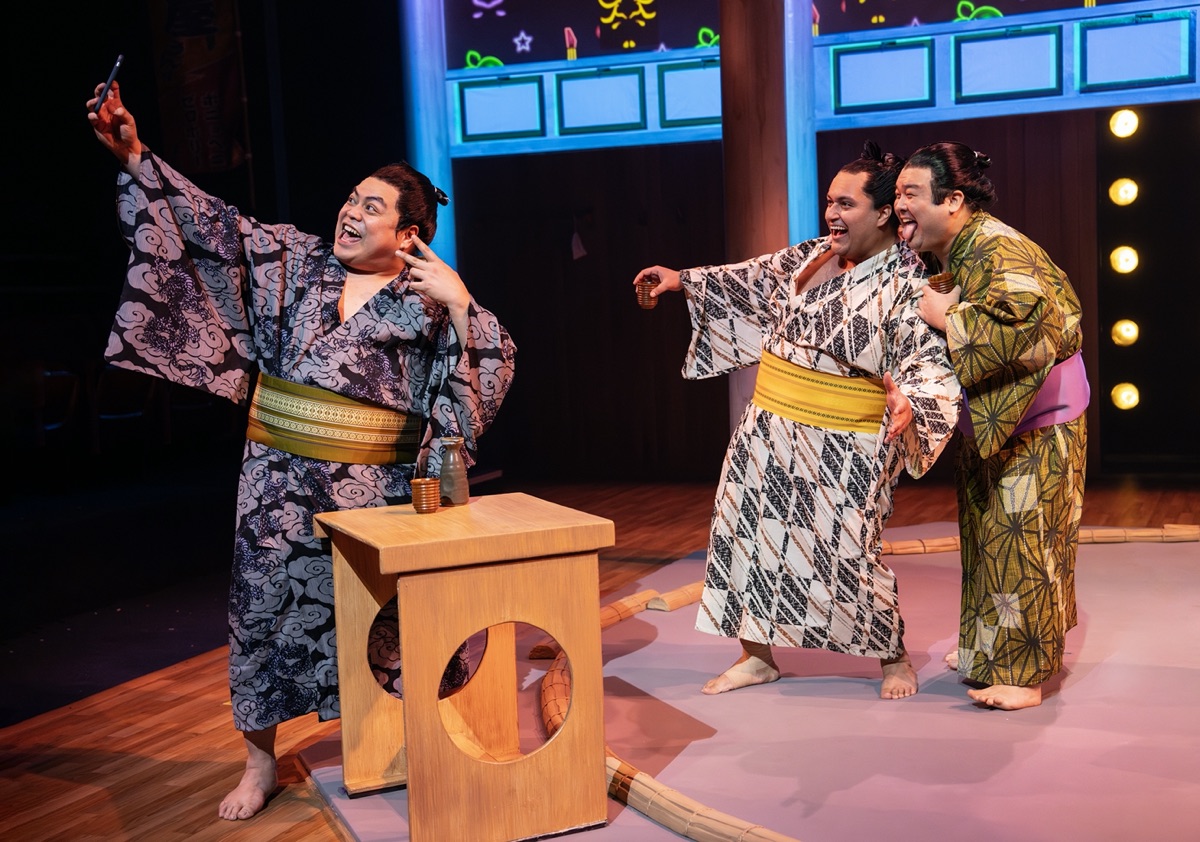
Mitsuo’s heya members compete against each other as well as members of other heyas at major sumo tournaments, or honbasho, held every other month. We watch as Akio, a crafty learner blessed with natural talent, rises among the ranks. But we also see the backstage dramas among the members of Mitsuo’s heya: the forbidden love between the closeted Fumio (Red Concepciòn) and the secretly romantic Ren (Ahmad Kamal); Shinta (Earl T. Kim), an outwardly placid giant under overpowering pressure to perform flawless ritual movements; and So (Michael Hisamoto), deeply in love with the world of sumo yet painfully realizing all his training will not take him any further than he now is.
There is also conflict over Akio’s soul. Mitsuo drums into him that there is no place for emotions in sumo, and that victory is the only worthy achievement. Akio’s stable-mates reveal the consequences of devotion to sumo — the loss and emptiness exclusion of the outside world brings to those who cannot rise to great heights.
The cast is under the direction of Ralph B. Peña, producing artistic director of Ma-Yi Theater Company, New York City’s Asian-American theatre company which is co-producing SUMO with the Public Theatre. Peña, who is Filipino-American and one of Ma-Yi’s founding members, brings his years of experience to bear on playwright Dring’s work, and brings with his cast a collaborative world of Japanese tradition and concepts of masculinity to life.






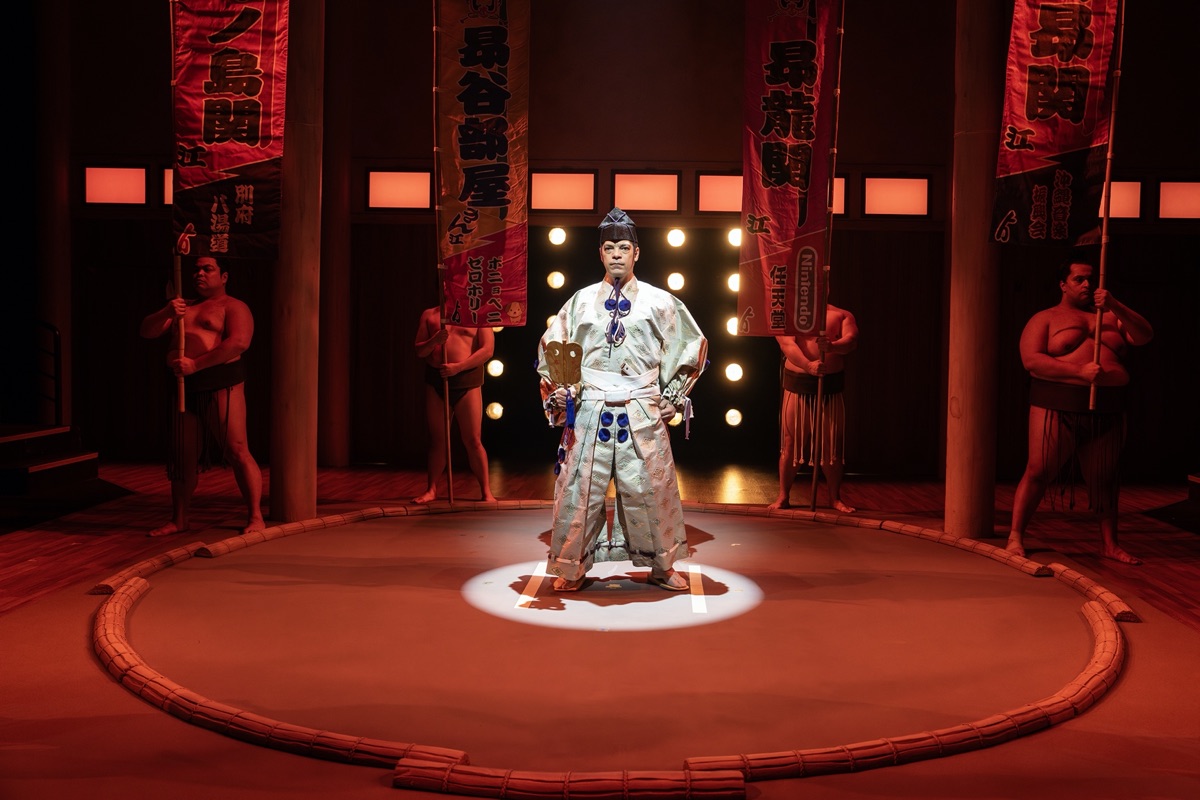
Worth noting is the quicksilver nature of the three Kannushi, Shinto priests who serve as the audience’s guides to the world of the play. Embodied by Kris Bona, Paco Tolson, and Viet Vo, the Kannushi play multiple roles within the story, from priests to referees, from big-money sponsors to lowly jonokuchi, and even powerful elemental Shinto gods.
Taiko drummer-composer Shih-Wei Wu performs high over the stage, with primal rhythms ushering us into each act and punctuating the battles at the honbasho. Fight co-directors James Yaegashi and Chelsea Pace create a solidly masculine ballet within the bounds of the dohyo (ritual wrestling ring) designed by Wilson Chin. Yaegashi is also the show’s sumo consultant, while Pace is the intimacy director.










SUMO is an eye-opening play, giving us a look into a world of masculinity, brotherhood, asceticism, sacrifice, and, yes, even love that is uniquely Japanese — far from Western traditions, perhaps, but with great power and beauty nonetheless. I strongly encourage you to see a drama of passion and ambition told with humanity and humor. Enter the world of SUMO!
SUMO is presented by the Public Theater and the Ma-Yi Theater Company at the Anspacher Theatre within the Public Theatre, 425 Lafayette St. in New York, through Mar. 30, 2025. For more information or to purchase tickets, go to publictheater.org.