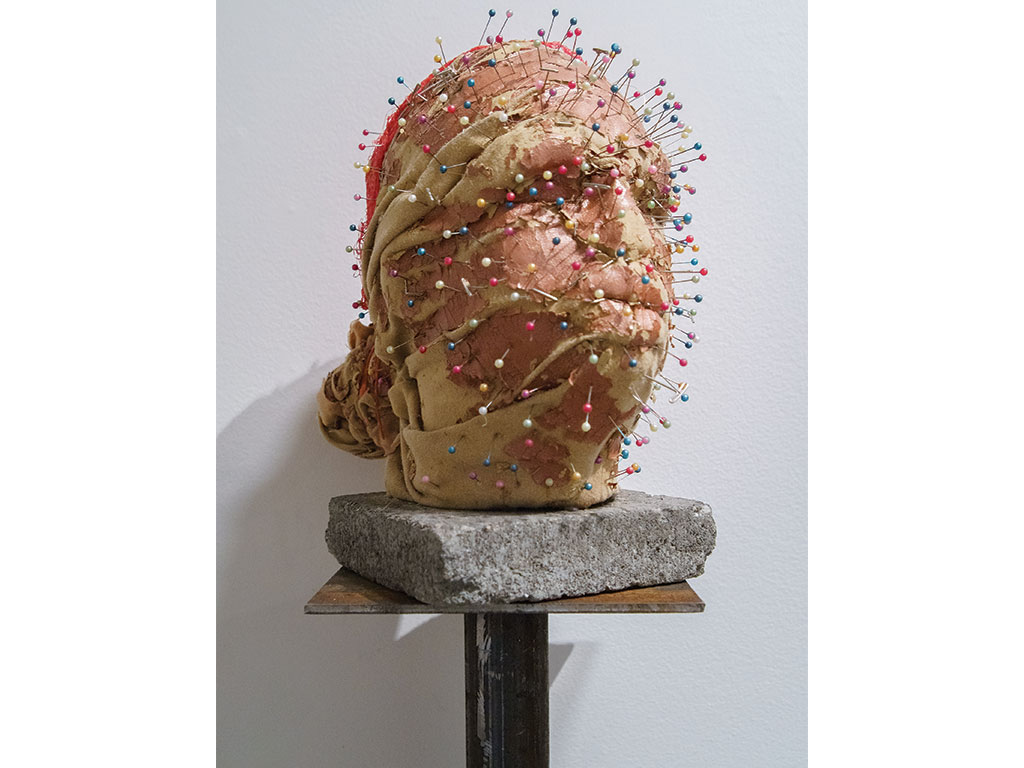
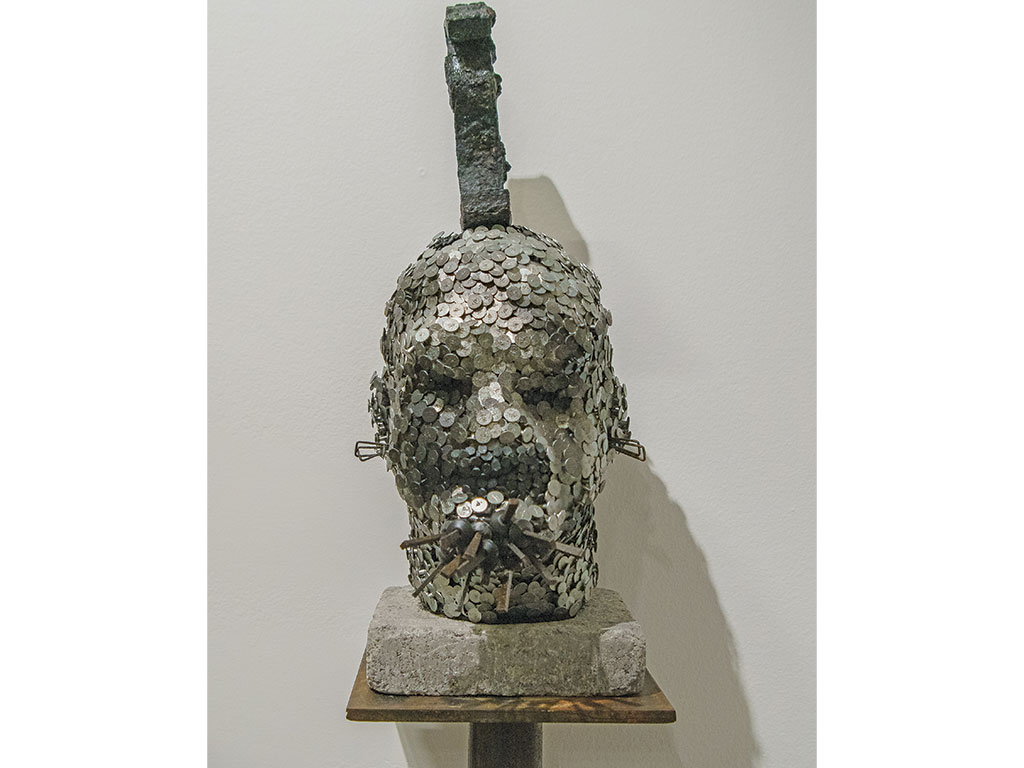
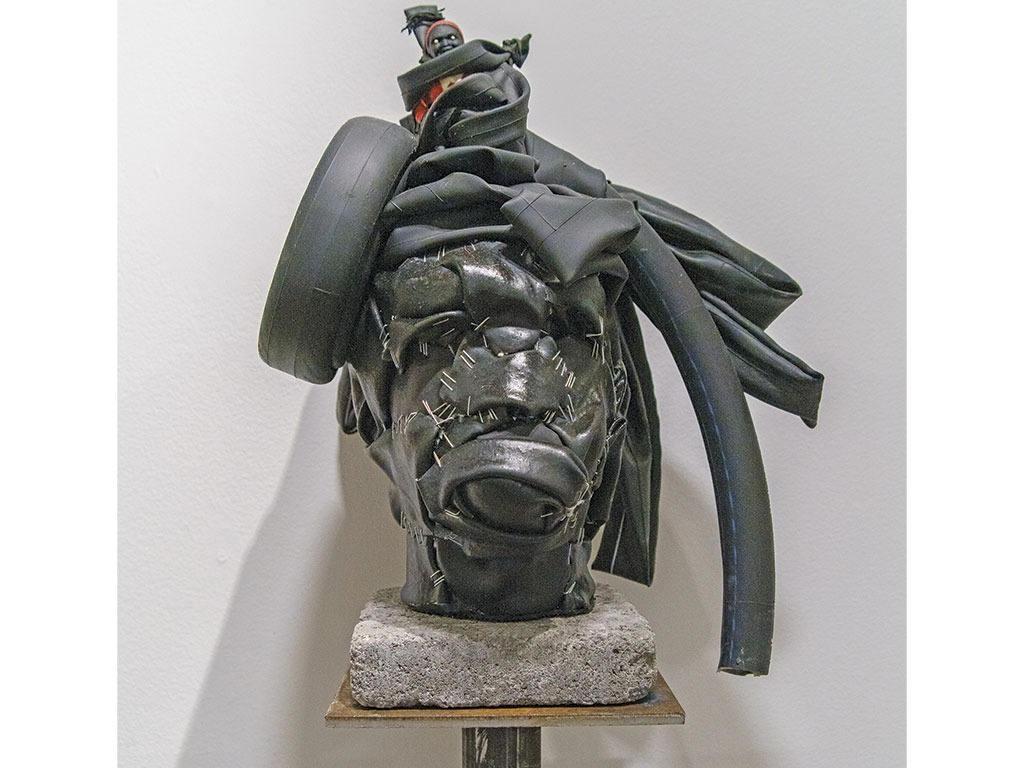
I saw a picture in Montclair Local promoting an exhibit by Montclair artist Richard Gaines. It was a black leather head with needles stuck in it, like a more ominous version of the character Pinhead from the Hellraiser films. I went to the exhibit, “All Things Considered,” at Montclair’s adventurous BrassWorks Gallery. When I walked in that head was the first thing I saw, and it stopped me in my tracks. Its pain was palpable. There were more heads like it in different colors with different means of torture: nails, spikes, shells. Right off the bat, Richard Gaines’ work did what he wanted it to: it made me stop, look, and think.
He calls these pieces “Headgear” and Spike Lee owns one of them. “The ‘Headgear’ series are busts of black men and women and the armor they wear to get through life,“ Gaines says.





One piece, Headgear 11, is dedicated to the trans community. “The pins represent the extra protection trans people need to survive.”
Another piece, Headgear 7, honors Sakia Gunn, a 15-year-old African American lesbian who was murdered in cold blood at a Newark bus stop in 2003 after she rejected a man’s advances.
With the “Headgear” series, Gaines, who is gay, found a way to make beautiful work and strong political statements at the same time.
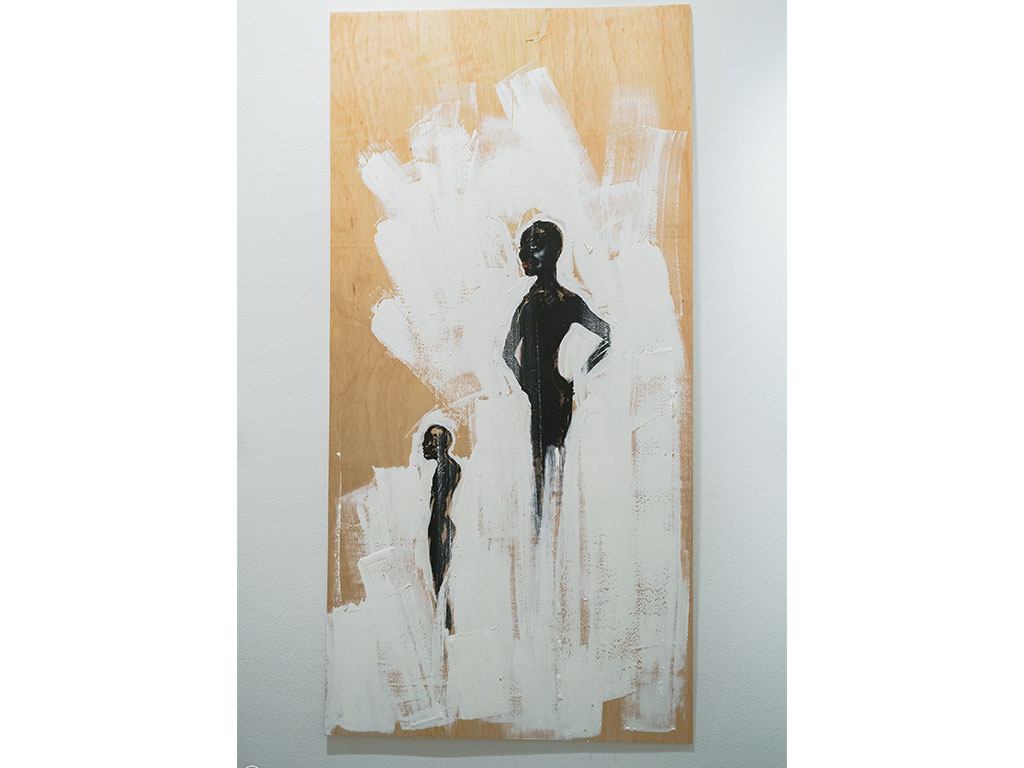
“All Things Considered” was filled with arresting images: portraits made from wood chips; mirrors draped with frayed rope; scrap wood in the shape of a tree; and small brown faces crammed into buckets. The Bravitas Group owns several distinctive properties in New Jersey and uses their hallways and free spaces for artists to show their work pro bono. They encouraged Richard to go for broke with this show.





I saw Gaines on the other side of the room talking to guests. You couldn’t miss him.
Six feet, six inches tall, with rugged features, and dressed in black, he looked intimidating, like a Marvel action hero (or villain). He turned out to be warm and charming, with a deep voice and a hearty laugh.












Richard Gaines is a dedicated walker; it’s how he gets his ideas and materials. “Wood chips, glass, gravel, scrap metal, etc.; these materials I find in my wandering through the streets of my neighborhood,” he says. Rope is another frequent element in his work with its disturbing echoes of black history. When he frays it, it can represent all kinds of hair. For Gaines, the medium is the message. He allows the concept to emerge from the materials he finds.
His work examines how black men are viewed by those who are not black. His sardonic humor skews racial stereotypes to expose the ridiculous, contradictory, and dangerous roots of racism. Gaines views the black male experience from the inside out, beyond the white gaze.
When I visited his home studio in Montclair, he proudly showed me a mahogany door he had just found. What he doesn’t find in his travels, he buys at American Royal Hardware in Montclair where they know him well. After we parted one day he was on his way to Home Depot, a couple of miles away, for more supplies.
Richard and his sister, Dana, were born in Newark and the socially conscious family moved to Montclair in the late 1960s. His mother, Marie, was an administrator in the Newark system and his father, Richard Sr., had been a professional basketball player who became an educator. With his height, it was assumed by some that Richard would play basketball too. No, you do you, his dad said. The family loved Broadway theater and one of Richard’s early influences was the caricaturist Al Hirschfeld, whose theatrical sketches were a beloved feature in The New York Times for many years.
Richard went to Montclair High, a great school, but he often played hooky and took the bus to New York City where he drank in the lively atmosphere of Washington Square Park. As it got close to graduation he heard about Portfolio Day at the Pratt Institute and with no formal training put together a presentation in two days. Remarkably, it got him accepted at four art schools. He chose the School of Visual Arts, where he hung out with Keith Haring, and moved to Manhattan. After graduation, he needed a job; through his mother, he became a teacher. He eventually landed a job he loved at the Regional Day School in Newark where he worked with children with autism and spearheaded a program between the Newark school system and the Montclair Art Museum. He lived in Manhattan during this time and did not make art again for 30 years.
Richard retired from teaching in 2017 and started making work again. He moved back to Montclair in 2020 just as the pandemic took hold. When George Floyd was murdered, “the knee on the neck” and all the images he saw on CNN angered and inspired him. Homebound, he poured himself into his work using all his history (his grandfather was killed by white men on his way home from work and his body was thrown onto train tracks). He had pent-up artistic energy to make art about society’s impact on black men.
The Bravitas show was a great success, generating interest from curators and people who actually buy art. His studio gets a lot of visitors these days.
He is one of the few men invited to show at a new exhibition, Women Heavy at Gardenship, gardenship.art, an inclusive artist-led interdisciplinary makerspace founded in 2019. They are soon moving to Montclair from a two-acre warehouse in Kearny Point, N.J. Once a grim industrial area, it is a new business and arts hub that includes two film studios, including Palisade Stages where parts of the movie Bros was filmed.
There are also collaborations in the works, including two projects with Brooklyn-based filmmakers like Kenneth Sousie.
With his keen eye, his skill, his history, and big heart, Richard Gaines’ art connects the dots between our troubled past, our volatile present, and what he hopes — we all hope — is a brighter future.