Reading is one of the oldest and most accessible pleasures available. Bookstores sprawl across the state, and with the rise in literary interest — thanks in part to online trends like BookTok pulling in readers — bookstore owners are seeing an increase in people entering their doors. Yet, where one might expect a state like New Jersey to host swathes of queer-owned, queer-centric bookstores, there are only three.
Here’s The Story Bookstore, Union





Here’s The Story Bookstore opened its doors in Union in 1995, making it the oldest queer-owned bookstore in the state. It sits at the heart of Union Center, the town’s shop-filled downtown area. Over the years, it has become a staple for residents.
Joe Leo, the store’s owner, got his start in the book-selling business early. “I started in high school at the local bookstore here in Union. … They opened up a video section, which I got hired in, and that was in 1987. Eventually I segued into the book section,” Leo said.
He worked there until its closing in 1995. The owner had another bookstore in Flemington to take care of, and competition from large chains had made business unsustainable.
“Then I was thinking, ‘I could do this.’ The whole store was out — vacant — so I reached out to the people in town, and they were like ‘Yeah, we would love to continue having a bookstore.’ So I just said, ‘What the hell?’ I was 25, and I had savings. I had nothing to lose at that point,” Leo said.






Since then, Here’s The Story has been going strong for the last three decades. Through that time, Leo found that the best model to follow was to create a store everyone would feel welcome in. He began investing more into offering a diverse range of books from authors from different walks of life and different genres — especially those targeted to younger audiences.
“I’ve always had diverse [books] for adults, but when I really expanded the kids section, I wanted to make sure that kids especially [had books] because when I was growing up, there were no gay books. It was rare, rare. I’d have to get The Outsiders, or something. I read a lot as a kid, but there was never anything for gay kids, so I make sure [I have books for] toddlers all the way up to young adults. I’ve always had stuff for LGBTQ kids, and then some, because I want every kid to walk in here and see themselves on the shelf. Always,” Leo said.













That lack of representation Leo experienced in his youth in no small part inspires the strong anti-censorship conviction he holds today, even going as far as to display a “banned books” selection at the counter.
Having grown up in Union and lived there for most of his life, Leo feels a sense of responsibility for the town. A passion for community outreach led Leo to become engaged in Union’s local government. He became a member of the Union Center Special Improvement District in 2006.
The SID focuses on vitalizing Union Center through promotional and marketing events. Leo has served in a number of different positions on the board, including president, over the past two decades. Currently he is the SID’s vice president.
“It’s an organization that was started in the early ‘90s that focuses on the downtown. There’s others in the state, but [this one] focuses on doing events, promotions, things to help promote the businesses in the town. And I’m a huge supporter of that because I think that the small businesses — of this town or any town — are the backbone of everything,” he said.
Leo’s involvement even extended to working with the school district. Collaborating with a close friend who happened to be the head of the English department at Union High School, Leo was able to offer the bookstore’s resources to students.
“I provide books to the school system. I’ve done book fairs, summer reading fairs. I’ve done purchase orders, given books away and stuff like that. I’ve always been involved with the school system and the township,” Leo said.
When COVID-19 swept the country and shut down most businesses, Here’s the Story held strong. Leo discovered that people were searching for solace in the confines of their homes and ended up finding it between the pages of a good book.
“I was never closed during COVID. COVID was a game changer. I kept the door locked like I was supposed to, and I was letting people in cautiously. People were getting sick of everything digital: Zoom, Netflix, talking on your phone — everything became screens, screens, screens,” he said.
“I noticed that people really wanted to get back to the comfort of holding a good book — an actual book.”
Here’s The Story was met with an influx of socially distanced shopgoers and online orders during the pandemic, which Leo was happy to accommodate. He would even deliver books to the doorsteps of his customers.
“I noticed that people really wanted to get back to the comfort of holding a good book — an actual book. There is a certain comfort in a book; it’s a sense memory that brought you back to a time, especially if you were a kid that read. The touch, the smell, the imagination, using your brain. I noticed that people were getting back into reading on paper, which was great, and business totally turned around since then,” he said.
When lockdowns were lifted and the pandemic began to die down, business did recede, but Leo maintains a hopeful outlook for the future of his store. In the 30 years since Here’s The Story opened its doors, he has certainly taken a few risks, not all of which have panned out.
“I always feel like if it’s good for the business, I’m happy to try it. I used to have a video [section] back there. It was great extra business, but eventually it died off. OK, adapt, close it. If it works, great. If it doesn’t, move on. That’s it. That’s the motto. But, you know, my instincts are good,” Leo said.
Here’s The Story sits squarely on Stuyvesant Avenue in Union Center and doesn’t seem to be going anywhere anytime soon. Leo has seen generations of readers peruse his shelves and hopes everyone can find a book they’ll love.
As for his latest venture, Leo has taken up promoting the store on social media through comedic videos, which he stars in.
Wolfe & Kron Books, Asbury Park
A bit of a drive south on the Parkway from Union in Asbury Park is Wolfe & Kron Books, a speculative fiction bookstore owned by Fin, who uses she/they pronouns and preferred their last name not be used. The store is nestled in a small space on Fifth Avenue and features a blue tin ceiling and exposed brick walls decorated with wooden shelves.
Fin also got their start in the book business early. Their first job was working at Borders, a former book retailer that has since been absorbed into Barnes & Noble.
“I loved working as a bookseller. I told my parents that I wanted to be a bookseller forever, and they were both horrified because they didn’t think I’d be able to make any money doing that,” Fin said.
That was in 1997. Fin moved to Asbury Park in February of 2020. COVID followed only a month later.
“When things started to open back up, I wound up first helping out at, then became the co-owner of, a little used bookstore in Belmar. They’d been there for a long time. I was helping to bring it up to speed by way of modern businesses and trying to do some renovation on it, and my co-owner wasn’t really wild about that, so we ended up parting ways.”
Still set on selling books but put at a loss for next steps after losing work, Fin spent some time exploring their options.
They said they wandered into Collingswood Auction and Flea Market and saw a big space had just opened up. “I [thought] it would be cool to have this little magic secret bookstore, hidden in the midst of, what’s otherwise, a weird place. Not the place you would expect to find a well-curated, well-laid out, alphabetized bookstore,” Fin said.
“Life is too short to read a bad book. You should just put it down and read something else.”
It was there that Wolfe & Kron was born, named after their grandmother, who enamored Fin with reading in the first place.
“My grandmother was a big reader. She was also a brutal player of Scrabble, and I have this wonderful memory of her when I was probably around 11. I [said,] ‘Oh this book is so boring,’ and she turned and said, ‘Life is too short to read a bad book. You should just put it down and read something else,’ in this sort of grand way that she had. My mother was standing behind me, and she said, ‘Except for if it’s a school book, you still have to read those,’ and what my mom didn’t see was my grandmother just shaking her head and sort of waving that off,” Fin said.
Wolfe & Kron remained in the flea market for just a year. Its hours were too restrictive for how Fin wanted to run the bookstore, so they started looking for a new space.
“I found this place right next to Georgies, and it seemed like the punchline to a joke — the queer bookstore opens up next to the gay bar. It had everything that I was looking for,” they said.
After a few months of renovations, Wolfe & Kron opened its doors in uptown Asbury Park. The store hosts a specialized catalogue of queer and BIPOC speculative fiction books for readers to choose from, which Fin curates to present foremost perspectives that aren’t shown quite as often.
“I’ve really leaned into being a specialty bookstore, where we do queer speculative fiction with some exceptions by way of the used books we have in here. Speculative fiction [is] a very broad definition that’s sci-fi, fantasy, but also horror and mystery and romance, because it’s anything that asks a ‘what if’ question.
“It’s been a slow realization that I’ve always been drawn to stories by queer authors. I think there’s something in the experience that lends itself to speculative fiction. Queer folk have always been the canaries of the coal mine, but there’s a history of having to adapt, a history of having to tell your story creatively. There’s a very strong history of queer folk using fictions in order to tell their truths,” Fin said.
The bookstore’s niche focus also helps garner attention to authors not picked up by larger chains. To that end, Fin also hosts a number of events, including author signings and interviews. The store also hosts a few book clubs, which aim to build community among readers in the area through their shared love of a book or author.
One such club was the “Asynchronous Book Club.” Instead of assigning reading for everyone to follow along to, this book club allowed readers to share a few of their favorites with one another, then find books they had in common and discuss them.
“I had folks that were coming to every single [book club], so it was very obvious there was a desire for this community connection and for that connection to be based around books. I’m really excited to continue on with the building of community through the bookstore,” Fin said.
Some of this work has been in collaboration with other businesses in the Asbury Park area. This has included restaurants and vendors closer to the boardwalk, including Paradise, a famous gay establishment like Georgies.
“Being next to Georgies was an intentional move. Georgies has been a cornerstone of the community since 1999. I really love that we have Georgies at this end of town and then Paradise at the other end of town. Kind of like it’s holding down the corners of Asbury Park and making sure we don’t forget the history of this city, which was the queer spot on the Jersey Shore for all of the ’50s, ’60s and ’70s.
“It was only in the ’80s when stuff started getting torn down and queer history started getting erased. So I’m excited to be a place where people can share that history and make new connections,” Fin said.
Wolfe & Kron’s journey hasn’t been easy. The store itself is somewhat vulnerable to flooding. During the particularly heavy rainfall in July, Fin lost a sizable amount of inventory due to water damage.
The damage indefinitely shut down the store, while they accounted for every book lost. A GoFundMe has opened to help recoup some of the losses, which is available to access via the store’s website.
Other than the short-term goal of reopening, Fin has other plans. They include a museum of genre fiction, which aims to highlight some of history’s underpublished authors, a micropress, which aims to turn Wolfe & Kron into a small independent publisher for authors, and a children’s bookstore in a second location.
Each time Wolfe & Kron has closed due to unforeseen circumstances, the store has always reopened. When it reopens this time, the store’s vast selection of books will become available to Asbury Park again.
Howling Basset Books, Lambertville
On the western side of the state, Howling Basset Books rests among the 18th-century city streets of Lambertville, just down the street from the Delaware River on North Main Street. It’s jointly owned by married couple Zohar and Lisa, who preferred their last names not be used.
Their start in the book business came later in life, beginning as a retirement plan. The couple originally hail from Brooklyn. During the pandemic, they chose to move to Pottersville to escape the suffocating lockdowns and try their hand at the quiet life.
However, given the drastic shift in environment, Zohar and Lisa found themselves rather lonely in the rural town. Although they had bounced around the idea before, the desire for community and connection drove them to open Howling Basset’s first location in Oldwick in 2022.
“It was in an old Victorian house — which was gorgeous — with a fireplace and creaking floors and a lot of charm. It immediately drew a lot of people to the store, and we started doing a lot of events and book clubs and really realized there is a need for that [there],” Zohar said.
They first considered opening a bookstore in 2008, but complications with Zohar’s residency shut those plans down. The couple moved to Canada because Zohar’s green card was denied, Zohar said. Eventually, work led them back to the states.
Both have backgrounds in academia. Lisa was chair of Drew University’s Media & Communications Department in Madison, and Zohar was a professor at the Parsons School of Design at The New School in NYC. Although neither had bookselling experience, their work exposed them to some of the industry’s crucial aspects.
“I knew the publishing world pretty well because, [in] my last academic job that I had, I was running a program where I would bring students into New York to look at the different parts of the media industries, so that helped me get a sense of where the sausage gets made,” Lisa said.
it quickly became a safe space for the local queer community.
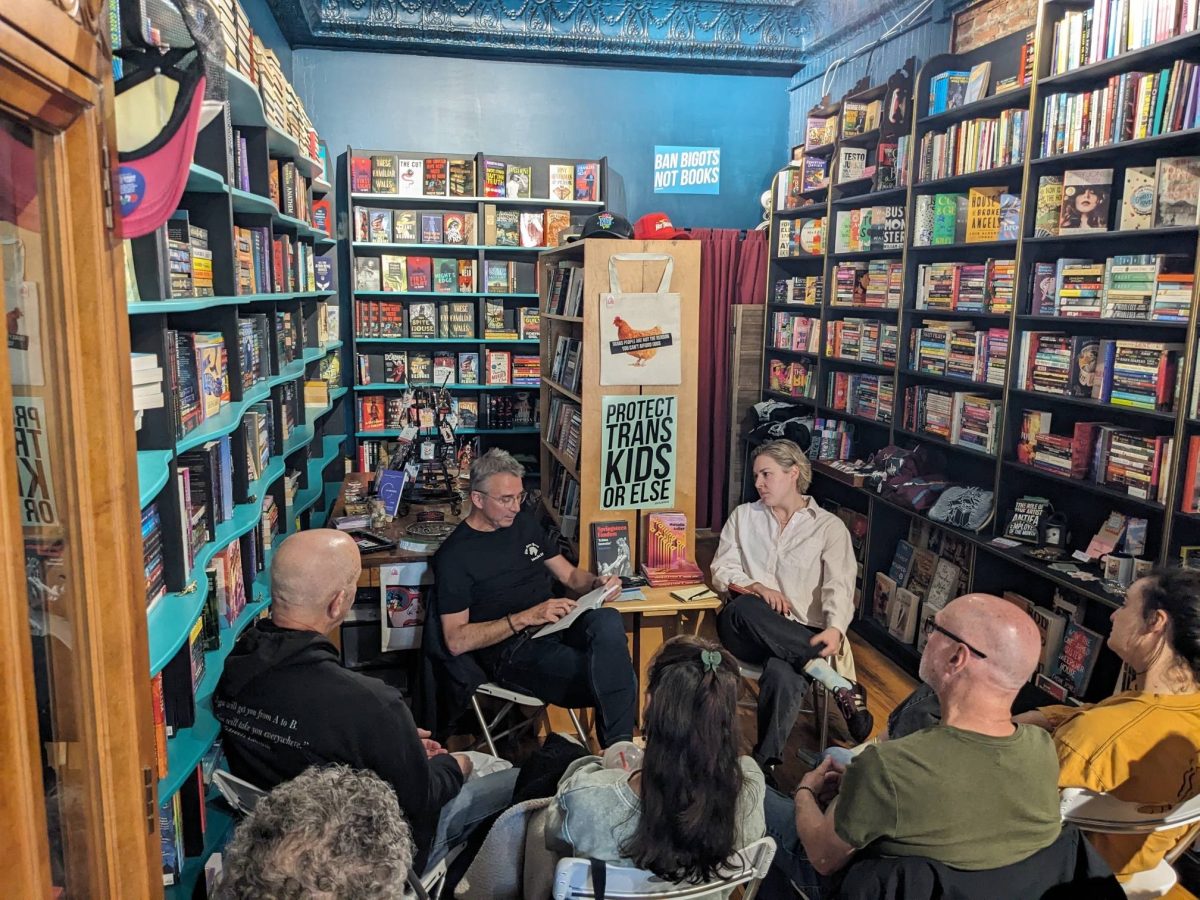
Howling Basset quickly became a hub for the area’s queer community, especially given its location in a more conservative region of the state. The bookstore hosted one book club that drew quite a lot of attention. It hosted it in collaboration with Gay Social, an LGBTQ+ event organizer group.
That “really marked us on the map, and we were also on the queer map of businesses,” Zohar said.
The store became a safe space in Oldwick, but as their daughter entered high school in Pennsylvania, they ended up needing to move. Their search led them to Lambertville, a more progressive area only a river away from the Keystone State.
“There is something [about] Lambertville that is very unique because it’s very community minded. There’s a very strong population here of young queers that are moving here to live [in] the arts and culture,” Zohar said.
Much like in Oldwick, when Howling Basset’s second location opened in 2025, it quickly became a safe space for the local queer community. Lisa and Zohar choose to cater to that community through their vast catalog and numerous themed book clubs. One, for example, is the “Hope in Dark Times” book club, which offers readers books that might alleviate some of the stresses of the constant stream of troubling news and to perhaps find solutions.
The couple finds that integrating into the community is the best philosophy for their business, and they employ that in choosing events such as an upcoming book club of theirs in collaboration with another local business.
“We were approached by a local brew pub, Odd Bird Brewing in Stockton. We’re going to do a kind of a book club with craft beers,” Lisa said.
“So that was a nice community cross pollination [when] they invited us to think about the book club with them,” Zohar said.
Howling Basset also has on its list of collaborations a fundraiser with the local library, a curated poetry event and talks with organizers and authors from the Lambertville Comic and Zine Con Festival.
Collaboration has served them well. For the future, the pair plans to continue to engage with the Lambertville community through hosting events and connecting with other local businesses.