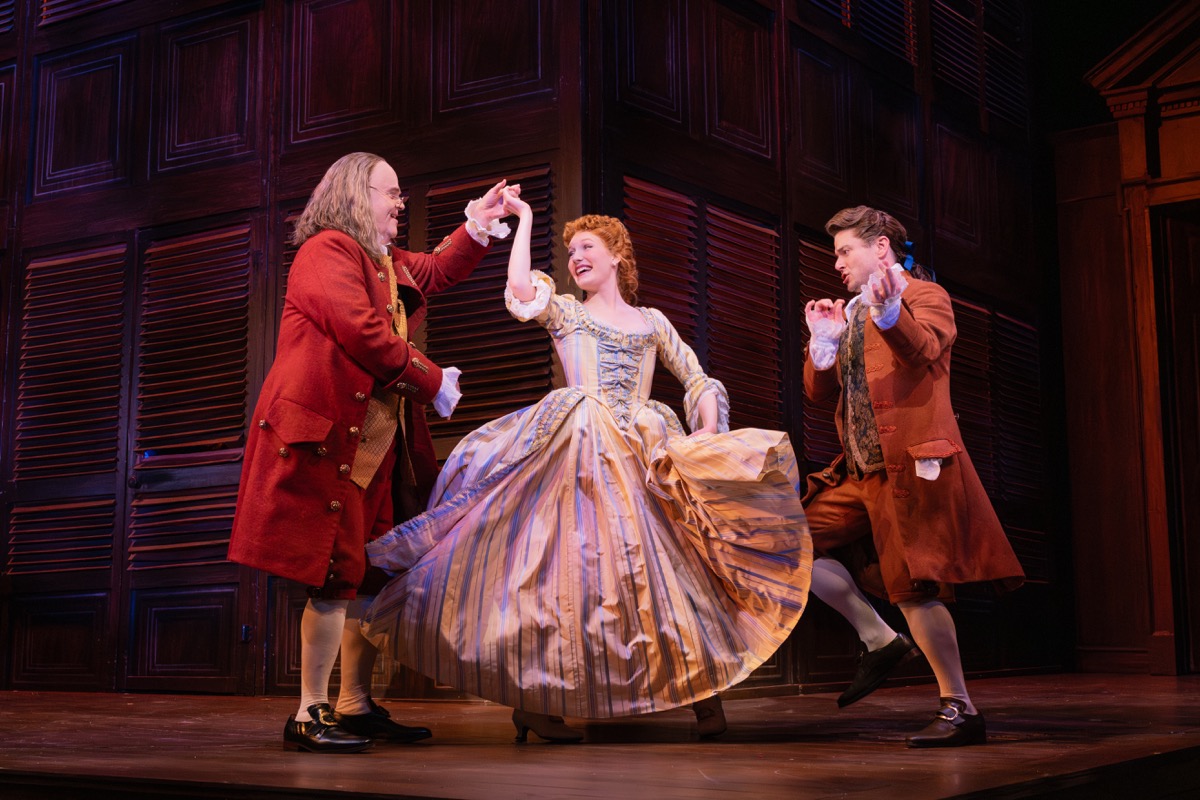
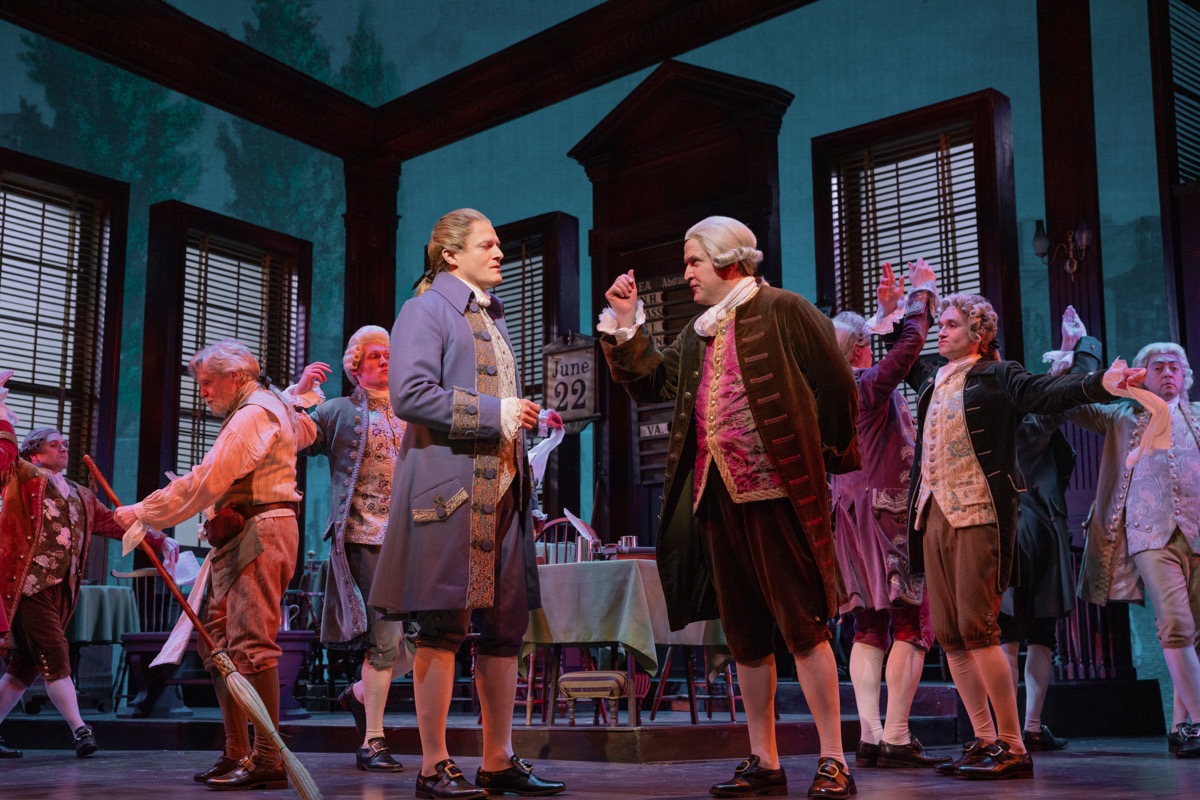
Have you ever been to a fact-based stage show where you know the outcome, yet you’re still kept in suspense up until the end? 1776, now at Millburn’s Paper Mill Playhouse, is one of those shows.
This 1969 Tony Award-winning Best Musical, with a book by Peter Stone and score by Sherman Edwards, tells the story of the creation of the Declaration of Independence. Most school history books give the bare bones: Virginian Thomas Jefferson wrote it; Boston’s John Adams and Philadelphia’s Benjamin Franklin supported it, and Congress approved it on July 4, 1776.





What makes Edwards and Stone’s show different is that it reveals the political struggle to achieve the unanimous vote of all 13 colonies necessary for ratification. And it also reveals the Founding Fathers as humans, flawed and emotional and not always unified, but each in their own way capable of greatness.
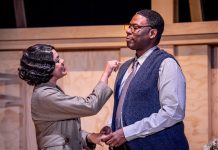
Chief among these is Adams, given a puckish portrayal by Will Blum. Blum’s Adams is the type of man who, convinced of the rightness of his beliefs, is exasperated that everyone else does not go along with him. He finds solace in corresponding with his wife Abigail (Elena Shaddow).
Adams’ main nemesis is John Dickinson of Philadelphia (Edward Watts), a conservative businessman who places his faith in reconciliation with King George III. Dickinson and his toady, Judge James Wilson, prevent Dr. Benjamin Franklin (John Treacy Egan) from putting Pennsylvania in the pro-independence camp.
To move things along, Franklin flatters Virginia’s Richard Henry Lee into getting explicit instructions from his legislature to support independence so that he and not Adams becomes the face of the cause in Congress. Once Virginia’s proposal is accepted, Congress opens debate. When the question is called, Dickinson moves that any motion on independence must be adopted by unanimous vote. When that condition is adopted, Adams moves to postpone the vote until a formal declaration be adopted, to state clearly the colonies’ reasons for their actions.






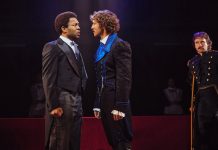
Thomas Jefferson (Michael Burrell) is cornered by Adams into writing the Declaration. But Jefferson cannot find inspiration until Adams brings Martha Jefferson to Philadelphia.
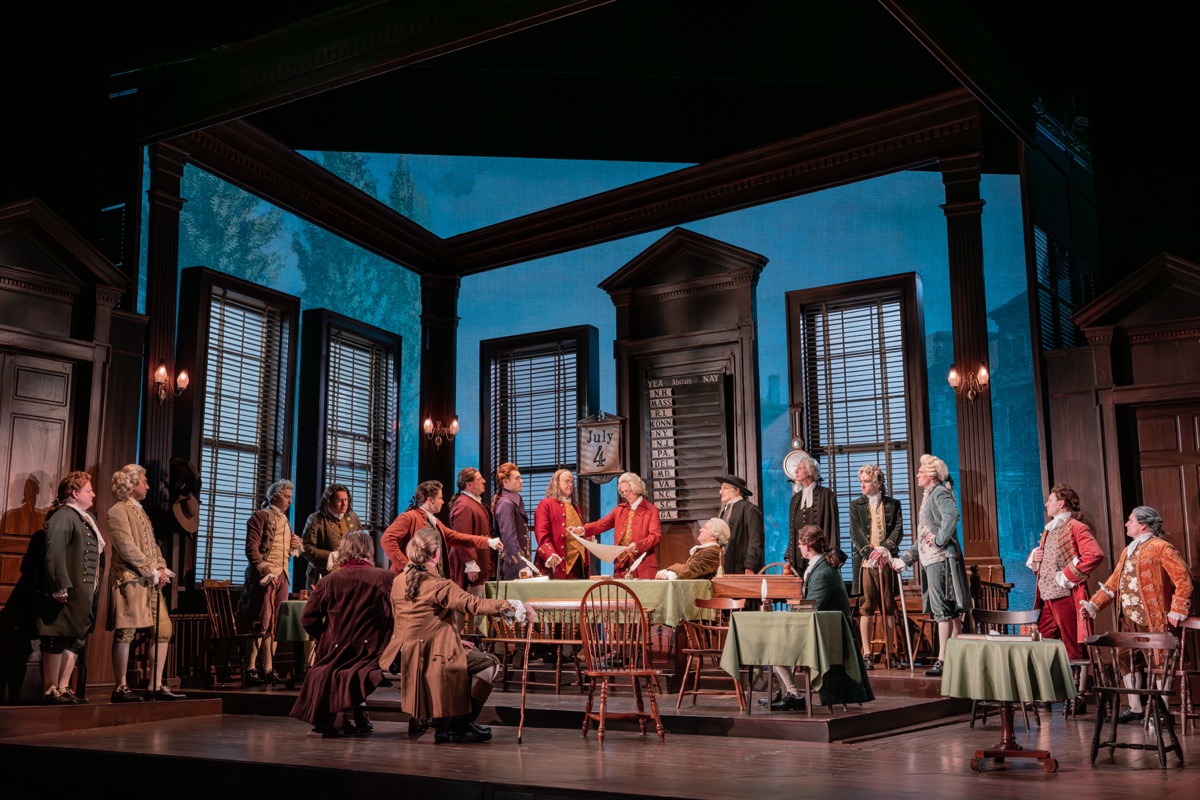
Once the declaration is put before Congress, another problem arises. Jefferson has made reference to slavery as one of the evils King George has imposed on the colonies. But Jefferson’s refusal to delete it causes South Carolina’s Edward Rutledge (Jonathan Young) to pull out of Congress, taking North Carolina and Georgia with him.













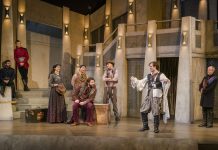
Director Mark S. Hoebee pulls out all the stops with his large, talented cast. His Congress is not a dry debating society but a gathering of proud, opinionated, passionate men feeling their way towards doing something never before done. And their women, represented by Abigail Adams and Martha Jefferson, are more than equal to the task of bringing out the best in their men through their support and inspiration.
The cast rises to the occasion. Aside from the main players — Adams, Franklin, Jefferson, Dickinson, Rutledge, and Abigail — the actors create vivid portraits of every character, usually through Sherman Edwards’ magnificent score, his only one for Broadway. Exasperatingly riding herd over this unruly Congress while trying to remain fair is James Moye as John Hancock. The easily flattered, malleable Richard Henry Lee is fleshed out by Bryant Martin in “The Lees of Old Virginia”. Liz Leclerc’s Martha Jefferson explains how her Thomas wooed and won her in “He Plays the Violin”, a song which, in its flirtatious implications, is both prim and rapturous. Dickinson and his conciliatory rightists stake out their viewpoint in “Cool, Cool, Considerate Men”. Rutledge takes Congress through the hellscape of the slave trade in “Molasses to Rum”. Washington’s courier (Praise Oranika) poignantly recounts the human cost of war in the elegiac “Momma, Look Sharp”. The relationship, the loving partnership, between the Adamses is realized in the songs “Till Then” and “Yours, Yours, Yours”, with lyrics based on their actual correspondence at the time.

Paper Mill’s design team comes through in fine form, with sets, lighting, costuming, and sound bringing to life the world of Congress during the hot Philadelphia summer of 1776. Jillian Zack’s orchestra is more than up to the task of bringing the score to life, from the first drum beats of the overture to the tolling bell of the finale.
Brimming with wit and music, 1776 reminds us of the sheer exuberant lust for living that was a hallmark of our fledgling nation. Even though its conclusion is foregone, this production still takes you on an emotional roller coaster ride right up to the end. I cannot more strongly urge you to attend this most excellent production of 1776!
1776 is presented by Paper Mill Playhouse in Millburn through May 2, 2026. For more information or to purchase tickets, go to papermill.org.