In a study by the Williams Institute at UCLA School of Law, researchers have found that 48 percent of LGBTQ+ adults support a police presence at Pride events, 19 percent oppose it and 33 percent neither support nor oppose.
The data used in the report comes from the 2022 study Policing the Rainbow, the first study to focus on the LGBTQ+ community’s experiences and perceptions of the police. Researchers surveyed 803 LGBTQ+ people about their views on police participation at Pride.





“Police participation at Pride parades and events remains a recurring and often contentious issue,” Jordan Grasso, study author and research data analyst at the Williams Institute, said in a news release. “For some LGBTQ people, police participation in Pride signifies progress in police-community relations. Others view it as a form of ‘pinkwashing’ that obscures historical and current patterns of police violence and discrimination against LGBTQ communities.”

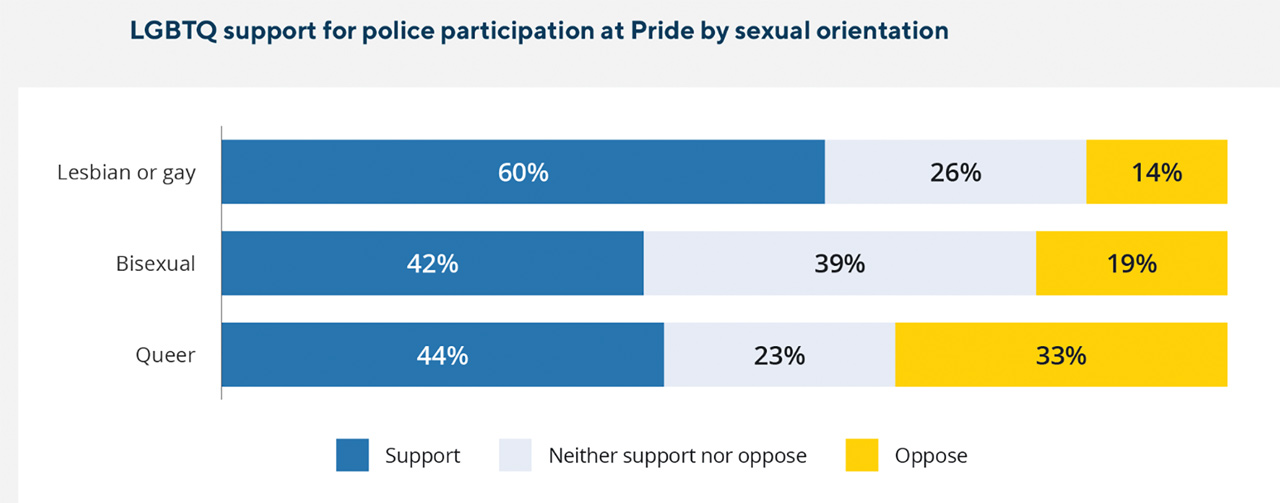
Opinion varies among identities and orientations, with 60 percent of gay and lesbian people most likely to support police participation, compared to 42 percent of bisexuals and 44 percent of people identifying as queer. Results showed that transgender and nonbinary people are least likely to support it, at 37 percent, with 53 percent of cisgender men and 49 percent of cisgender women supporting in higher numbers.
A larger split lies in the difference between older and younger members of the community. Only 33 percent of LGBTQ+ people between 18 and 29 years old support police participation at Pride, while older people range from 53 percent to 64 percent in support. The study found that class plays a role in opinion as well, as those of higher socioeconomic status are most likely to support police at Pride, at 60 percent.
“The LGBTQ community is not a monolith, particularly in their perceptions of the police,” Laurel Sprague, study author and research director at the Williams Institute said in the release. “The parts of the community most vulnerable to negative police interactions, including those who identify as transgender, have lower economic status, and are younger, understandably feel the most opposition to police participation at Pride.”