The late ’60s to mid ’70’s was a divisive time in America. At home, massive marches for civil rights and an end to institutional racism filled the streets with protestors and the television screens with scenes of marchers set upon with fire hoses and police dogs and truncheons. Overseas, the increasing involvement of the United States in the armed conflict between two halves of a divided Vietnam — what has been called the first televised war — aroused a civilian protest against the loss of life and waste of money perpetrated by a military unwilling to admit error.
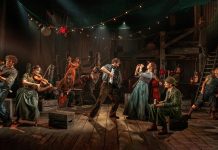
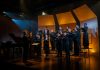
This is the era brought to the stage in Rolling Thunder, a musical revue using pop music of the era to tie together stories of survivors and victims of the War in Vietnam, both those abroad and those at home.





Australian journalist and writer Bryce Hallett tries to create a sort of chronological timeline tying together six composite characters through statements from survivors, letters from servicemen, and selected songs of the period. We follow three young men — Johnny (Drew Becker), Thomas (Justin Matthew Sargent), and Andy (Daniel Yearwood) — from shortly before their induction through their tours of duty in Vietnam.
Their youthful bravado quickly evaporates during the rigors of basic training, and what little idealism they have left is quickly shattered by the realities of combat. Back home, Johnny’s girlfriend Linda (understudy Erin Ramirez) tries to stay faithful, dreaming of the future they’ll have on his return. Andy’s mother (Courtnee Carter), appalled by the rising death counts and frightened for her son, joins the growing group of mothers protesting in opposition to the war. Jimi (Deon’te Goodman), a draft resister and peace activist, learns the hard way that voicing opposition comes with its own dangers.
The choice of songs is, at times, confusing. While one can see the relevance of such songs as “Eve of Destruction,” “War (What Is It Good For?),” and “We Gotta Get Out of This Place,” one has to question the inclusion of “Help Me Make It Through the Night” sung by Linda, “Black Magic Woman” and “Magic Carpet Ride” done by the recruits, and “Killing Me Softly With His Song” performed by Andy’s mother. “Bridge Over Troubled Water” seems to be another odd choice, but as performed by Linda and Johnny it transforms into an emotional ballad of future hopes with a surprising climax.
While I don’t doubt the sincerity of book writer Hallett in trying to create a non-nostalgic picture of a tumultuous era, and while the cast is talented, the main problem of Rolling Thunder is that it is oddly disjointed. It is a patchwork quilt of images and music that never seems to come together as a unified work. Even the audience-participation finale, to the song “Get Together,” feels artificially tacked on. While this may be, for audience members from the era, a welcome reminder of their youthful selves, it falls short of creating a vibrant picture of America and Americans during a turbulent era for other audience members. I cannot fully recommend seeing Rolling Thunder.





Rolling Thunder is playing at New World Stages, 340 West 50th St., in New York, through Sept. 7, 2025. For more information or to purchase tickets, go to rollingthunderus.com.