Congressional candidate Rachel Peace won the New Jersey Democratic primary election on June 2 for the state’s fourth congressional district and is now focused on the upcoming general election Nov. 3 in which she aims to break the 45-year grip that Republican Rep. Chris Smith has had on the district since 1981. U.S. Sen. Andy Kim, D-N.J., endorsed Peace on Aug. 20.
Peace, 34, a single mother who grew up in a conservative Christian household in Brick, said she does not consider herself to be a politician but rather a concerned citizen who is capable of researching and translating proposed legislation and then deciding how it will benefit or harm others. She said she felt called to do something about the crises people are facing in what she characterized as a political climate that is divided and corrupt with politicians who forget they work for the people.



“I want people to feel safe, seen, and I refuse to see this seat in Congress as unflippable. My goal is to fix the larger systems, but really to establish that pathway, so that the younger generations can continue the work to advocate for their neighbors, programs and policies that will benefit our community,” Peace said during an interview at Spire Coffeehouse in Toms River. District 4 covers portions of Monmouth and Ocean counties.
President Donald Trump’s second win motivated Peace to find a way to actively advocate for people who might be at risk as a result of dangerous choices she could anticipate the administration making. “I realized I could be the conduit for action into the community. I visited Congressman Frank Pallone’s office and began there,” she said. Peace was told Pallone’s team that she “made quite an impression on him” after speaking at a press conference about the concerns she had about protecting her young son in a society that might not be equipped to protect him.
“I couldn’t accomplish all the change to systems in desperate need of reevaluation at the local level.”
Through town hall events and press releases with Pallone, she discovered her new path. Peace dove headfirst into her local chapter of the national progressive organization once known as Indivisible, currently Jersey Shore Blue, and participated in Kim’s initiative for aspiring leaders. Peace was flooded with comments implying that she should wait her turn to run for Congress and that she should begin with school boards and town councils. The discouragement did not work.




Congress, she said, felt like a better fit. “I couldn’t accomplish all the change to systems in desperate need of reevaluation at the local level. My calling is to change the systems that are designed to benefit the few at the expense of the majority.”
Peace said she enjoys having conversations involving all sides of issues and genuinely tries to relate to everyone’s experiences with the goal of getting to the core of why they vote the way they have in the past — possibly changing the trajectory of their future voting. She said that there are so many habits attached to voting and that is a problem. She speaks about this when she addresses audiences. She said she is kind, firm and thrives on engaging in meaningful conversations with people about ideas they may not have considered. She noted that her expectation is not to change their political affiliation, but to consider an individual candidate — one who will make the necessary changes and then perhaps inform how they vote.













Peace said she knows that shifts begin with community-level conversations about what people need to do to climb out of what she characterized as a black cloud of improper healthcare coverage. Everyone, she said, should have access to child care and quality medical resources. She alluded to the Lanham Act of 1940 when the country ran its first universal child care program, which was federally funded, for working mothers. “We did it once; we can do it again,” she said.
In terms of LGBTQ+ rights, Peace said she is prepared and determined to address what she called the right-wing exploitation of the trans community. “There are close to 150 pieces of federal legislation thus far this year alone targeting the community,” Peace said. “The trans community makes up only close to 1 percent of our population, yet the political right fixates on attacking them to distract people from actual threats to their well-being,” Peace said.
Another example she offered was a yes vote by Smith in May regarding a proposal for a new Smithsonian American Women’s History Museum on the National Mall. The legislation was revised to ensure that no transgender people were included in the exhibits, according to the Associated Press. The House rejected what had begun as a widely backed proposal 216-204, the AP reported May 21.
The trans community, she said, deserves a candidate who will make them a priority, adding that the homophobic and transphobic behavior of the current presidential administration is not a secondary issue, but rather one that demands immediate action.
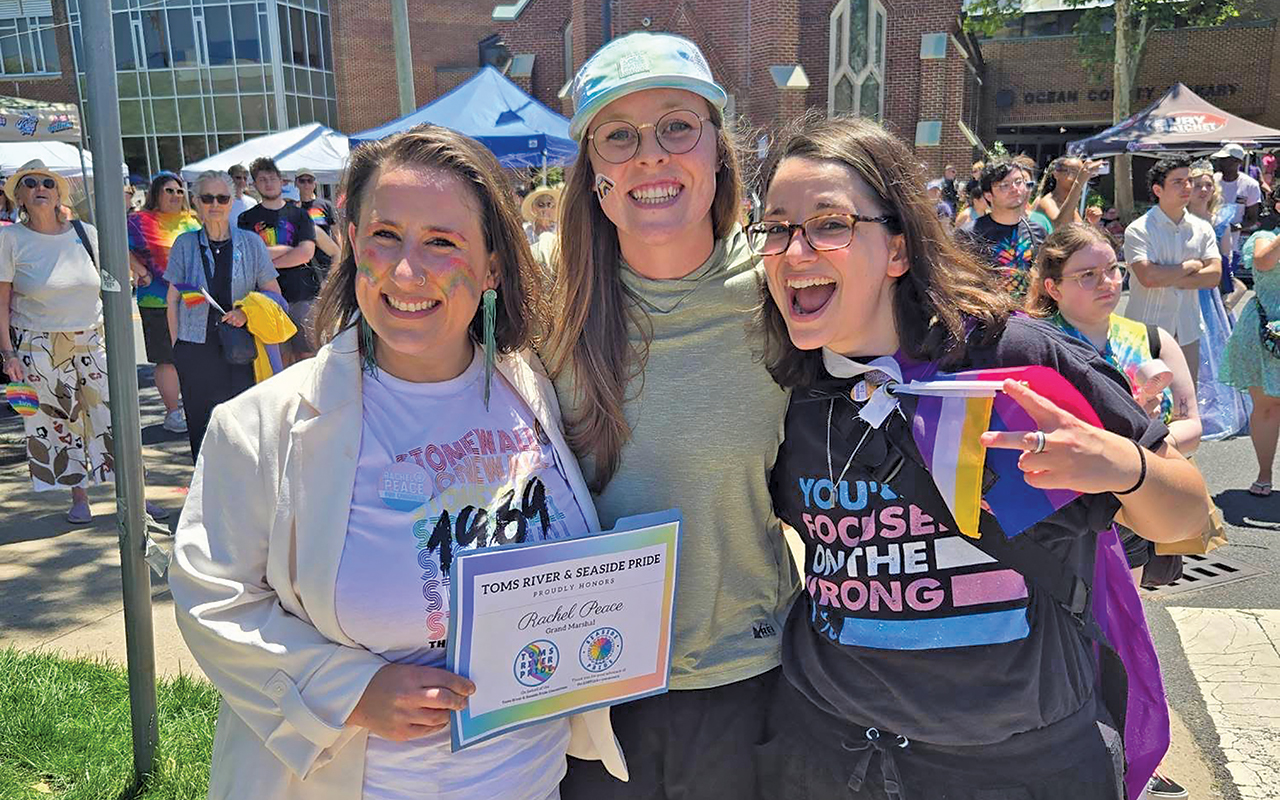
In June, Peace was named grand marshal of the Toms River Pride Festival, only days after securing her primary win. She promised the community she’d advocate for their rights as diligently as possible.
Peace maintains a strong stance on reversing Medicaid cuts and supports paid family leave. Regarding voting, she said election primaries need to be open to unaffiliated voters and she supports ranked-choice voting. Regarding immigration, Peace said she believes immigrants “deserve pathways for success within their industries, not demonization.”
Growing up in a conservative Christian household in Brick, Peace said she experienced her “full share of internal shame about her bisexual identity.” Grammy award-winning and LGBTQ+ singer Chappell Roan’s “Good Luck Babe” helped her find the courage to fully acknowledge herself and come out to those she loved about two years ago.
Peace is also neurodivergent. “I found myself ultra-sensitive to injustices while I was growing up,” she said. Now she is a mother whose son will grow up a Black man in a society that she said will not treat him equally unless change persists. “I am raising him to question authority. First, I need to actively make him safe. Ocean County is my home, which is why I begin here.”
Peace is transparent about not wanting to be in this role forever, saying she’d rather build an unbreakable batch of new leaders and young minds that can carry people through later decades. “I am interested in creating a pipeline before having power of any kind. If counties like Atlantic and Morris can flip, can’t we do this in Ocean, too?”
In addition to voting, Peace encouraged people to make art, write prose or poems, create music and show up for events. She wants people to show up for candidates who will represent their beliefs.
For young people interested in advocacy, leadership or politics, Peace’s campaign has a coalition called GenZ4Peace. Most importantly, though, she said to get out and vote this November. “Consider letting your heartache and the fact that our country has hit rock bottom as the driving factor to get out and vote.”
As a concluding thought, Peace quoted Kim: “We need more ordinary people to do more extraordinary things.”
Update: This story, which originally was published in our Oct/Nov 2026 print issue, has been updated with additional information.
Find out more on the Rachel Peace campaign website.