


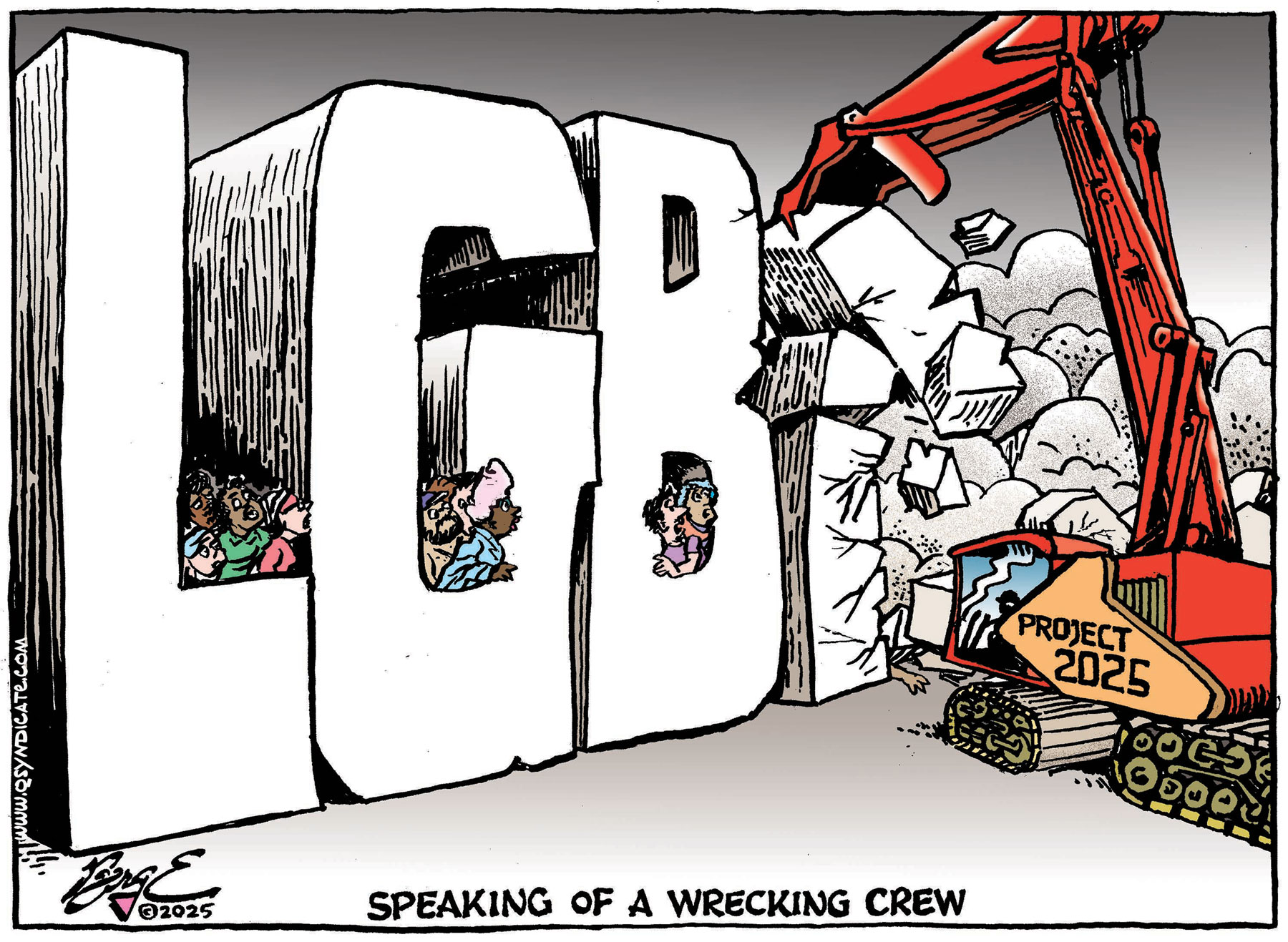
Overturning marriage equality is now a present threat. Many of the issues both POC and LGBTQ Americans confronted in Trump’s first term — health care, unemployment, housing, immigration, voting rights, among others — are front and center, again, and on the chopping block. And the fear is palpable. “I think it’s going to go away. I don’t know what’s going to happen to those already married, but there are a lot of benefits, a lot of benefits,” Pat of West Palm Beach, Florida, told me. “What would that be? A forced divorce?”
Put a ring on it





With this threat still looming large, many LGBTQ couples are dashing to the altar. The thought of many more former Kentucky county clerks like Kim Davis becomes a nightmare. Davis is infamously known for refusing to issue marriage licenses to same-sex couples in 2015, and this August, she formally petitioned the Supreme Court to overturn Obergefell v. Hodges.
“I told a nephew who’s gay, young, 22, to get married last year because we don’t know,” Pat said. Former Secretary of State Hillary Clinton echoed the same sentiment. On the “Raging Moderates” podcast in August, Clinton strongly advised couples to get married before SCOTUS overturns it. “Anybody in a committed relationship out there, in the LGBTQ community, you ought to consider getting married,” she said, “because I don’t think they’ll undo existing marriages, but I fear they will undo the national right.”
Clarence Thomas’ goal
In a Trumped-up Supreme Court, SCOTUS has been his enabler. Justice Clarence Thomas faulted the Supreme Court for refusing to block marriage equality in Alabama twice — in 2015 and in 2022. Targeting marriage equality has been his goal since its passage.






Shortly after the SCOTUS overturned Roe v. Wade in the Dobbs v. Jackson Women’s Health Organization case in 2022, Clarence Thomas seized the moment to state; “We have a duty to ‘correct the error’ established in those precedents.” Thomas further stated that the Court “should reconsider” its past rulings codifying the rights to contraception, same-gender intimacy, and marriage equality. Surely, he jests, I thought, because of Thomas’ interracial marriage, which marriage equality is built upon. Moreover, the slippery slope is one he, too, could confront, once SCOTUS eliminates federal protection for loving whom you choose. The irony here is that many of the civil rights gains that ascended Thomas to the highest court in the land, he now wants to dismantle.
This year, the country celebrated 10 years since the Obergefell v. Hodges decision, allowing LGBTQ Americans the fundamental right to marry nationwide. However, while Justices Thomas and Samuel Alito dissented in Obergefell in 2015, the broad public support that both parties once embraced has now waned among Republicans.












According to the Gallup Poll, in 2025 support for marriage equality among Democrats rose to 88%. Republicans’ support, which peaked at 55% in 2021 and 2022, has dropped to 41%, the lowest point since 2016, following the Obergefell decision.
With Republicans dominating all branches of government, there is concern whether Biden’s “Respect for Marriage Act,” signed into law in 2022, would be upheld, instead of marriage equality being thrown to the states. Four out of ten judges Trump chose during his first term are unabashedly anti-LGBTQ. He appointed over 54 conservative judges, and they will remain on the bench long after he’s gone. LGBTQ Americans in red states especially have concerns.

“Well, marriage equality issues, for me, are not really a new issue. It has been an issue for my 30-some-year-plus relationship,” Charlotte told me. Charlotte and her wife, Sherry, are from Indiana, whom I met while vacationing in Provincetown this summer. “In today’s world, as far as I’m concerned, they could take anything and everything away from you if you don’t have, basically, a tiny white penis.”
“There was always talk among Christian evangelicals of walking Obergefell v. Hodges back without disrupting other precedents on marriage,” Rebecca Buckwalter-Poza wrote in the 2017 article “The End of Gay Rights” in the June issue of Pacific Standard magazine.
“The Supreme Court can significantly undermine LGBT rights even without reversing a single case. Right now, the federal prohibition against sex discrimination doesn’t bar discrimination on the basis of sexual orientation or gender identity; the Equal Protection Clause affords no specific protections for LGBT people, as it does for members of groups defined by race or nationality,” Buckwalter-Poza wrote. “The Court can strip the rights to intimacy and marriage of their meaning, carving away gradually and masking the magnitude of changes by phrasing them in arcane legal terms.”
Benefits up in the air
Those arcane legal terms can strip 1,138 federal benefits and hundreds of state-specific benefits that heterosexual couples take for granted. Denying these benefits will cause financial instability and immense stress. “Being a widow, all the federal benefits have benefited me,” Pat stated. “I’m on spousal Social Security because Anne had a slightly higher salary than mine. I’m…not paying taxes on our joint money, is that going to go away?”
Jim Obergefell, not an activist of any sort, never expected to be a cause célèbre. But when he sued his home state of Ohio for refusing to recognize him as the widower of his deceased spouse, the lawsuit made its way to the highest court. Obergefell, then 48, the lead plaintiff in the four marriage equality cases collectively known as Obergefell v. Hodges, is now hanging in the balance once again.
In 2015, the day Obergefell v. Hodges was being debated in the U.S. Supreme Court, a rally was taking place as a steady stream of LGBTQ speakers shared their compelling narratives of how marriage equality would give them rights, benefits, family security, and full citizenship that heterosexual couples and families have.
With victory comes backlash
Ratifying marriage equality was the right thing to do and should not be repealed. Obergefell’s victory expanded the nation’s understanding of marriage as a fundamental right awarded to all people. However, if Roe v. Wade can be overturned after 50 years, so too can marriage equality, highlighting that no one’s rights can be taken for granted.
“For a long time, I thought that [marriage] was the wrong issue. That [marriage] was the wrong hill to die on,” Sherry shared with me. Sherry’s a retired professor of nursing and Charlotte’s spouse. “That there were other things that gay and lesbian folks needed that were more important than marriage. But I’ve changed my tune about that as time has gone on. I’m aware now that what we take as a right is always conditional.”
Sadly, that’s true. I have married over 250 LGBTQ couples since 2004, when it was legalized in Massachusetts, to the present day. Each one was an honor to officiate. When I was interviewed for Massachusetts’ 20th anniversary of marriage equality, a newsman asked to see my photos; I have hundreds of them. I had to sort them into three piles: deceased, divorced, and still together. However, I never imagined the day would come when I might have to stop.


