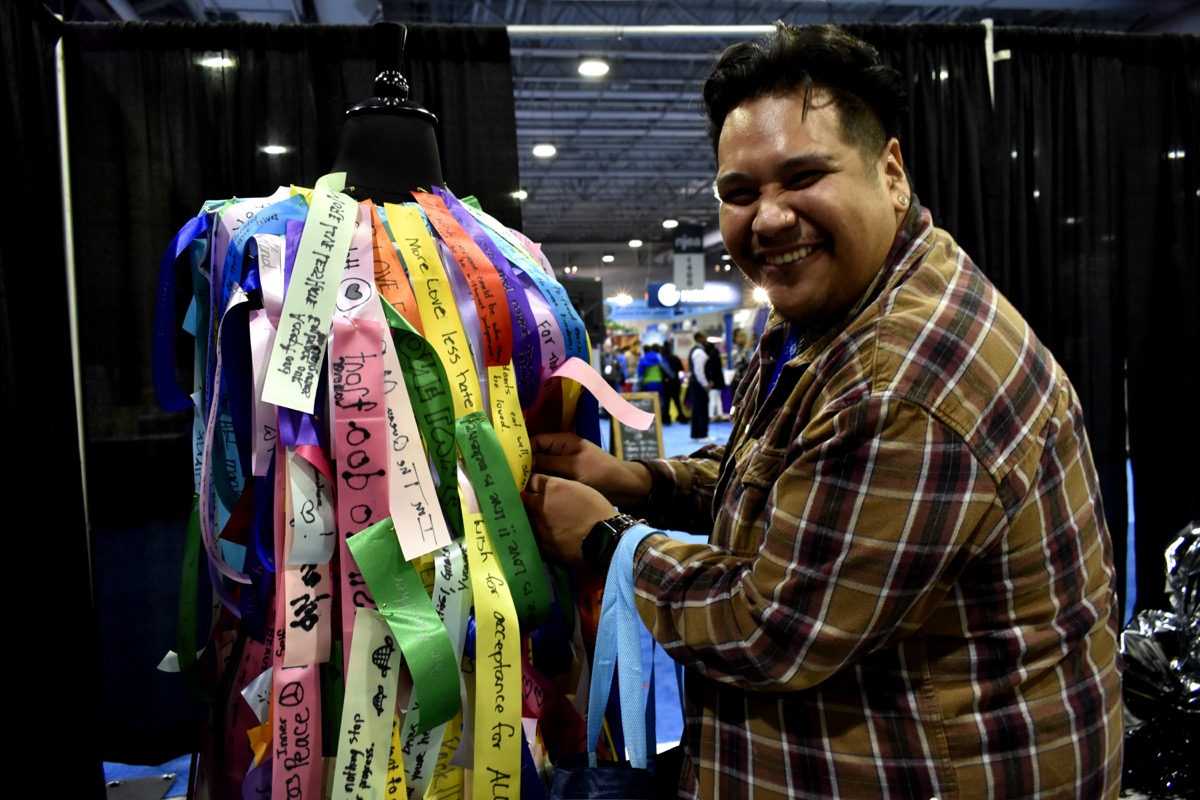
“Drag is not a crime” is the message a Pride group brought to the New Jersey Education Association at its 2025 convention in Atlantic City.
The NJEA invited Hammonton Pride to bring its previously shown exhibit on the art, history, culture, social commentary, and advocacy of drag to the convention, which was held Nov. 6 and 7.




“Our goal was to highlight drag as a form of creative expression, resilience, and storytelling — especially in a time when it’s often misunderstood or politicized,” said Maximilian Rodio, Hammonton Pride’s president and founder.
The group debuted its exhibit in the summer of 2024 for Pride Month in collaboration with Stockton University’s Noyes Museum of Art in Hammonton, Atlantic County.
“We curated this exhibit, and it was on display for Pride Month (2024), but it actually ended up getting extended through the end of September because of how well-received it was,” Rodio said.
Then over the winter, the education association and Hammonton Pride connected and talked about bringing the exhibit to the 2025 convention in November. The reaction there, according to Rodio, was positive as well.






“It was phenomenal at the convention itself. We’re still waiting on some statistics back from them,” he told Out in Jersey in an interview Nov. 11, “but we had really wonderful attendance, incredible interactions with all the attendees and other exhibitors as well as the board members themselves of the NJEA. It was a rewarding experience being with them this year.”
Bringing the exhibit to the convention gave Hammonton Pride the opportunity to communicate its message to a new audience. Its message is that, well, as the convention exhibit’s title — “Drag Is Not a Crime: Pt. II” — says in response to the anti-drag and anti-LGBTQ rhetoric that’s been on the rise over the past several years, the art form is not a crime, and it represents the queer community in many different ways.












“With bringing it to the NJEA convention specifically, we look at drag as education in action, its history, its art, its performance, its social commentary, all rolled into one, so when drag is visible in educational spaces, it can invite dialogue about identity, diversity, [and] empathy while also challenging stereotypes and building safer, more inclusive schools and communities,” Rodio said.
Drag has been around for centuries dating back to early Greek theater and to Shakespearean times. What is now considered an art form was done originally for practical reasons. In the theater, women were not allowed to perform, so male actors had to play the female roles. The word “drag” comes from an acronym that was used in play scripts. It stood for “Dressed As Girl.”
In the 19th Century, there were masquerade balls in which men dressed as women and competed similarly to the way they do on RuPaul’s Drag Race. In the late 1880s, a formerly enslaved man named William Dorsey Swann was known for hosting such events in Washington, D.C. and became the first known person to self-identify as a “drag queen,” although that term wasn’t widely used at the time, according to an article in Smithsonian Magazine.
“Drag has always been woven into the fabric of society in so many different forms,” Rodio said.
Jason Schmidt is a drag queen I reached out to to share what he knows about the art form as someone who studied theater at Adelphi University on Long Island and who’s done drag since 1998, when he was cast as Bianca in The Taming of the Shrew in a college play. There are also photos of him in his grandmother’s wig when he was 5 or 6, he noted.
“I know that drag has existed for as long as people have been telling stories,” said Schmidt, who currently impersonates the late Bea Arthur and who has performed at venues throughout New Jersey. He also has done shows in other parts of the country and internationally as well.
Drag in Greek theater, he said, was often done with giant masks. And he noted that it hasn’t existed only in Western culture; it’s in Japanese theater, too. As an actor, Schmidt finds drag interesting and says it opens up the possibility to the roles he can play.
From an actor’s point of view, drag is part of the history of storytelling, from the earliest times when human beings told stories to inform or to entertain, according to Schmidt. Drag can also provide a platform for social commentary.
“It gives someone who is louder a point of view and a microphone to represent people and to tell people stuff like ‘Don’t vote for that guy’ or ‘Stand up for this shit’ or ‘Be careful when you go to this place,’ those kinds of things,” Schmidt said, “like a town square kind of thing. Also, it’s a place to just get together as queer people and have fun and enjoy each other and laugh and have a great time, which we deserve.”
And for straight people in the audience, he added, it gives queer people an opportunity to connect with them and tell them “things that we might want to tell them,” and “it gives them the opportunity to see us as queer people having fun.”
Drag is not without its controversy. Many conservatives find drag to be objectionable and say it’s not suitable for children. Some have accused drag queens and the queer community in general of “targeting” and “grooming” children by holding events known as “drag queen story hours” for them at public libraries and in other places.
Threats of violence against these story hours have also occurred. On July 29, 2023, a bomb threat delayed the start of a drag story hour at Canco Park in Jersey City, Hudson County, and on Aug. 26, 2023, a bomb threat targeting a drag story hour at the Bayard Rustin Center for Social Justice in Princeton, Mercer County, was received by police, who responded to the center to evacuate the building. No explosives were found in either incident.
Some who object to the story hours have questioned why drag queens read to children and not to, say, the elderly in nursing homes, for example.
“Well, people in nursing homes can already read, so we don’t need to read to them,” Schmidt quipped, “and I do perform in nursing homes. I do bingo in nursing homes all the time, so that’s just a made-up thing.”
Rodio said there’s really no factual evidence to support claims that drag performers have harmed any children whatsoever. “They’re rather baseless claims,” Rodio said. “Obviously, each parent has the decision to either participate or not participate in an event like that, but I think it’s safe to say that any drag queen, or drag performer for that matter, understands their audience, so certainly a night-club set versus a story-time set is going to look completely different, and they’re accomplishing two completely different goals with two completely different sets of audiences.”
Schmidt said that while performing at a drag story hour for children isn’t his favorite thing to do, he has done it. “It’s like theater,” he said. “It’s like dress-up. It’s reading a story in a costume. What’s the difference between Bozo the Clown — frankly, it’s scarier than a drag queen — and me?”
Rodio said that at the convention, it was amazing to see the number of children who attended and to watch them interact with Hammonton Pride’s performers who were there as part of the exhibit. “It was just such a beautiful, rewarding experience to see how kids do react to this, and it was nothing but excitement and awe and wonder for the glitz and the glamor,” he said. “It’s almost like they’re meeting a princess or something like that.”
Schmidt said that in his experience, kids either don’t understand or they immediately do. “They’re like, ‘You’re a boy,’ and I’m like, ‘Well, maybe, but right now I’m dressed as your grandma,’” he said.
“Kids love to play dress-up, and the word ‘grooming?’ No. I was groomed to be a straight person for so many years of my life, and it never worked out,” he said.
Schmidt, who grew up in Texas, said boys at 5 years old are asked if they have a girlfriend, are groomed to be athletes and to go play in the dirt. “I’ve done drag story hour. I promise you there’s nothing, you know, it’s not like a stripper is showing up and doing drag story hour. Even if there was, I’ve seen a lot of kids at the Hooter’s, which is grooming by the way,” he said.
Rodio emphasized that there is certainly no harm in drag and reiterated that parents have “the complete right to share with their children whatever they’d like to share.”

He said the bigger picture is the exhibit’s intent at the convention to promote diversity and inclusivity in the classroom and “how teachers can cultivate a positive, affirming environment for all students, not just LGBTQ+, but for all students because I think we all know just how important our teachers are in their responsibility for getting us to where we are as adults, and I know personally [that] having teachers who see you for who you are and meet you there really makes a difference for the rest of your life.”
Schmidt said drag shows are theatrical, fun events, and their audiences vary. “Some drag events are for adults, and some drag events can be for lots of people. The majority of the shows that I do, anyone can come to because that’s my personal taste. That’s what I like to present,” he said.
“Life is full of choices. If you don’t want to go see a drag show, then don’t go see it,” Schmidt said, adding that trying to prevent someone else’s child from going to a drag performance like a story hour doesn’t make sense. Moreover, he said he thinks kids would probably want to go.
“Yeah, it’s not a crime; it’s just a show. It’s theater. There’s been drag in theater ever since theater existed, so — get over it.”