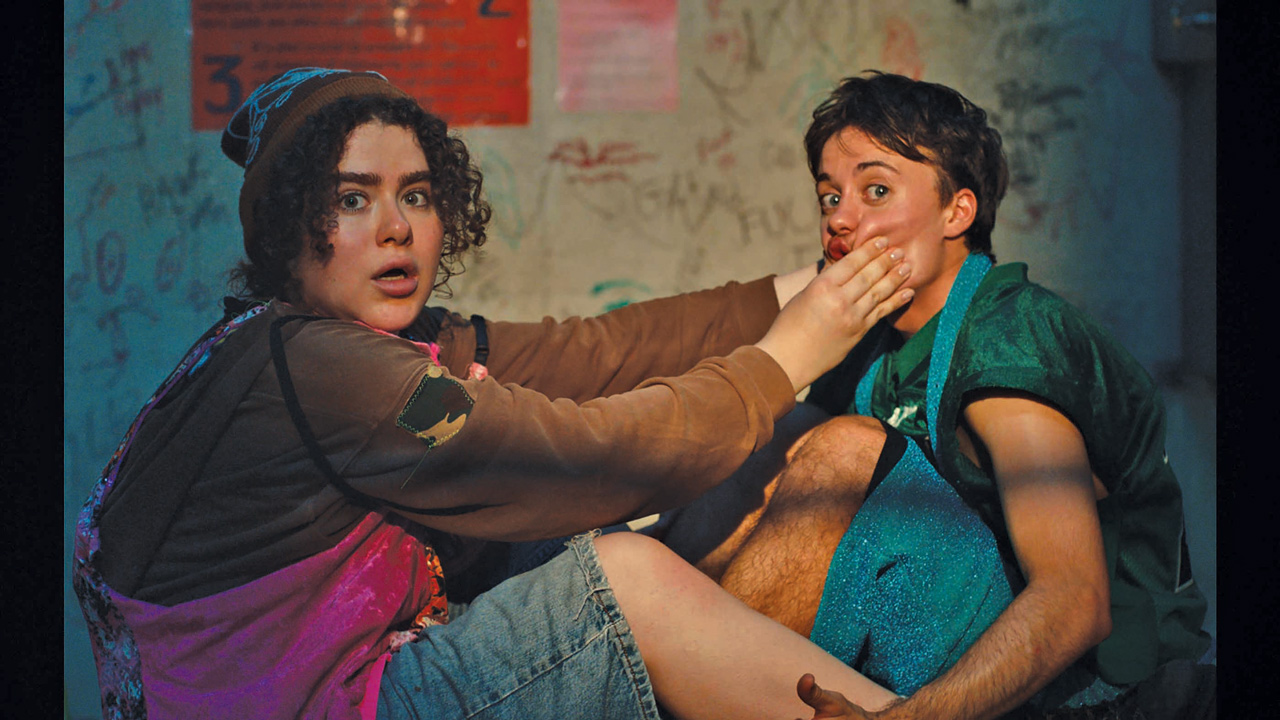
She’s the He celebrates the diverse trans identity in an over-the-top, zany, yet incredibly grounded film that’s bound to be a queer classic.
In addition to following in the dynamic footsteps of past coming-of-age high school flicks, She’s the He paves its own path forward. Like Mean Girls or John Tucker Must Die, there is a larger story about identity unraveling behind the campy chaos and gender-based shenanigans.





We spoke with writer/director Siobhan McCarthy, along with stars Nico Carney and Misha Osherovich, about the impactful movie making rounds at LGBTQ+ festivals all summer long. Both heartbreaking and joy-filled, this film promises to invite you into a story you won’t soon forget — complete with a bloody tampon battle, of course.
How are you celebrating this Pride Month?
Misha Osherovich: I had to be reminded that it was Pride. Someone told me yesterday. I don’t know how Shiv and Nico are feeling, but I think all of us have projects that we are sort of climbing through after She’s the He. A lot of the world is a pretty dark place right now. So, if we’re going to be celebrating Pride, it’s wonderful to just keep putting queer people in positions of power, allowing queer people to work together and continuing to put our art out in the world. That’s personally what I’m focused on with Pride.
Nico Carney: Unfortunately, it doesn’t feel like much of a celebration right now. What’s exciting about this Pride Month is getting to do this premiere and doing it twice with this group. One of the best things about this movie has been the fact that the last year was a lot of the festival circuit. It’s kind of the gift that keeps on giving. We get to keep seeing each other, keep celebrating the production and our collaboration.






I’m very much looking forward to doing New York and LA premieres. But yeah, Misha’s point is spot on. For queer artists, Pride becomes like the best money-making month in a way. It’s the month you’ve got to work. As a stand-up, everybody’s like, “Hey, let’s have a gay person on the show this month,” so you get busy. I’m very much looking forward to celebrating with these guys.
Siobhan McCarthy: Yeah, I definitely think that it’s interesting to be a gay person and have a month dedicated to the recognition of gay art. But honestly, Pride remains similar to any of the other months. I’m still trans, and I’m still gay, so I move like I’m doing the same thing I’ve been doing most months: working hard and trying to keep moving.













What are you hoping audiences take away from this impactful film?
SM: It’s always just great to get to share (my work) with audiences. Truly, one of the most rewarding parts about this entire process is getting to meet trans people after screenings who do feel like they are seen or reflected in this movie. I’ve gotten to talk to trans people across the age bracket, from 70 to trans teenagers. They all respond to the movie, and that just feels like such an incredible blessing and like one of the most amazing experiences I could have. I’m proud that this is managing to reach not only trans people globally, but also such a huge age bracket of transness is unbelievable.
NC: Totally, I have to echo what Shiv said. I’ve been very fortunate as well to get to meet people when I’m on tour for stand-up who are like, “Oh my god, I saw the film when it came to our local festival, and I loved it so much.” It’s been really rewarding to get to see that the film’s reaching people.
What I’m really excited about is for people outside of the different festivals to see the film. It’s great to show it to film nerds at SXSW, but our average moviegoer and more trans kids, teenagers and people really need to see this movie. I’m really excited that it’s gonna finally be out there for the populace to see, which is very exciting.
MO: Echoing what these two have both said, this movie definitely is special. You know how some movies you need to see in a theater or with other people? It’ll be great streaming at home, but there’s a real raucous audience reaction that makes this movie come to life. That reaction has been really rewarding.

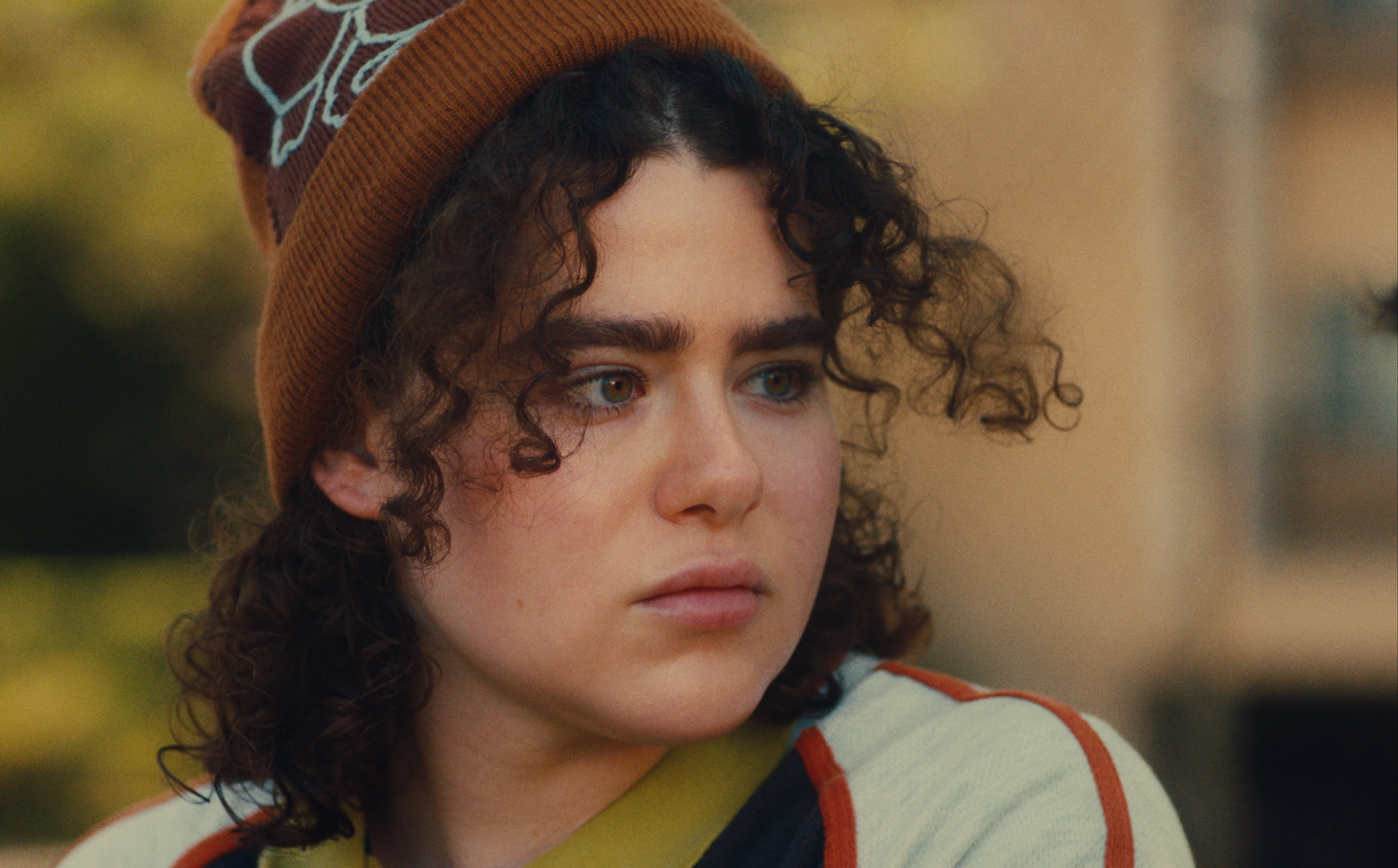
One of many really powerful scenes was Misha’s character, Ethan, who discovers she actually is trans, trying on feminine clothes for the first time. How did you collaborate on bringing that scene to life with such sincerity?
SM: That was such an interesting experience to get to work with Misha on, just across the board. Getting to have this movie and experience this with Misha has been so rewarding because it is really interesting to create representations of transness and more joyous trans moments, because often, that is somewhat of a private experience.
For trans people, when it comes to trans media, that has not always been something that has been foregrounded. I don’t think this is particularly common as it stands right now in trans media again, so getting to craft a scene like that or any of the scenes in the movie that are so fixated on trans joy was such an incredible collaborative experience because not only is Misha trans, and I’m trans, but most of the people on this crew are, too. Even the camera operator, one of my very good friends, is also trans.
I remember looking at them after we got the shot, and seeing the look in their eyes was such a beautiful thing. If I’m feeling it, if Misha’s feeling it, if other people are feeling it, then I did my job. When I’m writing it alone, it’s just me and so getting to be in that room made me realize, “Oh, it’s not just me that felt that. And not only just me; there are other trans people in this room.” We saw that come to life and saw that magic happen and that’s just such an unbelievable experience to get to be part of.
MO: Yeah, I couldn’t honestly have said it better. The only thing I’ll add is that this movie was the most massive meta experience because I’m still fairly early in my transition. Figuring out myself, figuring out myself on camera, going through the script with Shiv before we even started filming and then hitting the set on a big day like when we filmed the dress scene … it created this sense of reality. I got to grow up a little bit, and I think a lot of us did on camera in real time, or relive parts of our high school experience that we didn’t really get to have in real life. I’m not sure I’m ever going to be on a set like this again, and that’s a compliment.
All of us were built from the community — me, my producers, Misha, Niko — everyone was connected to each other in the real world.
NC: I was in 90 percent of the movie. Misha’s in 100 percent of the movie. So there’s this small percentage of scenes I didn’t get to see on the day when we shot them because I was wrapped out. That moment with her and Malia (Pyles) was one of my favorite scenes because I didn’t get to see it in real time, and so it was so magical to watch that part of the film. I hadn’t seen them work on it. It really hit me hard when I saw it for the first time. I thought it was one of the most grounded, magical moments of the movie that transcends. It will be one of the things that people think about a lot when they watch this film back. It was a heartwarming scene on screen that made me feel like it captured the trans experience.
Sounds like the set was incredibly inclusive. Why was it so important to bring in fresh perspectives?
SM: I think it speaks to the fact that, for the most part, everyone on this set was under 30. It was almost entirely people somewhere in their 20s, down to about 21, working on this movie. All of us were built from the community — me, my producers, Misha, Niko — everyone was connected to each other in the real world. In a social aspect, when that’s already there and is reflected on set, it makes for a fundamentally different environment, a fundamentally different version of filmmaking. That just feels like something inherent to being a younger filmmaker, inherent to working with younger people, and inherent to speaking to things that are honestly a reflection of a younger experience. You just end up with more diverse people.
If you’re speaking to these more diverse experiences, especially those that skew toward a younger audience, you need to reflect that diversity both behind the camera and in front of it. And if you’re hiring people you care about, you’re hiring people who are your friends, and usually that will be reflected there as well.
NC: One of the things that Hollywood is starting to embrace a little bit is the idea of the diverse auteur or the diverse filmmaker or the writer or the director, right? Those are the lines that are getting across a little bit, but the folks behind the camera are still not valued for what their perspective brings to their artistry.
One of the great things about this film is that we showed why it’s important to have a trans crew around this film. That’s what elevated the film so much, that we had the support of the costume designers, who are also trans. Siobhan was just saying there’s a camera operator who knows we got the shot because they emotionally know we got the shot. You’re not going to get that if you just think about the sort of “creatives” and don’t think about all the other artists and hardworking people behind the scenes. They have this lived experience that is going to elevate the project.
That’s something I took away from this film: that everyone is valuable. What they bring to the table is not just their actual on-the-ground skill set. It’s this other stuff, too. That’s something I’m trying to take with me for all the sets, that I have a chance to do what she did and create something by herself. I saw firsthand how unbelievably valuable that support is. I hope that Hollywood starts to understand that it’s not just the front-facing talent. It’s everybody around the crew.
What was that experience like working together on set?
MO: Some sets are like a dream, and some sets are like going to Starbucks. Sometimes you go to work at Starbucks, and that’s fine. This was not working at Starbucks. This was a really transformative experience, and it was really fun.
SM: It was so interesting to basically be back in high school because we were shooting in these actual high schools, except with a class of trans people. It was such a joyous experience to be in a locker room for the first time, where it wasn’t a threatening environment because every other person in that locker room was queer or trans. We got to relive and relitigate all of these experiences of youth, but in such a beautiful and queer environment.
NC: It was a total blast. I had the time of my life. It was a great month of shooting, and the reason I think this has been such a gift for the last two years with this rollout at the film festivals and everything is that we get to keep seeing each other. I am very excited for the LA premiere because I think we’ll get to see more of the crew there as well, who are LA locals.
When (Siobhan) collected this incredible group of young queer people, it was just going to be a great vibe. We had an interview a couple of weeks ago with Suzanne Cryer, who plays Mary in the film, and she mentioned that she got there towards the end of our shoot. She was like, “Oh, did you guys just get started?” And we were like, “No, this is the last week.” And she said, “What, you guys still like each other?” But that was the vibe, and it’s the end of the shoot in no time at all. I think that’s a real testament to how much fun we were having.
When I walk into a room of trans people, even on a set like this, I’m still like, “Oh my god, there are so many of us.”
You captured trans joy so well. How would you find and define that perspective?

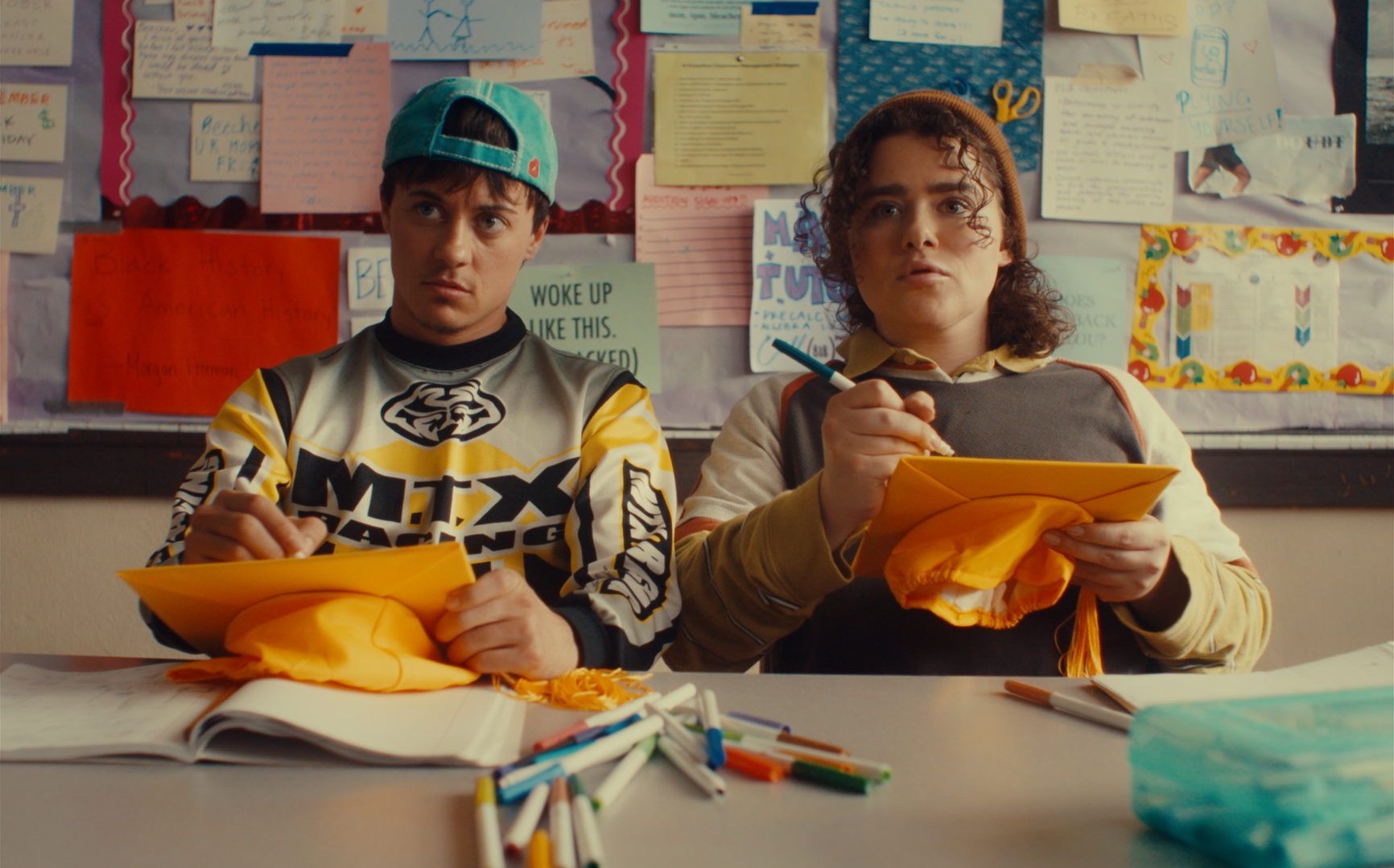
NC: I think, for me, it’s this type of thing. It’s the collaborative experience of working with other trans people. I always find that it’s easier to love myself when I see people who are like me. I love them so much, and I can take a little bit of that and give it back to myself.
When I walk into a room of trans people, even on a set like this, I’m still like, “Oh my god, there are so many of us.” It always gets me going. I would say community is number one for me.
SM: Being around trans people reminds me not only how much fun it is to be trans myself but also, when I’m having a harder time, that other people are having fun with this. It is not necessarily always a dire experience. Being around other trans people is such a reaffirmation of the beauty, joy and fun of being trans because it’s just nice to see someone else having a good time with it. The movie helped to reaffirm my own joy with it. Yeah.
MO: Yeah, I’m trying to find a smarter way to say what both of these two have said really brilliantly. [Laughs] Can you tell that I was always the one laughing on set? Well, Nico in particular, I have never looked like a worse actor than when he was just making me laugh so hard. Much of the editing hid my laughter.
We hear a lot about representation. That word has gotten a little tired because so many people, especially now with the world how it is, don’t feel like it is enough to simply see the one token trans character on XYZ Amazon show — sorry. I wish I had that growing up. We all did. Maybe that’s why we made this movie. But representation is also being in a room of other trans people and feeling like you actually belong somewhere physically in the world, away from everything, away from Hollywood, away from all of that. So that’s certainly what this movie brought to me and us on a soul level, and I think right now, the world as it is, that’s what trans joy is to me: as being in a physical room with people that I know and love and connect with who are of my same experience.