We’ve all heard tales about those families whose holiday gatherings become battlegrounds. There’s too much to eat, too much to drink, and too many old resentments and rewritings of family history. In Cult of Love, a new play by Leslye Headland being put on by the Second Stage, we go to Connecticut to visit one of those families, the Dahls, over a tense Yuletide holiday.
The house is presided over by Bill (David Rasche), who is starting to show signs of Alzheimer’s disease, and his wife Ginny (Mare Winningham), defiantly holding on to the family’s history and image as she wants to remember them. They are hosting a Christmas Eve dinner for their four children: Mark (Zachary Quinto), the eldest, a lawyer, and his Jewish wife Rachel (Molly Bernard); Evie (Rebecca Henderson) and her newly pregnant wife, Pippa (Roberta Colindrez); Johnny (Christopher Sears), who arrives late with his guest Loren (Barbie Ferreira); and Diana (Shailene Woodley), wife of clergyman James Bennett (Christopher Lowell), who is pregnant with their second child.




The Dahls do have a tendency to break out into song at random intervals. And not just any songs: seasonal carols, in perfect harmony. And if you’re visiting with the Dahls, you are expected to join in, even if you aren’t Christian, even if you don’t believe in God. In fact, you’re expected to join in with all the family’s traditions and rituals, even if you’ve never been exposed to them before. It’s funny, until it reaches the point of discomfort — or becomes downright painful.
I cannot praise highly enough the high-power talent of the cast. Under the skillful, firm yet subtle direction of Trip Cullman, they deliver not only the story but the back stories intertwined in Cult of Love, allowing secret resentments and disappointments to emerge with astonishing, unexpected naturalness. There is a casual cruelty and bias in Virginia that seems hilarious at first hearing but grows less so as the play progresses; Winningham manages to play both at once, an amazing example of her skills. Rasche as Bill gives a thoughtful, non-stereotyped portrayal of an intelligent man showing the first stages of a failing mind he is well aware of, yet refusing to succumb to despair just yet.
All four children argue amongst themselves — and with their spouses — while feeling the strong unifying pull of comforting, familiar rituals. Henderson’s Evie is fiercely protective of her wife and their marriage, even though Colindrez’ Pippa is almost too keenly attuned to anti-Hispanic cultural appropriation and anti-gay bias. Yet Evie is apparently the only child concerned with what will happen to her parents when Bill’s illness progresses.
Quinto’s Mark tries to stave off familiar familial conflicts, but faces a losing battle. Bernard’s Rachel sees the toll this is taking on her husband and attempts to break him free from his “appointed” place as family peacekeeper. Sears’ Johnny seems to have found his bliss outside of the family by going through addiction recovery, yet remembered resentments over how his own gifts were stifled threaten to burst through. Ferreira portrays Loren as self-aware and clear-eyed enough to avoid being entangled in family dynamics without falling into smugness.






Woodley’s Diana is only too eager to give blunt, unsolicited comments she describes as the “voice of God”. But is she really acting as a messenger of God, or is she only blurting out her own hurtfully unfiltered opinions? Lowell’s performance as her husband James reveals a man desperately invested in believing in his wife’s divine gifts due to his own secrets.
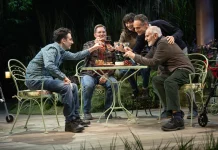
Tony Award-winning scenic designer John Lee Beatty has come up with a cozy New England cabin home for the Dahl’s, with large windows giving a view of the snowy night outside, festoons of evergreens and lights strung along the tops of the walls, and a large decorated Christmas tree. Heather Gilbert’s lighting design, Darron I. West’s sound design, and Sophia Choi’s costumes all add to the portrait of the Dahl family home. Special credit goes to fight director Rick Sordelet for choreographing family conflict, and to vocal coach Gigi Buffington, who gets the Dahl clan to sing in their perfect harmonies throughout the play.












Cult of Love is a funny yet heart-breakingly poignant story of family ties that not just bind but at times strangle. It is a play of delusions and secrets, of prejudices and acceptances, that will leave you in awe of the talents — the cast, playwright, director, and designers — that have brought it to raw emotional life.
This is probably the best play on Broadway so far this season, and I cannot more strongly encourage you to see it. You must make the trip to visit the Dahl family over the holidays, where traditions are the trap in a Cult of Love.
Cult of Love is presented by the Second Stage at the Hayes Theatre, 240 W. 44th St. in New York through Feb. 2, 2025. For more information or to purchase tickets, go to 2st.com.