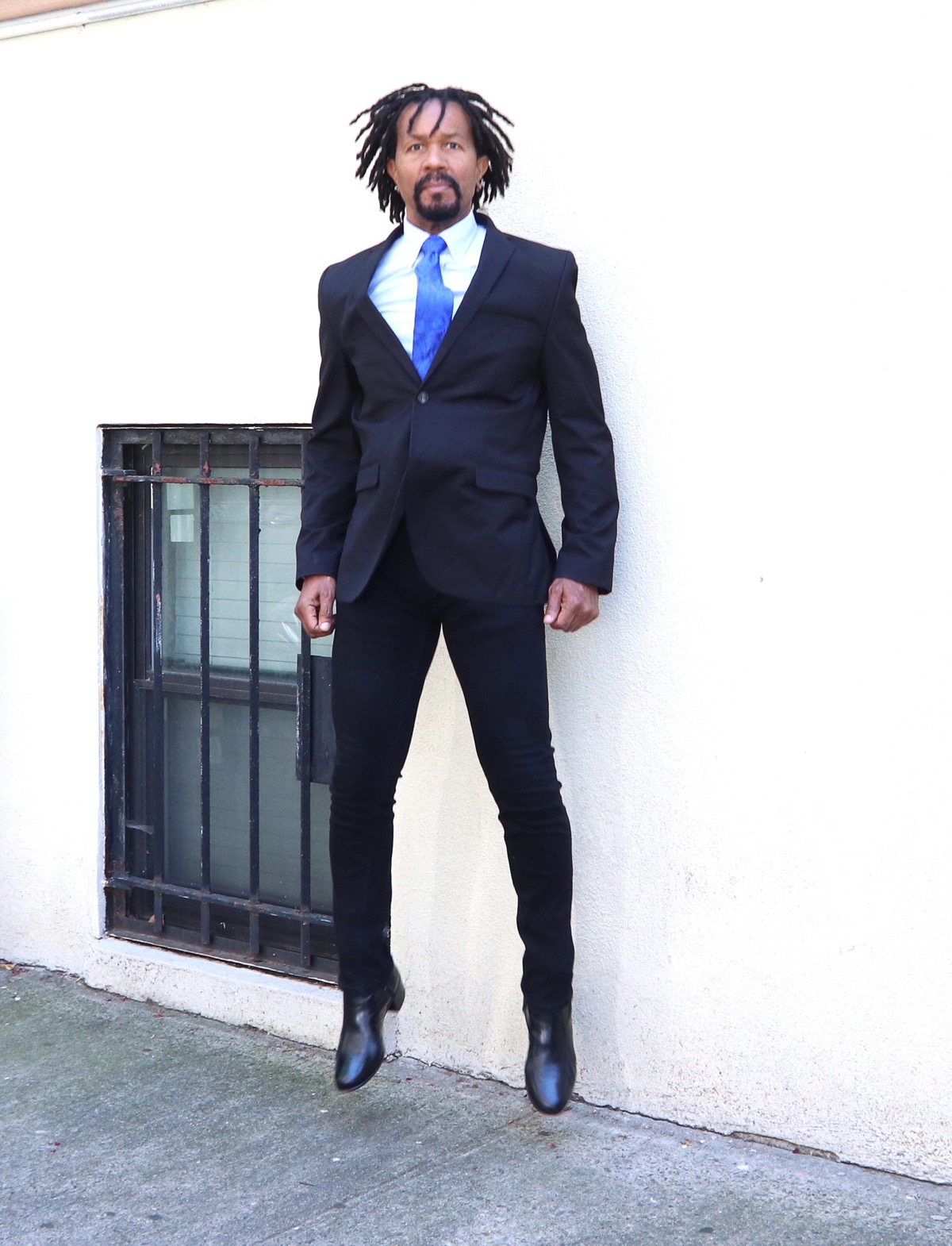
Allen Gilmore is more than an award-winning actor of stage and film, he’s also a teacher, an instructor, a veteran of the US Army, a director, and an LGBTQ activist. Gilmore’s parents were schoolteachers, and they lived in a middle-class area, in a “solidly black neighborhood” in Houston, Texas, in the ’60s. “I had a pretty normal childhood with a big sister, a little brother, and lots of friends.”
Gilmore believes he was born an actor. “I don’t recall what or who lit the spark — possibly my mom,” who was a fan of movies. “I have been interested in the stage even since I can remember.”





Starting off in grade school plays, then in high school, Gilmore began refining his acting talent at the renowned High School for the Performing and Visual Arts (HSPVA) before training at NYU’s Tisch School of the Arts under legendary teacher Stella Adler. He later earned a BFA from the prestigious Juilliard Theater Center.
Following his graduation, Gilmore served in the U.S. Army Infantry, where he continued pursuing his love for theater, directing three productions at the Baumholder Playhouse in Germany — one of which earned “Best New Play” in the U.S. Army Europe’s Tournament of Plays. Following his honorable discharge from the Army, Gilmore began his career on the stage which has lasted decades and is still vibrant and active today.
Like many LGBTQ performers, Gilmore lived a double life. His friends and schoolmates in New York, where he lives now, knew he was gay, but he kept that information from friends and family in Houston. “I finally came out to my family after returning from the military. It was just time. I wasn’t sure how that revelation would be taken, so I had prepared myself mentally for the worst. It turned out to be much simpler and easier than I had created in my thoughts.
“I have not faced any blowback at all since being out to family. In fact, others have come out as well. I don’t think I influenced this, however. The society simply changed and being who you are is far more accepted across our culture now than it ever was when I was a youth.”






On Gilmore’s website he shares that he’s added a queerness to certain roles. “I’ve created a gayness to several roles just because it’s fun. This allows me more freedom in a character. I think gay men are more fearless about expression, unencumbered by any need to look a particular way or satisfy certain rules of behavior. I mostly use this technique in comedies, but it can also be very useful in dramas — as it was in Choir Boy.”
That play brought up memories from Gilmore’s past. “Choir Boy took me back to some of the more uncomfortable times of my childhood and youth: growing up in a black, conservative, religiously influenced community in the South. Seeing and being a part of the story of Choir Boy made me remember the hurt, fear, rejection, and longing of those days. I realized how much those times still impacted and shaped my life and perceptions in good and negative ways. I felt it was past time to own those things and, in some cases, deal with them.”










In fact, the show inspired him to write a blog post coming out publicly on his website. True representation in the acting world still needs work for all the letters that comprise our diverse community. “I feel like ‘Lesbian & Gay’ representation in the theater is very good. Lesbians are less represented but I don’t think less valued in the industry. However, not being lesbian and not knowing intimately what that part of our community faces/deals with daily, I’m not a reliable source to speak to their condition.


The rest of the letters, BTQ+ are certainly underrepresented. Again, I don’t know if there aren’t as many stories being written. But I must think, knowing the conservatism and exclusionary parts of our American society, that the stories are out there just not being told.”

Gilmore would love to see more stories about the bi and trans communities and what they face, especially today. “Many years ago, there was a truly beautiful and exceptional transgender story called Soldier’s Girl. It was based on a true story and it’s one of my all-time favorites. It starred Jane Fonda’s son, Troy Garity, who was superb as the soldier,” and Calpernia Addams, who is transgender, played his love interest. “You never hear of this TV movie or of its leading stars, or of more stories like this one. I rest my case.
“It’s far easier to be openly gay in the entertainment industry today than it was when I was first starting out in this business. Another excellent gay film of many years ago, Making Love, nearly ended Harry Hamlin’s career, according to him. Making Love came out in 1982 and Soldier’s Girl in 2003. I believe that greater openness has come since those two films. This has meant that since then many younger actors and actresses can be out today, and many older ones have been able to come out after years of being closeted. I don’t believe that Jodie Foster, for example, could have had the career she has had, including two Oscars, if she had been out back in the day when she was younger. She had to protect her career and all the livelihoods of her team.”


Today LGBTQ performers have much more freedom to be their authentic selves. “I would tell any aspiring young LGBTQ performer that the sky is the limit. It’s absolutely okay to be yourself, whoever that is. The foundation has already been laid, even if parts of the country are now trying to regress. There is no going back! You and people like you are here to stay. You are NEEDED to push further forward because the work is not complete. I would say a loud and hearty ‘Welcome!’”
After decades in a field that is constantly changing and evolving, it’s difficult for Gilmore to whittle down a list of accomplishments, “There have been so many highlights in my career that it’s impossible to choose one project. Because I have no blood children, I have thought of my projects as my children, and I try to love them equally. But I will say that in the theater, it’s the relationships that matter the most. I have been blessed to have cultivated many, many great friendships and repeat collaborations throughout my time in the theater. Those connections mean the most to me.
“I’m not working all the time, thank god! I could be, and I’m lucky that I could. But I’ve begun saying ‘No’ far more frequently so that I have more time for my own life, friends, and relationships. ‘No’ is a very powerful and useful word for an actor. It must be used judiciously. And, since the pandemic, when I was still working, I have learned even more how to use it. I have been lucky and blessed in my work and in my life.”