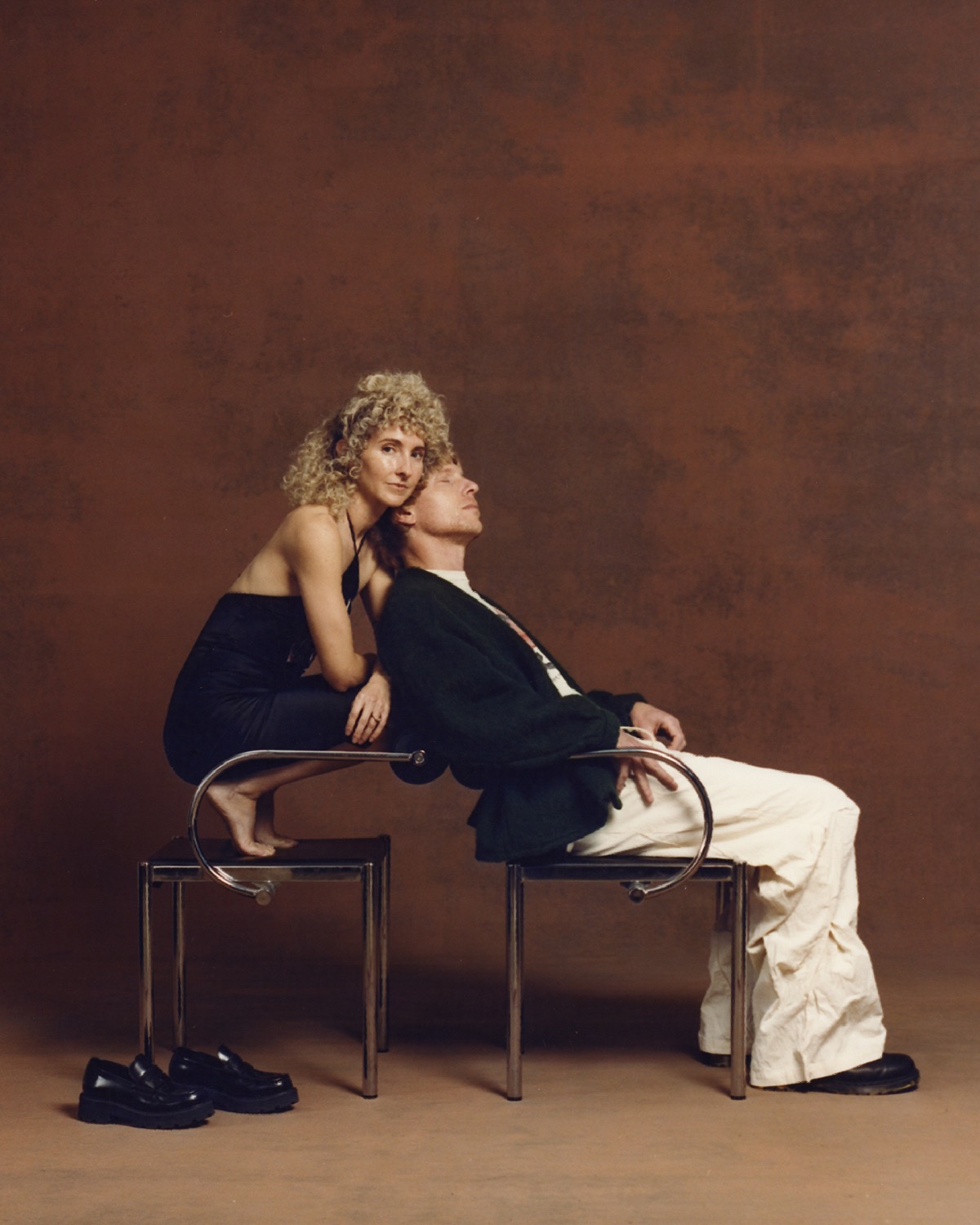
Tennis was formed in 2010 and has acquired a very strong LGBTQ fanbase. It is the product of husband and wife duo Patrick Riley and Alaina Moore. They have embarked on several tours, and just released their seventh studio album, Face Down in the Garden.
The band recently shocked fans when they announced their retirement, stating that this will be their final album which will be supported by The Farewell Tour, which consists of dozens of dates spanning through late October. In this conversation Alaina Moore opens up about her radical religious and homophobic upbringing, the trauma she endured from it, her sexuality, and the future burn book sure to hit stands post-retirement. Moore also dives deep into all things music and explains why this album was the most difficult to create. There is nothing held back and that illustrates why Tennis is one of the best indie bands of today.





Let me start off with a big topic in the fandom… Where the hell can fans get a copy of the Ritual in Repeat vinyl?
Alaina Moore: That is the only album we do not own. It is the only record we did a major label deal with. They will not press the vinyl anymore because they’ve written it off as a loss.
It is not a loss to the fans though.
AM: We have actually tried to license it from them to appease the fans, but we literally can’t make it. I honestly do not know which label owns it anymore because they keep selling it off like stocks. It keeps changing hands. If we knew they would stop making it, we would have held a batch of them over, but we do not even have it. Major labels really fucking suck. They are essentially the Russian villain of everything.




Just let us have our album. No one is making money off it, nobody wins in any way, fans just can’t have our album.
Having received a taste of both sides of the music industry, with major record labels as well as indie record labels, do you feel major labels tend to control their artists more and limit creative freedom?













AM: Major labels just clearly treat it as what it is, which is a financial investment. I do not think it is about controlling the artist as much as it is about controlling the investment. There are great people who work on both sides, and there are just as many people who are as shady and shitty at indie record labels. Indie labels can have just as predatory of deals with just as unfair of terms. Many musicians often think indie labels are more artist friendly however that is typically not the case.
That is interesting because people do not typically perceive it that way at all. It must be very difficult to find a record label to truly back you as an artist.
AM: Absolutely, especially a label who will support you for a long time while you build your career and learn how to write a good record and perform live. Granted, we are aware of development deals with popstars, but outside of that there is no example of that with a band, most likely due to profitability. I feel bands do not receive a long foundation of industry support until they become the best version of themselves.
Fortunately, the labels we worked with were very kind to us. We have had good experiences with Fat Possum Records, and if I remember correctly, the album deal was only one page with no fine print. Then we worked with Communion Records, which is founded and run by Ben Lovett of Mumford & Sons. He is amazing, runs a tight ship, and we loved that experience. That album got up streamed to a major label, until we were passed on to different hands from Communion Records, and that is when we stopped having a good experience. We just felt like we got to a point where we would do better on our own. I am not going to name any names now, however later when our career is done, I am going to burn so many bridges.
I sense a good autobiography in the future.
AM: I am actually writing it now. I plan to write an entire burning bridges chapter. Patrick, who is way more reasonable than me, will probably come and delete it before print [laughs].
When did you meet Patrick Riley, and moreover, how was Tennis formed?
AM: We met in college. He recognized me because I had been his waitress. He approached me and we started becoming friends. We were music majors before we met, ended up not liking it, and felt our relationship with music was being destroyed by the academic experience. We both switched to becoming philosophy majors and later met at a new school in a new department. We both rode bikes everywhere, we did not have cars, and as you can tell [we] had so much in common, naturally. Ironically, we did not make music until after we got married.
I feel the strongest relationships start out as friends and organically develop into something romantic if the chemistry is there. The last guy I was with long-term I met through Bumble BFF, not the dating app, and I feel I have had better luck with BFF than all the traditional dating apps.
AM: I think that is beautiful because it takes the pressure off. I feel if I saw Patrick on an app, we would have swiped past each other. There is a heavy superficial element with dating apps coupled with immense pressure that comes when meeting in person. I feel I have the most attraction to someone when I see them in a different context, and now that you mentioned it, my manager is in the background saying he is about to try BFF dating [laughs].
I have been following your sound for a while and it has really evolved. What was the inspiration behind your music originally as well as its transformation over time?
AM: With every album, we are motivated to want to do something different. We want to try to do something we previously did not do before. My initial urge to write a song was to try to convey something that I could not explain. The first sailing trip I went on with Patrick was so transformative. We lived half of the year on a tiny sailboat, sailing from the Gulf stream to the Bahamas. The first album documents that sailing trip. From then on it became a ritual to start creating each album on long sailing trips. We also approach music making from a production and engineering standpoint.
We felt like the universe was conspiring against us to keep us from writing the album.
Face Down in the Garden is the title of your new album which marks your seventh and final studio album. How does this album differentiate from the others?
AM: Well, in one way, it was the most arduous and painful to write. We also felt like the universe was conspiring against us to keep us from writing the album. We felt very inspired and very motivated to finish. It was a huge, shared goal. Yet, we felt every day, something bizarre would come up to curtail us.
There were a few moments where we almost pulled the plug on the album. It was not due to writer’s block, but rather, more pragmatic elements. We went on a writing sabbatical to Mexico on our sailboat, and while we were there, the engine on our sailboat broke 10 times. During our sailboat writing session I received an odd chronic illness, my grandmother passed away, and we got boarded by pirates who robbed us. That was a three-month writing sabbatical where no music was made. Every time we got out the guitar something bad would happen. Then, once we got home, there were difficulties which continued that also made it hard to work. It just felt out of sync with the universe. For example, “12 Blown Tires” was about when we lost four tires in two days.
Given this new tour is also The Farewell Tour, can fans expect an integration of music from all your albums?
AM: Yes, we try to make sure we play all the hits. I know it is a big deal to leave your house and go to a show. You want to hear all your favorite songs. Our catalogue is big, so it is hard to do all of it, but we do our best to get representation from all the albums. We are currently testing what songs sound best with the live band.
“Borrowed Time” was featured on the Rick and Morty: Season 5 soundtrack. It was a surprise to see such an unlikely collaboration. How did that transpire?
AM: Our friend, Ryan Elder, does the original music for Rick and Morty. He knew we were huge fans, and that if the opportunity ever came, how much we would love to do something for the show. Finally, the right moment came along, and he pitched us the job. It was a fun project.
I was not able to explore my sexual orientation until after I had already met Patrick.
You have garnered a very strong LGBTQ fanbase.
AM: We have noticed that and are very proud to have created that. I love that we have this culture around us. I am not straight, but I am in a straight cis relationship. I like to tell Patrick I chose him out of all genders. I fell in love with him! And he is very honored that the pool is so big and extends past just men. I am particularly grateful, especially since I grew up in a very strict religious environment that was both homophobic and sexphobic. I am so happy to have moved so firmly beyond that.
Can you elaborate on your upbringing and the challenges which came once you realized you were not heterosexual?
AM: My parents are amazing, loving people. However, I did grow up in a church environment. I was also homeschooled and was part of the Christian homeschool purity movement of the 90s. It was terrifying and all-consuming. I kissed dating goodbye, I had to wear a purity ring, I had to sign a contract stating I was saving sex for marriage. I had to make these decisions before I even had my period. It felt very nonconsensual and forced.
On top of this, there was so much anti-gay messaging. I felt like I had to do extensive deprogramming and unlearning of the aforesaid to have any healthy sexual exploration in my own life. Unfortunately for me, I was not able to explore my sexual orientation until after I had already met Patrick. I still think I would have loved Patrick and bonded regardless because he is my human. We have already discussed how I missed out by entering a life partnership before I even understood that I can allow myself to actually have my desires and be attracted to women too. I had to mourn that and release it.
it was ingrained in me that if I had sex, I would regret it, which I am sure is true for some but for me I really regret abstinence. I wish I fucked more people.
Patrick has been amazing through all of this. I have written about it. There is a song on the new album titled “Always the Same”, which is about me standing in my sexuality without any shame or judgement. The lyrics, “Lay your hands on me, I am not wasting my body,” specifically refers to all the years I wasted on abstinence. I wasted the horniest years of my life on abstinence. What a fucking waste, literally.
Patrick and I joke about it all the time. If I could wind back the clock, I would be getting laid, instead of puritanical self-flagellation. My entire life it was ingrained in me that if I had sex, I would regret it, which I am sure is true for some but for me I really regret abstinence. I wish I fucked more people [laughs].

Do you feel the reason you held off for so long is due to sexual guilt and/or guilt being attracted to both sexes? I ask this as someone who went through a very difficult coming out experience and felt anxiety having sex for years after I came out.
AM: I felt guilty to do anything. I felt guilty for even desiring sex. Not to overshare, but I am one of the girls who discovered masturbation very young and proceeded to have the most monumental shame and humiliation privately. As soon as I discovered it was “morally wrong,” I felt there was something wrong with me.
As far as sexual orientation, one of my best friends in college was married in a straight relationship and later came out to me. We both came from the same type of Christian background. That was the first close friend in my life I got to witness come out, live freely, and it made me realize this is possible for me too. It took someone else taking that first step to get me to break the cycle. Throughout life, I knew so many people who were gay, yet hid it.
Between your wild upbringing and your experience in the music industry, you really should author a book! I feel people can really resonate with your story.
AM: My life is a lot, but I also feel everyone’s life is a lot. You never know someone’s secrets and their journey. Thank you for asking the right questions.