We never know what the universe might have in store for us, which is hopefully a comfort to all considering the state of things in our nation right now.
One conceit that might sustain is that there are messages, this source that can be perceived, interpreted, and utilized to make decisions. We are in a world suffused with signs and portents. In short, divination. Whether it’s observing heavenly bodies in their courses or the appearance of the unexpected, the signing significance to the out of the ordinary, they engage our analytical side, as we attempt to make sense of our surroundings.





While playing cards have only existed for a short time, as one might measure time, references to them do permeate our culture, and their association with divination is quite solid in many traditions. We may start with “luck of the draw” or “it’s in the cards” or lyrics (know when to hold them and when to fold them).
There was a fable, current when I first started reading tarot cards, that they contained the esoteric mysteries of ancient Egyptian culture. They were introduced in Europe by the Romani peoples, as a device to tell fortunes. In fact, they may have reached Western culture through Egypt or Persia with their assistance.
The addition of the images we know from Tarot cards, which come to us from an Italian game, Tarocchi, have ended up with two basic sets of pasteboard to utilize in parting the veil of uncertainty — a nice turn of phrase, I think.
There is an abundance of books of instructions to interpret the cards that might benefit you to search out.





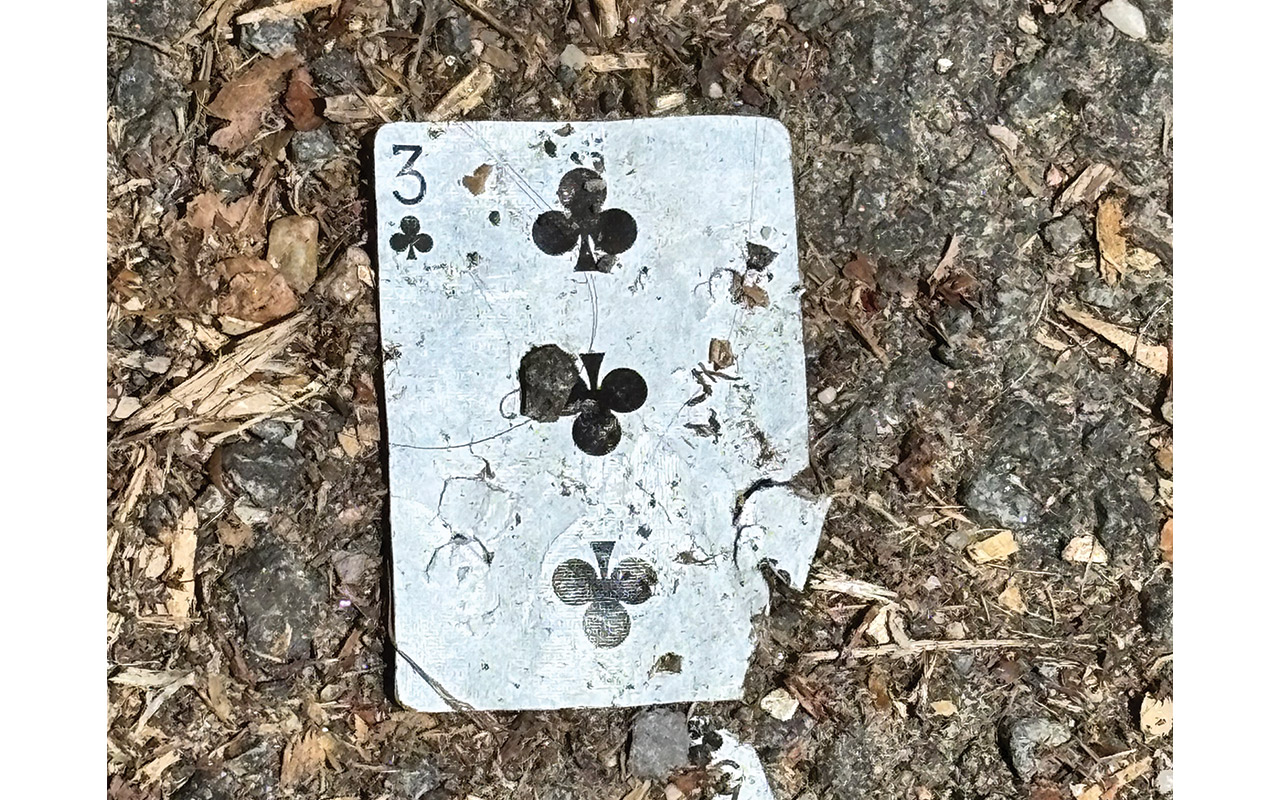
I had recently been discussing at the most recent meeting of the Diviners Club this very phenomena of playing cards randomly appearing, and how we might treat them as a divination tool. Right after that, this very one illustrated in this column appeared. Debris in the road is hardly a surprise, but a card that can contain a world of associations manifesting is difficult to pass up.
So: the card here is a Three of Clubs, a bit forlorn, careworn. Even as it stands alone, it can signify a profitable enterprise, or that it’s time to form an alliance; in general, it stands for success and a positive outcome (think of the Trinity).










To aid in the interpretation of this sign, it is good to consider that before there were printed calling cards, playing cards were written on and left as as a calling card. Not only did an elaborate etiquette of presenting them develop, there was even an additional set of messages that could be communicated by otherwise altering the card by bending corners. To use the bottom right corner was to deliver a message that it was time to depart, to get on with things, to go on your journey.
This is how the mind of a magician may turn most any circumstance around and around, to examine it in depth, and pass from merely observing the surface of a thing, whether pleasant or not, to discern what might be learned and what path might be taken subsequently.
So I offer to you a suggestion that you spoil a deck of playing cards yourself (unless you have the time to wander the byways of the neighborhood until the universe drops a card on the verge in front of you). Extract this very card from the deck, bend the corner, and carry it with you as a magical reminder that it’s time to get on with what we all should be doing. Perhaps we should stick them on our foreheads, and engage in a bizarre version of liar’s poker. At least we won’t be concealing our faces from those around us as we suggest that it’s time to get on with it.
I will not apologize for attempting a somewhat more lighthearted column this issue. Consider it as a palate cleanser, the pause that refreshes (some company ought to use it as a tagline for their product). We can’t mount the barricades 24/7 without completely losing our minds.