It’s possible, even if the 42-year-old Sacramento native is too modest to admit that his latest screen ambition, When We Rise, the accomplished filmmaker’s tremendous seven-part undertaking chronicling the progressive uprising of the ’60s and ’70s, is certainly golden statue-worthy. Partly inspired by LGBT rights activist Cleve Jones’ memoir, When We Rise: My Life in the Movement, the miniseries sheds light on our foremothers and fathers who raised hell — working to combat misogyny, homophobia, and racism — to create a changed world for future generations of, as the show declares, “others.”
During this intimate conversation with Black, the filmmaker gets candid about the beginning of his activism at age 7, the importance of “we” in any resistance movement, and how sharing a story is the first step in changing a mind.
Tell me how this miniseries ended up on a commercial network like ABC.





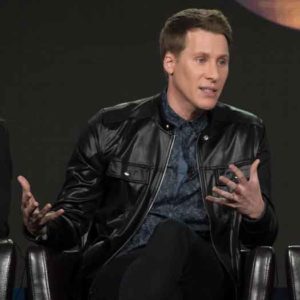
Dustin Lance Black: This project started for me four years ago, when I heard a rumor that ABC was looking at optioning LGBT history properties, and I called my agent and was like, “Is that true?” Just four years before, I had to charge the development cost of Milk on my credit card because no one wanted to pay for it — no one was interested! So, I had made my agent book a meeting with the powers that be at ABC, to look them in the eye and see if it was true — and it was. The funny thing is, they said, “We can’t afford you, but who do you think would be good to write and create something like this?” and I just laughed (laughs). Like, come on!
So, I thought, “Boy, this is an incredible opportunity to tell our LGBT story, or a part of our LGBT story, and not be preaching directly to the choir.” I had other networks that had been interested for a long time in something of this nature, and I thought, “They’re gonna spend more money, they’re gonna give me all the time in the world, it’ll be a great experience, and we’ll get it absolutely right… and we’re gonna turn around and preach directly to the choir and we might not change a single mind.” Here, I had a chance to tell our stories on the network that I watched as a kid, because as a kid, I grew up in the South, I grew up in the military, I grew up in a conservative home, in a Christian home, and we trusted ABC because ABC told family stories. I thought, “Well, here’s a chance to finally be able to tell the story of my LGBT family to my actual family,” and that’s what I set out to do. That’s why I think it’s remarkable that it’s on ABC. We’ve come to a place where we can perhaps talk the same language of family between these two Americas, and perhaps change hearts and minds in a time when that seems absolutely, critically necessary.
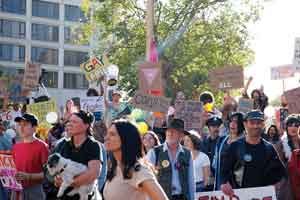 Did you go to the recent Women’s March? And having shot a similar march for When We Rise, did it feel like history repeating itself?
 The most important word in the struggle for equality is “we.” It’s why I told ABC right from the beginning when we designed the title: “We” has to be the biggest word in it. It’s a word we’ve forgotten, and it’s the answer to beating back a backlash. The key is that we have to struggle together. So, I was heartened, frankly, by the diversity I saw, not just in the march that I was physically present for here in London, but the ones I paid careful attention to on TV and online. It gives me a little bit of hope.
When We Rise touches on this glancingly, but I want to remind gay men that the Gay Liberation Front (of 1969) started as a group of men who were feminists because feminism says loud and clear that “gender ought not determine destiny,” and that means one thing to women, but it certainly means that gay men ought to be able to love who they love regardless of gender. So, gay men need to examine why we haven’t been more vocally feminist.
How was the idea for When We Rise first conceived?






 DLB: I toyed with the idea for a long time. After Milk was over, I started to think about other stories that need to be told, and I’m doing other LGBT-themed history projects, but I always wondered, “Was there something bigger, and how would I go about doing that?” As I met people — activists — along the way, I would sort of catalog their names in my head in case I ever got the chance to do something like this, and it was ABC saying they would actually pay for a year of research to really figure out who to depict that set it in motion.
So, it was always something I wanted to do, and I thought ABC was the right home for it. So then, at great personal expense, I set out on a journey. Let me just say nobody made any money off this thing. If anything, my poor agent and business manager were sweating it as we got it to year four.
You have Rachel Griffiths, Mary-Louise Parker and Guy Pearce, and then a terrific cast playing them in their youth. How did the casting process work for this? Did you have any of these actors in mind while researching the real-life person they’re playing?













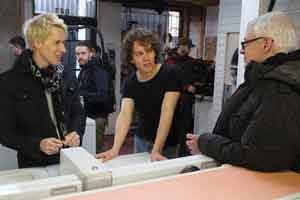
The young cast — we went out searching, and we just wanted to cast the very best people. (Transgender civil rights leader) Cecilia Chung was a really interesting one to me. I had said to my casting director that I only wanted to cast trans actors and actresses in the show to play the trans roles, and they brought up Ivory (Aquino) to play Cecilia Chung. I got a little upset with him and said, “You know, I told you it’s important we make an effort and cast trans actors and actresses for these roles,” and he said, “We think you need to get on the phone with Ivory,” and Ivory came out to me as trans on the phone call. She’s now come out to the world.
Why was it important for you to include actual trans actors in the trans roles?
I think people have the impression it is difficult based on what they’ve heard from directors and casting agents, so this is refreshing to hear.
An interesting tidbit to share is, they also worked incredibly hard with the real people when that was possible. For both the young cast and the old cast, on my own dime, I flew up the real people to wherever we were shooting so they could be there to work with the costume department, the set design department and the actors, just to make sure we were as close to truthful as possible.
Do you remember the first time you stood up for something you believed in?
I was an incredibly shy kid. I rarely said a word in school. But there was this student named Anthony who was severely mentally disabled, and he would get bullied constantly. I remember the time I finally stood up for him. I was very afraid, because I was a tiny little thing (laughs). And I remember trembling, but the bullies backed down. I told that story to my mom, and my mom looked me in the eyes and said, “You have a strong sense of justice — where does that come from?” And the answer is pretty obvious: I was hiding a pretty big difference of my own, and I knew at that point that I had crushes on my guy friends and not the girls in school. Certainly, having watched my mom being treated so differently because of her differences, those sorts of moments of witness instilled a sense of justice in me.
And now you are one of our most recognized activists.
We both tell stories about LGBT people, and I imagine, like me, you hope that non-queers see your work and come away with a sense of just… humanity.
That’s the key, isn’t it? Listen, this show is for ABC. As a kid who grew up watching ABC in the South in a Christian, military home I knew I could show up at the dinner table with all the laws and facts and science I wanted, and I wouldn’t change a single mind. You want to change a mind in that other America? You gotta lead from the heart, and you do that by telling stories, not by arguing facts or the Constitution.