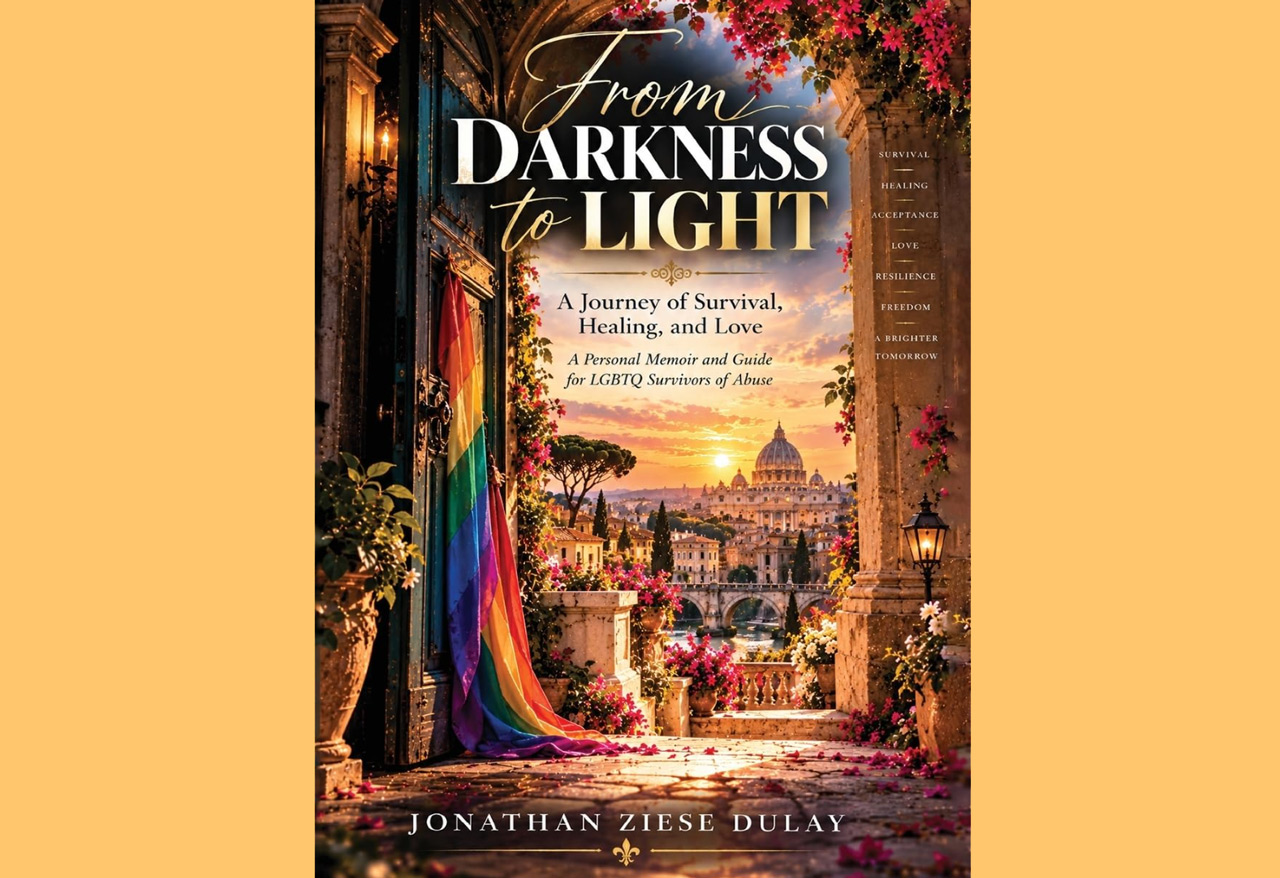
“Today, being a husband, an author, and an openly gay man means something deeply personal to me,” said Jonathan Z. Dulay. He is a debut author and just released his memoir From Darkness to Light: A Journey of Survival, Healing, and Love. “I want other LGBTQ people to know they deserve safety, belonging, and the freedom to be themselves.”
His memoir details the abuse he suffered at the hands of his biological father as a child, family rejection in the face of speaking out against an abuser, and finally a path towards acceptance. “For me, courage hasn’t meant not being afraid; it has meant deciding that fear and other people’s judgments cannot keep making my decisions for me,” Dulay said of his decision to speak out. “After everything I experienced, learning that I deserved love, without having to hide parts of myself, was powerful.”





Rejection is unfortunately a part of Dulay’s story, and one that many other members of the queer community can relate to. “A difficult part has been dealing with people who deny or minimize what happened. Healing has meant learning that their willingness to acknowledge my pain does not determine whether it matters.”
Dulay hopes that other LGBTQ+ survivors know that they are not alone, and that his words can be a part of the healing journey for other survivors of abuse. “One of the hardest parts is that surviving the abuse doesn’t mean it impacts my end. You grow up, build a career, fall in love, still carrying memories of a child who should have been protected. What happened was not my fault, and I deserved protection.”
Dulay has had an 18-year-long career working in Human Resources, and is happily married. He lives in California with his husband, Ricky.
“My career in Human Resources has involved a great deal of communication, but writing about my own life required a very different kind of honesty,” he said. “This memoir asked me to be vulnerable. Writing became a way to express things that I carried for so many years. There were nights when I lay beside my sleeping husband, writing with tears running down my face.”




“I started writing about this when I was 24,” Dulay said. At first, his memoir started as a collection of writings on his phone. “Starting on my phone made it possible for me to write when the words came, including at night,” he said. “I didn’t have to wait for the perfect setting. I could begin with what I remember.
“I decided about a year and a half ago to be an advocate for others, maybe going through the same thing. If I can share my story and help one person, I’m fulfilled. It took me a long time and a lot of courage to put this on paper. So. I’m here today, hopefully, to inspire and help others.”













Alongside helping other survivors feel seen, Dulay does not want anyone to feel sorry for him. The book is meant “to help others who are in a similar situation, to let them know that they don’t have to stay in the darkness; there is a light,” Dulay said. “You will see the light. Give it time: It’s okay to cry. It’s okay to be angry. It’s okay to stay in your room by yourself for a while. Not to close yourself off to the world, but to take time for yourself. That’s how you heal.”
As for his relationship with writing Dulay says, “I’m required to write things; it’s part of my job [in HR]. However, that inspired me to put everything that I experienced down on paper.”
It seems that writing has been an important part of healing for Dulay. “Writing about being confined as a child and the violence I experienced was deeply difficult. The scars I have are still with me; putting those memories into words actually brought me close to that pain again. Writing about my husband and the love in my life gave me some breathing room; those passages reminded me that my story contains more than what happened to me.”
Through his career in HR, Dulay gained invaluable analytical skills, strength, and courage which he needed to use to share his story. “Sharing the story publicly means letting people see something much more personal than my professional accomplishments. It means allowing them to see what it took to become the person I am today.”
Dulay said he hopes that “the book encourages compassion and a willingness to listen.”
In typical memoir fashion, the book is retrospective in its tone. He often returns to scenes from his childhood with an adult perspective: “As a child, I didn’t have the understanding or the power I have today. Returning to those memories actually allowed me to offer that young version of myself some compassion. I can look back now and say, ‘You were a child. You were not responsible for what adults choose to do.’ That perspective actually became an important part of telling the story.”
When asked what messages he has to those who have not experienced abuse firsthand, Dulay said he hopes that “the book encourages compassion and a willingness to listen.”
Dulay’s final message to his readers is: “I want my readers to know that, for years, the darkness followed me. The scars remained, but the memories never completely disappeared. But something changed. I stopped allowing my past to control my future. I found my strength. I found love, and I found the courage to tell the truth. To the LGBTQ child who feels invisible. I see you. To the survivors who still cry behind closed doors, you are not alone. To anyone who believes their past has destroyed their future. Your story isn’t over.
I’m stepping into the light. From darkness to light. The scars tell you that I survived; the book tells you how I found my way out. Share this message. Someone out there needs to know that survival is possible.”
Click here to purchase Dulay’s book.